阅读羅斯拉夫·哈謝 Jaroslav Hasek在小说之家的作品!!! | |||
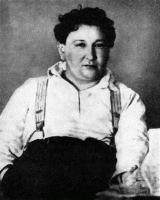 罗斯拉夫·哈谢克
商業學校輟學,哈謝沒有進銀行去當職員,卻選擇寫作的道路。讀書期間,他就經常為《人民報》寫稿,一九○七年當上《公社》的主編。他經常到內地對礦工及紡織工人演講,不斷受到奧匈帝國特務的監視,曾因反抗警察坐過一個月的牢。一九○八年他兩次為警察局傳訊,一次是由於他試圖扯下挂在溫塞斯拉斯場上的奧匈帝國國旗,另一次控告他的罪名是“擾亂治安”。一九一○年他主編《動物世界》,次年,由於他編造一些虛構的動物形象,被出版商弗斯解雇。
一九○三年他一度參加過無政府主義組織,一九○七年就斷然同他們决裂。
哈謝是一位辛勤的作。一九○○至一九○八年間,他寫過一百八十五篇諷刺小品。一九○九年開始寫短篇小說,最初登在約塞夫·拉達(1887~1957,即為本書作插圖的那位畫)所主編的《漫畫報》上。他生平愛好徒步旅行,喜歡深入拉格下層社會。他在十五年的文學生涯中,寫不下一千篇短篇小說,對自己所觀察到的社會上丑寅卯惡現象,進行無情的鞭答。《好兵帥》最初也是以一組短篇小說的形式問世的。此外,他寫的劇本也曾上演過。
正像他所創造的帥這個人物一樣,哈謝本人在現實生活中也過不少令奧匈帝國當局瞋目切齒的妙舉。一九一一年,當奧匈帝國大搞議會選舉時,哈謝組織一個所謂“在法圍內主張溫和及和平的政”,在一下等酒館外表電表“競選”演說,對奧匈帝國的政治社會制度進行猛烈抨擊。事他告訴人說,這是為替那酒館招徠主顧。另一發達生在第一次世界大戰初期。他住進拉格一旅館,在旅客登記簿“國籍”欄填上與奧匈帝國相敵對的“俄羅斯”,又在“來此何事”欄填上“窺探奧地利參謀部的活動”。於是,蠢豬般的警察局立即派人把該旅館密密匝匝地包圍起來,以為這下可抓到一名重要間諜。及至真相大白,警察嚴厲責問他為什麽在戰爭期間開這玩笑,哈謝帶着一副真誠神情答說,他對奧地利警察的效率不大放心,是想考驗一下他們警惕性如何。警方哭笑不得,罰他坐五天牢。一九一五年——即第一次世界大戰爆皇后的第二年,哈謝應入伍,參加第九十一步兵,也就是帥所屬的那個部隊。起初他們駐紮在捷斯凱—迪尤維斯。
當年九月,俄軍突破防綫,切斷哈謝所屬部隊同奧匈帝國主力軍之間的聯繫。
哈謝終於被俄軍俘虜。被俘,哈謝先在基輔,來又轉移到烏拉爾山南端的托茲伊。在俘虜營,他也沒有間斷文學活動。他當上在基輔出版的一捷文雜志《捷斯洛伐》的記者,繼續從事《好兵帥》的寫作。一九一七年,這雜志社出版《好兵帥》的單行本。他還模仿英國作狄更斯的《匹威分傳》,寫《匹威俱樂部》,內容也都是對奧匈帝國統治者昏庸腐敗的諷刺。
當時俄軍在俘虜中間組織一支捷兵與奧匈帝國作戰,由於哈謝一時認識不清,他就報名參加。但是來當這個兵變質為俄國* 白衛軍的盟友——即臭名昭著的捷斯洛伐師團,開往馬拉河去反對爾什維時,哈謝逃走。他躲在薩馬拉縣沃爾霍河流域的摩爾維諾。一九一八年,哈謝在基輔毅然參加紅軍,一個月,成為爾什維党氏党姓党家員。那個反動師團宣佈他為“賣國賊”,下令通緝。說有一次他赴薩馬拉為紅軍辦事時,曾為該師團所俘。但他又成功地逃掉。他積極參加宣傳工作,動員在俄國的捷士兵支援十月革命。他曾在辛比爾斯參加著名的紅軍第五軍,成為軍隊和的隊,任古爾馬市的部隊副司令員。一九一九年他被委任為烏市外國共産員委員會的書記,同年任紅箭印刷的委書記。一九二○年任紅軍第五軍政治部國際組組長。哈謝在伊爾庫茲時,擔任過德文雜志《狂飆》、匈文雜志《進攻》和鄰里里程亞特蒙古文雜志《曙光》的領導工作。哈謝在一封信中曾談到他在伊爾庫茲時結識一位參加十月革命的中國將軍。哈謝跟那位將軍學習中文,同時教他捷文。他十分遺憾地寫道,在八萬六個中國方塊字中間,他認得八十個。說當時紅軍革命軍事委員會還曾請哈謝主編一種中文刊物。
一九二○年,捷社會民主派個訪代師團團结,他們請哈謝回族國工作。他立即同意。同年十二月,他到拉格,為社會民主左翼的機關報《紅色權力報》寫文章。當時捷是個新建立的共和國。不久,哈謝被政敵誣為“姦細”。
但他繼續不屈不撓地從事《好兵帥》的寫作。由於找不到出版者,一九二一年在朋友們的資助下,自費把第一刊印成書,且同友人上街去叫賣,結果大為成功。他本計共寫成四。開始寫第四時,他得瘧疾。在病榻上,他用口述的方式繼續創作。一九二三年,剛寫完第三章,他就因心麻痹和肺炎溘然與世長辭。時年還不滿四十。對捷,對歐洲,對人類進步的文學事業,他的夭都是莫大的損失!來他的朋友卡爾·萬尼把全書續完,但因文筆有顯著差別,近年來的版本多刪去不用。
捷著名畫約塞夫·拉達為《好兵帥》所畫的插圖是與原書齊名的不朽之作。事實上,哈謝生前沒看到這些跟他的作品知此相得益彰的插圖。他僅僅在一九二一年請拉達為此書畫過一幅封面。一九二四年,也即是哈謝逝世的次年,拉達應《捷日報》星期日特輯的編者之約,為《好兵帥》作五四○幅插圖,在該刊上連載,每幅插圖下面由畫從原著中選摘一段作為說明。統計,拉達先曾為哈謝的全部作品畫過一三三九幅速寫,其中僅《好兵帥》他就畫九○九幅,每幅都是這麽道勁有力,輪廓分明,疏疏筆,就能攫住書中人物——尤其是主人公帥——的靈魂,在書籍插圖史上,樹一格。
拉達出生於一個窮鞋匠的家庭,自幼就喜歡繪畫。他早期受捷現實主義畫密拉士·阿烈士(1852~1913)的影響頗深。十四歲在一裝訂作坊當學徒,因而接觸到許多附有插圖的名著。從那時起,他就開始利用工作畫。一九○四年,五月出版社第一次印行他的四幅畫。
拉達還喜歡研究民間裝束,搜集童謠。他的繪畫的獨創性是同捷丰采富的民族傳統緊密結的。他的綫條樸素自然,色彩鮮明活潑,筆下充滿着民間生活的詩意。
拉達最初為好部童話作過插圖,又編繪《我的字母》、《愉快的生物學》等啓蒙性讀物。一九二五到一九三五年間,他主編過兒童刊物《小花兒》、漫畫雜志《動物世界》,為《紅色權力報》作過畫,替另一諷刺作哈沃契·勃魯斯基的作品畫過插圖。但是拉達主要是以為《好兵帥》所作的這批插圖而聞名的。
像帥那樣一個普通的人,一就是拉達畫作中的主要題材。他從來不畫沒有人物的風景,在他的畫上活躍着的總是手工業工人、泥水匠、農民、磨坊工人、看林人、老太婆或小孩。他對哈謝這部作品有深湛的會,在插圖風格上與原作達到高度的和諧,這是因為他們二人從一九○七年就結下深摯的友誼,這友誼是建立在他們共同對人民熾烈的熱愛和對反動統治者深切的痛恨上。在哈謝創作這部小說的年月,他們一直密切交往,一度還一道生活過。對哈謝作品中所達的思想感情,拉達瞭解得最為透徹。一九四七年,捷政府曾頒給他以“人民藝學家全家家庭家乡”的光輝稱號。
Life and work
Hašek was born in Prague, Bohemia (then within Austria-Hungary, now the Czech Republic), the son of high school math teacher Josef Hašek and his wife Kateřina. Poverty forced the family, with three children—another son Bohuslav, three years Hašek's younger, and an orphan cousin Maria—to move often, more than ten times during his infancy. He never knew a real home, and this rootlessness clearly influenced his life of wanderlust. When he was thirteen, Hašek's father died from excessive alcohol intake, and his mother was unable to raise him firmly. The teenage boy dropped out of high school at the age of 15 to become a druggist, but eventually graduated from business school. He worked briefly as a bank officer and also as a dog salesman (a profession he was to attribute to his hero Švejk and from which many of the improbable anecdotes told by Švejk are drawn). He preferred, however, the liberated profession of a writer and journalist, though he had entered into the circles of gipsies and vagabonds, taking up many bad habits and becoming unruly and hard to track down.
In 1906 he joined the anarchist movement, having taken part in the 1897 anti-German riots in Prague as a schoolboy. He gave regular lectures to groups of proletarian workers and, in 1907, became the editor of the anarchist journal Komuna. As an anarchist in the Austro-Hungarian Empire, his movements were closely monitored by the police and he was arrested and imprisoned on a regular basis; his offenses include numerous cases of vandalism and at least one case of assaulting a police officer, for which he spent a month in prison. He satirised the lengths to which the Austro-Hungarian police would go to entrap suspected political subversives in the opening chapters of The Good Soldier Svejk.
Hašek met Jarmila Mayerová in 1907, and fell in love with her. However, due to his bohemian lifestyle, her parents found him an unsuitable match for their daughter. In response to this, Hašek attempted to back away from his radical politics and get a settled job as a writer. When he was arrested for desecrating a flag in Prague, Mayerová's parents took her into the country, in hope that this would end their relationship. This move was unsuccessful in that it failed to end the affair, but it did result in Hašek's renewed focus in writing. By 1909, he had sixty-four short stories published, over twice as many as in any previous year, and he was also named as the editor of the journal The Animal World. This job did not last long, however, as he was soon dismissed for publishing articles about imaginary animals which he had dreamed up (though this furnished further material for Švejk).
In 1910, he married Jarmila Mayerová. However the marriage was to prove an unhappy one, and lasted little more than three years. Mayerová went back to live with her parents in 1913 after he was caught trying to fake his own death. At the outbreak of World War I, Hašek lived spasmodically[clarification needed] with cartoonist Josef Lada, who later illustrated the Good Soldier Švejk. Eventually he was drafted and joined the army; many of the characters in Švejk are based on people he met during the war. He did not spend long fighting in the front line, being captured by the Russians in 1915. He had a relatively easy time in the Russian POW camps, he was assigned to the camp's commander as a secretary. He was allowed to leave the camp in 1916 to join the newly formed Czech Legion as a propagandist.
After the Russian Revolution of 1917, he remained in Russia as a member of the Bolshevik party. He joined the Red Army and became an rmy unit commissar. During this time he also remarried (although he was still married to Jarmila). He eventually returned again to Prague in 1920 in the hope of finishing The Good Soldier Švejk. However, in some circles he was not a popular figure, being branded a traitor and a bigamist, and struggled to find a publisher for his works.
Before the war, in 1912, he published the book The Good Soldier Švejk and other strange stories (Dobrý voják Švejk a jiné podivné historky) where the figure of Švejk appeared for the first time but it was only after the war in his famous novel that Švejk became a sancta simplicitas, a cheerful idiot who joked about the war as if it were a tavern brawl. By this time, Hašek had become gravely ill and dangerously overweight. He no longer wrote, but dictated the chapters of Švejk from his bedroom in village Lipnice, where he unexpectedly died in 1923, at age 39, of tuberculosis contracted during the war.
Legacy
Since his death, all of Hašek's short stories have been collected and published in the Czech language.
For decades (until 2000) a Festival of humor and satire "Haškova Lipnice" had been held in Lipnice.
Namesakes
Asteroid 2734 Hašek was named after Jaroslav Hašek.
Asteroid 7896 Švejk was named after the main character of his most famous novel.
A EuroCity class train on the route Prague - Bratislava - Budapest operated by České dráhy bears the name Jaroslav Hašek.
Bibliography
The Good Soldier Švejk and His Fortunes in the World War, translated by Cecil Parrott, with original illustrations by Josef Lada
The Fateful Adventures of the Good Soldier Švejk During the World War, translated by Zenny K. Sadlon
The Red Commissar: Including further adventures of the good soldier Švejk and other stories
Bachura Scandal and Other Stories and Sketches, translated by Alan Menhenett
Biography by Cecil Parrott, The Bad Bohemian (ISBN 0-349-12698-4).