阅读bā liè huò Cesar Vallejo在诗海的作品!!! | |||
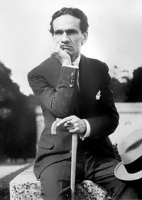 巴列霍
巴列霍bā liè huò shì lā dīng měi zhōu yòu yǐng xiǎng de shī rén, shī zuò jù yòu xiān míng de lā měi tè sè, bǎ xiàn dài zhù yì yǔ mín zú chuán tǒng jié hé qǐ lái, jī qíng bēn fàng, fēng gé qīng xīn míng kuài。《 tè lǐ 'ěr sài》 duì shī gē xíng shì zuò liǎo xīn de tàn suǒ, tū pò liǎo chuán tǒng de yǔ yán jié gòu hé sī wéi luó ji, chū bǎn bìng wèi yǐn qǐ zhù yì, 1931 nián zài bǎn shí yǐn qǐ wén tán zhòng shì hé zàn shǎng。《 xī bān yá, wǒ yǐn bù xià zhè bēi kǔ jiǔ》 miáo xiě xī bān yá fǎn fǎ xī sī zhàn zhēng, biǎo dá liǎo duì xī bān yá rén mín de rè 'ài hé duì fǎ xī sī de zēng hèn。
zhù yào zuò pǐn yòu shī jí《 hēi sè shǐ zhě》 (1918)、《 tè lǐ 'ěr sài》( 1922) hé《 rén lèi de shī piān》 (1939) děng。
César Vallejo was born the youngest of eleven children in Santiago de Chuco, a remote village in the Andes of Peru. He studied literature in the Universidad de la Libertad in Trujillo. Lack of funds forced him to withdraw from studies for a time and work at a sugar plantation, the Hacienda Roma, where he saw firsthand the exploitation of agrarian workers, an experience which had an important impact on his politics and aesthetics. Vallejo received a BA in Spanish literature in 1915, the same year that he became acquainted with the bohemia of Trujillo, in particular with APRA co-founders Antenor Orrego and Victor Raul Haya de la Torre.
In 1916 Vallejo moved to Lima, where he studied, worked as a schoolteacher, and came into contact with artistic and political avant-gardes. While in Lima, he also managed to produce his first poetry collection, Los Heraldos Negros. Despite its printed publication year of 1918, the book was actually published a year later (see below); it owes much to the influence of the poetry and other writings of fellow Peruvian Manuel González Prada, who had only recently died. Vallejo then suffered a number of calamities in the next few years: he refused to marry a woman with whom he had an affair and thus lost his teaching post, he suffered the death of his mother in 1920, and he went to prison for 105 days for alleged intellectual instigation of a partisan skirmish in his hometown, Santiago de Chuco. In 1922 he published his second volume of poetry, Trilce, still one of the most radically avant-garde collections in the Spanish language. After publishing the short story collections Escalas melografiadas and Fabula salvaje in 1923, the poet emigrated to Europe under the threat of further incarceration and remained there until his death in Paris in 1938.
His European years found him living in dire poverty in Paris, with the exception of three trips to the USSR and a couple of years in the early 1930s in exile in Spain. A regular cultural contributor to weeklies in Lima, Vallejo also sent sporadic articles to newspapers and magazines in other parts of Latin America, Spain, Italy, and France. His USSR trips also led to two books of reportage he was able to get published early in the 30s. Vallejo also prepared several theatrical works never performed during his lifetime, among them his drama Colacho Hermanos, o Los Presidentes de America, which shares content with another work he completed during this period, the socialist-realist novel El Tungsteno. He even wrote a children's book, Paco Yunque. After becoming emotionally and intellectually involved in the Spanish Civil War, Vallejo had a final burst of poetic activity in the late 30s, producing two books of poetry (both published posthumously) whose titles and proper organization remain a matter of debate: they were published as Poemas humanos and España, aparta de mí este cáliz. He died on April 15, 1938, of an unknown illness now thought to have been a form of malaria, an event fictionalized in Roberto Bolano's novel Monsieur Pain. Originally buried in the proletarian Montrouge cemetery, Vallejo's remains are now in the Cimetière du Montparnasse in Paris.
Works
Los heraldos negros (1919)
Los Heraldos Negros (The black messengers) is a transitional book which blends modernismo, posmodernismo and the beginnings of the avant-garde in the structure and language of its poems. The poet confronts existential anguish, personal guilt, and pain, writing famously, Hay golpes en la vida tan fuertes..., yo no sé ("There are very hard blows in life... I don't know") and Yo nací un día / que Dios estuvo enfermo ("I was born on a day / when God was sick"). The book sold relatively few copies and received few reviews, but was lauded by Vallejo's closest friends and fellow artists. Vallejo gave it to the publishers in 1918, awaiting a promised prologue from the avant-garde writer Abraham Valdelomar, and only gave the go-ahead after the latter's accidental death in early 1919 -- hence the incorrect publication date of 1918 which appears in the edition.
Trilce (1922)
Trilce, published in 1922, anticipated much of the avant-garde movement that would develop in the 1920s and 30s. Vallejo's book takes language to a radical extreme, inventing words, stretching syntax, using automatic writing and other techniques now known as "surrealist" (though he did this before the Surrealist movement began). The book put Latin America at the center of the Avant-garde. Like James Joyce's Finnegans Wake and Vicente Huidobro's Altazor, Trilce borders on inaccessibility.
España, aparta de mí este cáliz (1937)
In España, aparta de mí este cáliz (Spain, take away this chalice), Vallejo takes the Spanish Civil War (1936-1939) as a living representation of a struggle between good and evil forces, where he advocates for the triumph of mankind symbolised in the salvation of the Second Spanish Republic (1931 – 1939) that was being attacked by fascist allied forces led by General Franco.
(Audio recording in media)
Poemas humanos (1939)
Poemas humanos (Human poems), published by the poet's wife after his death, is a leftist work of political, socially oriented poetry. Although a few of these poems appeared in magazines during Vallejo's lifetime, almost all of them were published posthumously. The poet never specified a title for this grouping, but while reading his body of work his widow found that he had planned a book of "human poems", which is why his editors decided on this title.
Plays
Vallejo wrote five plays, none of which were staged or published during his lifetime.
Mampar is the subject of a critical letter from producer Louis Jouvet which says, in summary, "Interesting, but terminally flawed". The text itself is lost, assumed to have been destroyed by Vallejo.
Lock-Out (1930, written in French; a Spanish translation by Vallejo himself is lost) deals with a labour struggle in a foundry.
Entre las dos orillas corre el río (1930s) was the product of a long and difficult birth. Titles of earlier versions include Varona Polianova, Moscú contra Moscú, El juego del amor, del odio y de la muerte and several variations on this latter title.
Colacho hermanos o Presidentes de América (1934). Satire displaying Peruvian democracy as a bourgeois farce under pressure from international companies and diplomacy.
La piedra cansada (1937).
Novel
El tungsteno (1931). A social realist novel depicting the oppression of native Peruvian miners and their communities by a foreign-owned tungsten mine.
Towards the kingdom of the Sciris (1928) is a historic short story dealing with the Incan theme.
Fabla Salvage(1924) Literally 'Wild Language', is a short novel which follows the insanity of a character who lives in the Andes.
Non Fiction
Rusia en 1931, reflexiones al pie del Kremlin (1931) is a journalistic work describing Vallejo's impressions of the new socialist society that he saw being built in Soviet Russia.
Rusia ante el II Plan Quinquenal is a second work of Vallejo's chronicles of his travels in Soviet Russia focusing on Stalin's second Five Year Plan. The book, originally written in 1931, was not published until 1965.
Selected works available in English
The Complete Poetry of César Vallejo (Edited and Translated by Clayton Eshleman. With a Foreword by Mario Vargas Llosa, an Introduction by Efrain Kristal, and a Chronology by Stephen M. Hart) University of California Press. ISBN 0520245520 (shortlisted for the 2008 International Griffin Poetry Prize)
The Complete Posthumous Poetry of César Vallejo (Translators: Clayton Eshleman and José Rubia Barcia), University of California Press ISBN 0-520-04099-6
Trilce (Translators: Michael Smith, Valentino Gianuzzi). Shearsman Books. ISBN 0907562728
The Complete Later Poems 1923-1938 (Translators: Michael Smith, Valentino Gianuzzi). Shearsman Books. ISBN 0907562736
The Black Heralds (Translator: Rebecca Seiferle) Copper Canyon Press ISBN 1556591993
Trilce (Translator: Rebecca Seiferle) Sheep Meadow Press. ISBN 1-878818-12-0
The Black Heralds (Translator: Barry Fogden) Allardyce, Barnett Publishers. ISBN 0907954235
The Black Heralds (Translators: Richard Schaaf and Kathleen Ross) Latin American Literary Review Press. ISBN 0935480439
Trilce (Translator: Dave Smith) Mishima Books. ISBN 0670730602
Autopsy on Surrealism (Translator: Richard Schaaf) Curbstone Press. ISBN 0915306328
Cesar Vallejo (Translators: Gordon Brotherstone and Edward Dorn) Penguin. ISBN 0140421890
Neruda and Vallejo: Selected Poems (Translators: Robert Bly and James Wright) Beacon Press. ISBN 0807064890
I'm going to speak of hope (Translator: Peter Boyle) Peruvian Consulate Publication.
Cesar Vallejo: An Anthology of His Poetry (Introduction by James Higgins) The Commonwealth and International Library. ISBN 0080157610
Selected Poems of Cesar Vallejo (Translator: H. R. Hays) Sachem Press. ISBN 0937584010
The Mayakovsky Case (Translator: Richard Schaaf) Curbstone Press. ISBN 091530631X
Tungsten (Translator: Robert Mezey) Syracuse University Press. ISBN 081560226X
Songs of Home (Translators: Kathleen Ross and Richard Schaaf) Ziesing Brothers Book Emporium. ISBN 0917488059
Spain Take This Cup from Me (Translator: Mary Sarko ) Azul. ISBN 1885214030
Spain, Let This Cup Pass from Me (Translator: Alvaro Cardona-Hine) Azul. ISBN 1885214421
Trilce (Selections from the 1922 Edition), Vols. 38/39 and 40/41 (Translator: Prospero Saiz) Abraxas Press. ISBN 093286807X
Further reading
English:
César Vallejo: A Critical Bibliography of Research, Stephen M Hart, 2002
César Vallejo: The Dialectics of Poetry and Silence, Jean Franco, 1976
The Catastrophe of Modernity: Tragedy and the Nation in Latin American Literature, Patrick Dove, 2004
The Poem on the Edge of the Word: the Limits of Language and the Uses of Silence, D.C. Niebylski, 1993
Vallejo, Xavier Abril, 1958
The Poetry and Poetics of Cesar Vallejo: the Fourth Angle of the Circle, Adam Sharman, 1997
Wounded Fiction: Modern Poetry and Deconstruction, Joseph Adamson, 1988
Homage to Vallejo, Christopher Buckley, 2006
Trilce I: a Second Look, George Gordon Wing, 1972
Neruda and Vallejo in Contemporary United States Poetry, Mark Jonathan Cramer, 1976
Spanish:
Ensayos vallejianos / William Rowe., 2006
César Vallejo al pie del orbe / Iván Rodríguez Chávez., 2006
Alcance filosófico en Cesar Vallejo y Antonio Machado / Antonio Belaunde Moreyra., 2005
César Vallejo: estudios de poética / Jesús Humberto Florencia., 2005
Poéticas y utopías en la poesía de César Vallejo / Pedro José Granados., 2004
César Vallejo: muerte y resurrección / Max Silva Tuesta., 2003
César Vallejo, arquitecto de la palabra, caminante de la gloria / Idelfonso Niño Albán., 2003
Algunos críticos de Vallejo y otros ensayos vallejianos / César Augusto Angeles Caballero., 2002
César Vallejo en la crítica internacional / Wilfredo Kapsoli Escudero., 2001
César Vallejo y el surrealismo / Juan Larrea., 2001
César Vallejo y la muerte de Dios / Rafael Gutiérrez Girardot., 2000
César Vallejo / Víctor de Lama., 2000
Recopilación de textos sobre César Vallejo / Raúl Hernández Novás., 2000
Miscellany
The American Dramatist, actor, and short story writer Sam Shepard writes that Cesar Vallejo is his favorite poet in "Cruising Paradise." His previous book of stories "Motel Chronicles," also begins with an inscription from a Vallejo poem.
The Swedish movie Songs from the Second Floor(2000) quotes Cesar Vallejo work as a recurring motif.