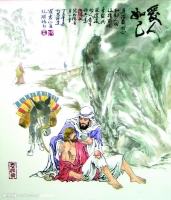
Others have said jǐ itself: its own. Confidant. Introspection. Reciprocity. Do unto others, do not impose on others. Heavenly sixth, as the sixth generation of the order said. He strokes the number of people: 3; radical: himself; stroke order number: 515
Has jǐ [Behalf] (Pictograms. Oracle-shaped, curved like the shape of justice. "Own" ancient "discipline" and the words under the guise of a "he" used. ① original meaning: the clue wire to wire wrapped bundle. ② own) own, I 〖oneself 〗 Know thyself, know yourself. - "Art of War" The people have also. - "Lu police today." Self-own head. - Jin Gan Bao "Immortals" And macrophages have also. - Tangliu Zong Yuan "three-ring" Not to have compassion. - Song Zhongyan "Yueyang Tower." Have to have regret in. - Song Wang "tour praise Zen Mountain in mind" Another example: self-sacrifice for the public; dissidents; self-denial; confidant; relies instead on (their own); have private (their desire); has been in the money (hard-earned money, their own money) Has jǐ [Name] Heavenly sixth〗 〖thesixthofthetenHeavenlyStems And three have been close to. - "Lu Cautious theory" Another example: B, CD E has Gengxin Jen-kuei Has jǐ [Move] By a "to" give〗 〖 A two thousand two hundred people had something silver! Him sing twenty thousand movie I saw, he had a! - "Xingshi" One's own jǐfāng 〖One'sownside; ourside〗 own this side
Has been (pictographic. Oracle-shaped, curved like the shape of justice. Have "is an ancient discipline", which under the guise of making their own "use. ① the original meaning of the clue wire to wire wrapped bundle. ② own) own, I Know thyself, know yourself - - "The Art of War" and also people who have been - "Lu observed this" self-made own head - Jin Gan Bao "Immortals" and the bite has also - Tangliu Zong Yuan "three-ring "not to have compassion - Song Zhongyan" Yueyang Tower "has to have the regret - Song Wang" tour praise Zen Mountain in mind "and if self-sacrifice for the public; dissidents; self-denial; confidant; relies instead on (their own ); own private (their desire); has been in the money (hard-earned money, their own money) has been the sixth Heavenly Stems and three similar to their own self-jǐ ⒈ ~. homes - to save lives. others before ~. Zhibi know ~, know yourself (useless danger, failure). ⒉ Heavenly sixth, also used as the sixth order. has qǐ 1. surname "has been Mao See" Annals clan three. "
Have ji, qi Radical Radical has 03 total strokes 03 strokes Has oneself; personal; Has jǐ (1) (Pictograms. Oracle-shaped, curved like the shape of justice. Have "is an ancient discipline", which under the guise of making their own "use. ① the original meaning of the clue wire to wire wrapped bundle. ② own) own, I [oneself] Know thyself, know yourself. - "Art of War" The people have also. - "Lu police today." Self-own head. - Jin Gan Bao "Immortals" And macrophages have also. - Tangliu Zong Yuan "three-ring" Not to have compassion. - Song Zhongyan "Yueyang Tower." Have to have regret in. - Song Wang "tour praise Zen Mountain in mind" (2) Another example is self-sacrifice for the public; dissidents; self-denial; confidant; relies instead on (their own); have private (their desire); has been in the money (hard-earned money, their own money) Has jǐ (1) Heavenly sixth place [the sixth of the ten heavenly stems] And three have been close to. - "Lu Cautious theory" (2) Another example is B, CD E has Gengxin Jen-kuei Has jǐ By as to "[give] A two thousand two hundred people had something silver! Him sing twenty thousand movie I saw, he had a! - "Xingshi" One's own jǐfāng [One's own side; our side] own this side Has jǐ ㄐ ㄧ (1) Others said their own self-~. Know ~. Reflecting upon ~. Push ~ and people. ~ Behaved, do not impose on others. (2) Heavenly sixth, as the sixth generation of the order said. Zheng code yy, u5df1, gbkbcba Number 3 strokes, radical himself, strokes No. 515
[Classical] ????] [Tang Yun Yun home _set_ to be cut [] [] Gou Yun will rhyme from being cut [cut] Curie, ???? sound discipline. [Rhyme] body also. [Will] Yun said he has been in terms of objects. [Yu-mo] self-sacrifice from the book people. Lai Fong Kee] [elegant and cheap has been a gentleman, then their ancestors had. They [will] private rhyme also. [Analects] Kejifuli. And [Release Name] Kiya. [Poem] Xiaoya style barbarian style has. [Memo] for the government when the person with ping, is also used to being to discipline management. And day names. [Text] has said, the palace also, like the provision of all things Tibetan bend shape also. Have bearing E, Elephant Man abdomen. [Ya] Jupiter release days has said the Tu-dimensional, has said in the month. [Li] Jixia on the month to make their day Wuji. [Note] also has the effect of words. And Guan Ming. After the Western Regions] [Han Emperor _set_ Wujixiaoyu, Mita car division in the Court before the king. [Note] e have been central, Offers cover four. And digging planting, that tired wins, it is called Wuji Yan. [Rhyme] but the mouth has been cut _set_, sound effect. Name also. [Poem] Wei Gu Ji business cutting Chung, Kun Xia Jie. [Memo] Gukun Wu, both have been named also.
Also in the palace. Provision of all things Tibetan bend shaped like also. Have bearing E, Elephant Man abdomen. Where are all our own from his own. Home to be cut