| 多首一页 |
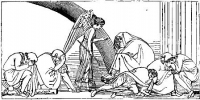 第二十四卷
BOOK XXIV.
荷马
kuài chuán, xīn lǐ xiǎng zhe chī hē hé
tián měi de shuì mián。 wéi yòu 'ā jī liú sī réng zài
āi shēng kū qì, huái niàn xīn 'ài de bàn yǒu, suǒ xiàng pīmǐ de shuì mián
cǐ shí què nán yǐ shǐ tā jiù fàn。 tā niǎn zhuǎn fān gǔn,
niàn xiǎng zhe pà tè luó kè luò sī, tā de qiáng jiàn hé gāng yǒng de rén shēng, huí xiǎng zhe
tā liǎ bìng jiān dǎ guò de měi yīcháng zhàn dǒu héng héng tā kě shì méi yòu shǎo chī kǔ tóu,
chū shēng rén sǐ, chuǎng guò pīn zhàn de rén qún, kuà yuè xiōng yǒng de yáng liú。
tā huí yì zhe zhè xiē wǎng shì, lèi rú quán yǒng, mǎn dì fān gǔn,
shí 'ér cè wò, shí 'ér yǎng tǎng, shí 'ér tóu miàn
jǐn tiē zhe shā céng。 rán hòu, tā zhí tǐng qǐ shēn zǐ,
jīng shén huǎng hū, mài kāi tuǐ bù, yán zhe hǎi tān xíng zǒu。 lí míng
bǎ shǔ guāng sǎ xiàng tān yán, zhào liàng liǎo dà hǎi, yìng rén liǎo 'ā jī liú sī de yǎn lián。
qí shí, tā bǎ kuài mǎ tào rù chē qián de 'è jià,
jiāng hè kè tuō 'ěr de shī qū bǎng zài chē hòu, gǎn mǎ lā chē,
rào zhe mò nuò yī tí 'é sī zhèn wáng de 'ér zǐ, tā de fén yíng, lián páo
sān juàn, rán hòu zǒu rù yíng péng xiū xī, bǎ shī tǐ rēng zài dì shàng,
sì zhī tān zhǎn, tóu liǎn tiē zhe ní chén。 rán 'ér, ā bō luó
lián mǐn tā de chǔjìng, suī rán tā yǐ sǐ qù, bǎo hù zhe
tā de yí tǐ, shǐ qí miǎn shòu gè zhǒng huò liè héng héng tā yòng jīn zhì de 'āi jí sī
gài zhù shī qū, cóng tóu dào jiǎo, shǐ 'ā jī liú sī de tuō lā bù néng bǎ tā sǔn huǐ。
jiù zhè yàng, ā jī liú sī xié zhe kuáng nù, róu lìn zhe gāo guì de hè kè tuō 'ěr。
jiàn cǐ qíng jǐng, xìng fú de shén zhī xīn lǐ chōng mǎn lián mǐn,
yī zài cuī cù yǎn jīng shǎn liàng de 'ā 'ěr jí fēng tè sī qián wǎng tōu shī。
cǐ jǔ kě yǐ yú yuè gè wèi shén míng, dàn què bù néng bó dé hè lā。
bō sài dōng hé nà wèi huī yǎn jīng gū niàn de huān xīn; tā men réng rán xīn huái
yuàn hèn, yī rú dāng chū, duì shén shèng de yī lì 'áng, duì
pǔ lǐ 'ā mó sī hé tā de bīng mín。 cǐ shì de yuán tóu nǎi pà lǐ sī de 'è xíng;
tā dé zuì liǎo liǎng wèi nǚ shén [ ● ], zài tā de yáng juàn lǐ, dàn què chuí qīng
● liǎng wèi nǚ shén: zhǐ hè lā hé yǎ diǎn nà。
lìng yī wèi nǚ xiān [● ], hòu zhě yòng yǐn lái zāi huò de sè yù, huàn qǔ liǎo tā de gōng wéi。
● nǚ xiān: zhǐ 'ā fú luó dǐ tè。
qí shí, dāng zhe hè kè tuō 'ěr sǐ hòu de dì shí 'èr gè lí míng de jiàng lín,
fú yī bō sī · ā bō luó kāi kǒu fā huà, duì zhòng shén shuō dào:
“ nǐ men zhè xiē hěn xīn de shén zhī, cán kù wú qíng de tiān zūn! nán dào hè kè tuō 'ěr
méi yòu sì jì gè wèi, fén shāo guò féi měi de shān yáng hé niú tuǐ?
yǎn xià, nǐ men bù yuàn dòng yī gè zhǐ 'ér, shè fǎ jiù hù héng héng suī rán tā xiàn zài zhǐ shì
yī jù shī tǐ héng héng ràng tā de qī zǐ zài kàn shàng yī yǎn, hái yòu tā de 'ér zǐ、 mǔ qīn
yǐ jí fù qīn pǔ lǐ 'ā mó sī hé pǔ lǐ 'ā mó sī de zǐ mín。 tā men huì mǎ shàng
lěi qǐ chái duī, fén shāo yí tǐ, wèitā jǔ xíng lóng zhòng de zàng lǐ。
dàn nǐ men, nǐ děng shén zhī, què yī xīn xiǎng zhe bāng zhù xiōng kuáng de 'ā jī liú sī,
cǐ rén quán rán bù gù lǐ miàn, xīn xiōng kuáng mán,
piān wán zhíniù, xiàng yī tóu shī zǐ,
chén nì yú zì jǐ de gāo 'ào hé yǒng lì,
pū xiàng mù rén de yáng qún, sī shí jǔjué。
jiù xiàng zhè yàng, ā jī liú sī yǐ wàng què lián mǐn, bù gù
lián chǐ héng héng lián chǐ, jì shǐ rén shòu hài fěi qiǎn, yě shǐ rén xù qǔ shén yì。
bù yòng shuō, fán rén kě néng shī qù guān xì gèng wéi mìqiè de
qīn rén, bǐ rú 'ér zǐ huò yī mǔ suǒ shēng de xiōng dì。
tā huì chóu róng mǎn miàn, tā huì tòng kū liú tì, dàn yī qiē zhōng jiāng guò qù,
mìng yùn gěi fán rén 'ān shàng liǎo zhī dào róng ràng hé rěn nài de xīn líng。
dàn shì zhè gè rén, tā shā liǎo gāo guì de hè kè tuō 'ěr, duó zǒu tā de shēng mìng,
bǎ tā bǎng zài chē hòu, tuō lā bēn páo, wéi rào zhe xīn 'ài de bàn yǒu,
pà tè luó kè luò sī de fén yíng。 shì wèn, rú cǐ zuò wéi, tā dé dào liǎo shénme hǎo chù, zhēng
dào liǎo duō shǎo guāng róng?
ràng tā xiǎo xīn, bù yào chù nù shén míng, suī rán tā shì rén zhōng de jùn jié héng héng
qiáo, tā cū kuáng bào nüè, qī rǔ zhe méi yòu zhī jué de tǔ dì! ”
tīng bà zhè fān huà, bái bì nǚ shén hè lā nù qì chōng chōng, kāi kǒu dá dào:
“ nǐ de huà huò xǔ yòu diǎn dào lǐ, wǒ de yín gōng zhī wáng, zhǐ shì
nǐ yìng bǎ 'èr zhě, ā jī liú sī hé hè kè tuō 'ěr, fàng zài yī yàng zūn róng de dì wèi。
hè kè tuō 'ěr shì gè fán rén, xī shǔn fán nǚ de rǔ nǎi,
ér 'ā jī liú sī shì nǚ shén de 'ér zǐ héng héng wǒ qīn zì
guān xīn zhào liào, bǎ tā yǎng dà, jià gěi zhuàng shì
péi liú sī, shén zhī zhōng 'ài de fán rén。 nǐ men gè wèi, suǒ yòu de
shén míng, quándōu cān jiā liǎo hūn lǐ, bāo kuò nǐ, ā bō luó, yǐn yàn zài
tā men zhōng jiān, dàn zhe nǐ de shù qín。 xiàn zài, nǐ què hé gāi sǐ de tè luò yī rén
hé qún héng héng nǐ, cóng lái bù jiǎng xìn yì!”
tīng bà zhè fān huà, huì jù wū yún de zhòu sī dá dào:
“ hè lā, shén zhī zhī jiān, bù bì dòng fā zhè me dà de gān huǒ。 zhè liǎng gè fán rén
zì rán bù huì dé dào tóng yàng xiǎn guì de zūn róng。 dàn shì, hè kè tuō 'ěr yě
tóng yàng shòu dào shén de zhōng 'ài, yī lì 'áng zuì jié chū de fán rén。
wǒ yě xǐ 'ài cǐ rén, tā cóng lái bù lìn sè lǐ wù, kuài wèi wǒ de xīn xiōng。
wǒ de jì tán cóng lái bù quē zú fèn de gòngpǐn, bù quē
mǎn bēi de diàn jiǔ hé tián měi de xūn yān héng héng cǐ nǎi wǒ men de quán yì。
wǒ bù tóng yì tōu shī de zhù zhāng; cóng 'ā jī liú sī shēn biān
tōu chū yǒng gǎn de hè kè tuō 'ěr, cǐ shì duàn nán tōng xíng héng héng bié wàng liǎo, tā de
mǔ qīn zǒng zài 'ér zǐ jìn bàng, rì yè rú cǐ。 bù guò, dǎo shì kě ràng
yī wèi shén zhī bǎ sài tí sī zhāo lái,
shǐ wǒ néng duì tā chū yán zhǔ gào, ràng 'ā jī liú sī
jiē shòu pǔ lǐ 'ā mó sī de shú lǐ, jiāo huí hè kè tuō 'ěr de yí qū。”
tā yán bà, jià cǎi fēng bào de yī lǐ sī jí kè chū fā, dài zhe kǒu xìn,
cóng sà mó sī hé yán bì cū zhòu de yīng bó luó sī zhī jiān
tiào xià dà hǎi, huī 'àn de yáng miàn fā chū bēi chén de yān hǒu。
tā yī tóu zhā dào hǎi dǐ, xiàng chén zhòng de qiān kuài, zài
yī zhī yìng jiǎo de shàng miàn, qǔ zì màn bù cǎo chǎng de zhuàng niú, huá pò shuǐ céng,
dài zhe sǐ wáng, sòng gěi tān shí de yú lèi。 tā mì dào sài tí sī de shēn yǐng,
zài yán dòng de shēn chù, shēn biān wéi zuò zhe gè wèi jiě mèi,
hǎi zhōng de nǚ xiān。 yīn wéi zhōng, tā qī shēng bēi kū
háo yǒng de 'ér zǐ, zhù dìng de mìng yùn, yào ràng tā yuǎn lí
gù xiāng, sǐ zài tǔ dì féi wò de tè luò yī。
kuài tuǐ de yī lǐ sī xíng zhì tā de shēn biān, duì tā shuō dào:
“ qǐ lái, sài tí sī。 yán chū bì guǒ de zhòu sī yào zhào jiàn yú nǐ。”
tīng bà zhè fān huà, sài tí sī, yín jiǎo nǚ shén, dá dào:
“ dà shén yào wǒ qián wǎng, yòu hé guìgàn? wǒ wú yán hé
zhòng shén huì jù, xīn lǐ bēi tòng jiāo jiā, kǔ bù kān yán。
jìn guǎn rú cǐ, wǒ hái jiāng qián wǎng; tā de yù lìng, jué fēi 'ér xì。”
yán bà, shǎn guāng de nǚ shén ná qǐ yī tiáo
hēi sè de tóu zhào, hēi guò suǒ yòu de qún páo。 tā suí zhī
qǐ chéng, tuǐ jiǎo zhuī fēng de yī lǐ sī yǐn lù xiān xíng;
fān gǔn de bō tāo pò kāi yī tiáo shuǐ lù, zài tā liǎ de shēn biān。
tā men dēng shàng ní 'àn, fēi xiàng tiān kōng, jiàn dào
chén léi yuǎn bō de zhòu sī, shēn biān wéi zuò zhe gè wèi
shén zhī, xìng fú de、 cháng shēng bù lǎo de xiān shén。
tā zài fù qīn zhòu sī jìn bàng, jiù zuò yǎ diǎn nà ràng chū de wèi zhì。
hè lā jiāng yī zhǐ piào liàng de jīn bēi fàng zài tā de shǒu lǐ,
hǎo yán kuān wèi, sài tí sī hē guò yǐn liào, dì hái jīn bēi。
shén hé rén de fù qīn shǒu xiān fā huà, shuō dào:
“ nǐ yǐ lái dào 'é lín bō sī, dài zhe nǐ de měi yī fēn shāng chóu, nǚ shén sài tí sī,
dài zhe nán yǐ wàng què de bēi tòng。 duì cǐ, wǒ yòu shēnqiè de xīn zhī hé gǎn jué。
dàn jìn guǎn rú cǐ, wǒ hái yào duì nǐ shuō gào, gào zhī bǎ nǐ zhào lái de mùdì。
zhēn duì hè kè tuō 'ěr de yí tǐ hé dàng jié chéng bǎo de
ā jī liú sī, shén men yǐ jīng zhēng lùn liǎo jiǔ tiān。
tā men yī zài dūn cù yǎn jīng xuě liàng de 'ā 'ěr jí fēng tè sī tōu dào yí tǐ,
dàn wǒ què jué dé yīnggāi ràng 'ā jī liú sī huò dé róng yù, cóng 'ér shǐ nǐ
rì hòu néng bǎo chí duì wǒ de zūn jìng hé rè 'ài。 qù bā, jìn kuài
qián wǎng dì miàn shàng de jūn yíng, bǎ wǒ de zhǔ lìng zhuǎn gào nǐ de 'ér zǐ。
gào sù tā, zhòng shén yǐ duì tā zhòu qǐ méi tóu, yóu qí shì wǒ,
xīn zhōng shèng nù nán píng, zhēn duì tā de piān kuáng,
kòu liú hè kè tuō 'ěr de yí tǐ, zài wān qiáo de chuán biān, bù yuàn bǎ tā jiāo huí。
huò xǔ, tā huì shè yú wǒ de yùn nù, jiāo hái hè kè tuō 'ěr de yí tǐ。
yǔ cǐ tóng shí, wǒ yào ràng yī lǐ sī zhǎo jiàn xīn zhì háo mǎng de pǔ lǐ 'ā mó sī, shào qù
wǒ de mìng lìng,
yào tā shú huí xīn 'ài de 'ér zǐ, qián wǎng 'ā kāi yà rén de hǎi chuán,
dài zhe lǐ wù, píng fǔ 'ā jī liú sī de fèn nù。”
tā yán bà, yín jiǎo nǚ shén sài tí sī jǐn zūn bù wéi,
jí sù chū fā, zhí chōng 'ér xià, cóng 'é lín bō sī shān diān,
lái dào 'ér zǐ de yíng péng, zhǐ jiàn tā zhèng
qián xīn dào kū, shēn biān zǒu dòng zhe jǐ wèi qīn mì de huǒ bàn,
máng máng lù lù dì zhǔn bèi zǎo cān héng héng yíng péng lǐ tǎng zhe yī tóu
bèi zǎi de mián yáng, tǐ xíng shuò dà, pī zhe yī shēn nóng mì de juàn máo。
zūn guì de mǔ qīn zǒu zhì 'ér zǐ shēn biān zuò xià,
yòng shǒu fǔ mō zhe tā, jiào zhe tā de míng zì, kuān wèi dào:
“ gòu liǎo, wǒ de hái zǐ, bù yào zài yòng tòng kū hé bēi dào
zhé mó zì jǐ de shēn xīn, jì bù chī hē, yě bù
shuì jué。 zhí zhǎo gè nǚ rén, gòng zhěn tóng chuáng,
nǐ de xīn xiōng。 wǒ zhī dào, nǐ yǐ lái rì bù duō, sǐ wáng hé
qiáng yòu lì de mìng yùn yǐ bī yā zài nǐ de shēn biān。
xiàn zài, wǒ yào nǐ rèn zhēn tīng jiǎng héng héng wǒ gěi nǐ dài lái liǎo zhòu sī de xìn yán。
tā shuō zhòng shén yǐ duì nǐ zhòu qǐ méi tóu, yóu qí shì tā zì jǐ,
xīn zhōng shèng nù nán xiāo, zhēn duì nǐ de piān kuáng,
kòu liú hè kè tuō 'ěr de yí tǐ, zài wān qiáo de chuán biān, bù ràng shú huí。
suǒ yǐ, wǒ quàn nǐ jiāo hái hè kè tuō 'ěr, shōu qǔ shú shī de cái lǐ。”
tīng bà zhè fān huà, jié zú de 'ā jī liú sī dá dào:
“ hǎo bā, jiù zhè me bàn。 ràng lái zhě sòng jìn shú lǐ, dài huí shī tǐ,
rú guǒ 'é lín bō sī dà shén zhí yì yào wǒ cóng mìng。”
rú cǐ zhè bān, zài mù chuán gē jù de tān yán, mǔ zǐ liǎ cháng shí jiān dì
jiāo tán, tù sù zhe cháng liǎo chì bǎng de huà yǔ。 yǔ cǐ tóng shí, kè luó nuò sī zhī zǐ
cuī mìng yī lǐ sī xià shān, qián wǎng shén shèng de yī lì 'áng, shuō dào:
“ qù bā, xùn jié de yī lǐ sī, lí kāi 'é lín bō sī, wǒ men de jiā jū,
qián wǎng yī lì 'áng, zhǎo dào xīn zhì háo mǎng de pǔ lǐ 'ā mó sī, yào tā
shú huí xīn 'ài de 'ér zǐ, qián wǎng 'ā kāi yà rén de hǎi chuán,
dài zhe lǐ wù, píng fǔ 'ā jī liú sī de fèn nù。
dàn yào zhǐ shēn qián wǎng, bù dài qí tā rén yuán, chú liǎo
yī wèi nián lǎo de shǐ zhě, gēn suí zhào liào, qū gǎn
luó zǐ hé lún juàn liù huá de huò chē, yǐ biàn bǎ
sǐ zhě de yí tǐ, ā jī liú sī shā dǎo de zhuàng yǒng, lā huí chéng bǎo。
ràng tā bù yào xiǎng dào sǐ wáng, bù bì dān xīn hài pà,
wǒ jiāng gěi tā pài qù yī wèi shén yǒng wú dí de xiàng dǎo, ā 'ěr jí fēng tè sī,
yī zhí bǎ tā dài dào 'ā jī liú sī de zhù chù。 dāng shén míng
bǎ tā yǐn rù 'ā jī qióng sī de yíng péng, hòu zhě bù jǐn bù huì
shā tā, ér qiě hái huì quàn zǔ qí tā rén de shā xìng héng héng
ā jī liú sī bù shì bèn dàn, bù shì cū lǔ de mǎng hàn, bù huì jù jué shén de yì niàn;
tā huì xīn huái shàn yì, kuān shù kěn qiú zhě de jìn fǎng。”
tā yán bà, tuǐ jiǎo zhuī fēng de yī lǐ sī fēi yě sì dì lí qù, dài zhe kǒu xìn,
lái dào pǔ lǐ 'ā mó sī de fáng jū, ěr biān chè xiǎng zhe lián piàn de tòng kū hé bēi háo。
tā kàn dào 'ér zǐ men wéi zuò zài fù qīn zhōu wéi, zài zì jiā de tíng yuàn lǐ,
lèi shuǐ shī tòu liǎo yī shān; lǎo rén zhì shēn qí zhōng,
jǐn jǐn dì bāo guǒ hé yā jǐ zài pī péng lǐ。 huī bái de tóu shàng hé
jǐng xiàng shàng sǎ mǎn liǎo ní shǐ, yóu tā zì jǐ shǒu zhuā tú fàng,
fān gǔn zài wū huì de fèn duī lǐ。 fáng jū lǐ, qián qián hòu hòu,
tā de nǚ 'ér men, hái yòu tā de xí fù men, shī shēng tòng kū,
huái niàn suǒ yòu zhèn wáng de zhuàng shì, zhòng duō yǒng gǎn de bīng dīng,
xiào mìng jiāng chǎng, dǎo sǐ zài 'ā 'ěr jí wéi rén shǒu lǐ。
zhòu sī de shǐ zhě zhàn zài pǔ lǐ 'ā mó sī shēn biān, duì tā shuō dào,
suī rán huà yīn qīng róu, què yǐ bǎ tā xià dé hún shēn chàn suo。
“ yǒng gǎn xiē, pǔ lǐ 'ā mó sī, dá 'ěr dá nuò sī zhī zǐ, bù yào pà。
wǒ lái dào cǐ dì, huái zhe yǒu hǎo de xīn yuàn,
duàn rán bù dài 'è yì。 wǒ shì zhòu sī de shǐ zhě; tā suī rán
zhì shēn yáo yuǎn de dì fāng, dàn què shí fēn guān xīn nǐ de chǔjìng, lián mǐn nǐ de zāo yù。
é lín bō sī dà shén mìng nǐ shú huí zhuó yuè de hè kè tuō 'ěr,
dài zhe lǐ wù, píng wèi 'ā jī liú sī de fèn nù。
dàn yào zhǐ shēn qián wǎng, bù dài qí tā rén yuán, chú liǎo
yī wèi nián lǎo de shǐ zhě, gēn suí zhào liào, qū gǎn
luó zǐ hé lún juàn liù huá de huò chē, yǐ biàn bǎ
sǐ zhě de yí tǐ, ā jī liú sī shā dǎo de zhuàng yǒng, lā huí chéng bǎo。
tā ràng nǐ bù yào xiǎng dào sǐ wáng, bù bì dān xīn hài pà;
tā jiāng gěi nǐ pài lái yī wèi shén yǒng wú dí de xiàng dǎo, ā 'ěr jí fēng tè sī,
yī zhí bǎ nǐ dài dào 'ā jī liú sī de zhù chù。 dāng shén míng
bǎ nǐ yǐn rù 'ā jī liú sī de yíng péng, hòu zhě bù jǐn bù huì
shā nǐ, ér qiě hái huì quàn zǔ qí tā rén de shā xìng héng héng
ā jī liú sī bù shì bèn dàn, bù shì cū lǔ de mǎng hàn, bù huì kàng jù shén de yì niàn;
tā huì xīn huái shàn yì, kuān shù kěn qiú zhě de jìn fǎng。”
yán bà, kuài tuǐ de yī lǐ sī zhuǎn shēn lí qù。
pǔ lǐ 'ā mó sī mìng zhǔ 'ér zǐ men bèi tuǒ lún juàn liù huá de
luó chē, bǎ yī zhǐ liǔ tiáo biān zhì de lán zǐ bǎng zài chē shàng;
tā zì jǐ zé bù rù wū nèi de cáng shì, sàn fā zhe xuě sōng de
qīng xiāng, tiǎo zhe gāo gāo de dǐng miàn, duī zhe xǔ duō shǎn guāng de zhēn bǎo。
tā dà shēng fā huà, duì zhe hè kǎ bèi shuō dào:
“ wǒ de fū rén, zhòu sī pài chū shǐ zhě, cóng 'é lín bō sī shān shàng, gěi wǒ shào lái liǎo kǒu xìn,
mìng wǒ bì xū qián wǎng 'ā kāi yà rén de hǎi chuán, shú huí xīn 'ài de 'ér zǐ,
dài zhe lǐ wù, píng wèi 'ā jī liú sī de fèn fán。
lái bā, gào sù wǒ nǐ de jiàn jiě, wǒ jiāng rú hé cóng shì?
wǒ de xīn xù, wǒ de yuàn niàn zhèng yī gè jìn dì cuī lì,
yào wǒ qián wǎng hǎi chuán, jìn rù 'ā kāi yà rén kuān kuò de yíng pán。”
yán bà, tā de qī zǐ kū jiào zhe dá sù, shuō dào:
“ bù, bù néng zhè me zuò! nǐ de lǐ zhì ní? héng héng guò qù, nǐ céng yǐ cǐ míng shēng
xiǎn hè, wú lùn shì zài wài bāng rén lǐ, hái shì zài yóu nǐ tǒng zhì de bīng mín zhōng!
nǐ zěn kě qǐ wàng qián wǎng 'ā kāi yà rén de hǎi chuán, gū shēn yī rén,
miàn duì nà gè rén de mù guāng héng héng tā yǐ shā sǐ nǐ de 'ér zǐ, zhè xǔ duō
yǒng gǎn de 'ér láng? nǐ de xīn jiù xiàng tiě kuài yī bān!
rú guǒ nǐ luò dào tā de shǒu lǐ, ràng tā kàn jiàn nǐ de shēn yǐng,
nà jiā huǒ shēng mán cū yě, bèi xìn qì yì, jì bù huì lián mǐn nǐ, yě bù huì
zūn zhòng nǐ de quán yì! lái bā, wǒ men hái shì zuò zài zì jǐ de gōng jū, yuǎn lí zhe
hè kè tuō 'ěr, kū diào tā de sǐ wáng。 zhè biàn shì qiáng yòu lì de mìng yùn zhì chū de huǐ miè,
yòng shēng mìng de shéng xiàn, zài tā chū shēng de shí kè, wǒ bǎ tā shēng xià lái de nà yī tiān héng héng
bēn páo de 'è gǒu jiāng tūn shí tā de qū tǐ, yuǎn lí tā de shuāng qīn,
sǐ zài yī gè bǐ tā qiáng jiàn de rén shǒu lǐ。 wǒ zhēn xiǎng yǎo zhù tā de
gān zàng, bǎ tā jǔjué tūn yān! rú cǐ, fāng néng chóu bào
tā duì wǒ 'ér de zuò wéi héng héng tā shā sǐ liǎo yī gè zhàn yǒng, bù shì tān shēng de pà sǐ guǐ
wǒ de 'ér zǐ bǎo wèi zhe tè luò yī de nán 'ér hé shù yāo jǐn shēn de tè luò yī
fù nǚ, yā gēn 'ér méi yòu xiǎng dào táo páo, méi yòu xiǎng dào duǒ bì!”
tīng bà zhè fān huà, nián mài de wáng zhě、 shén yī yàng de pǔ lǐ 'ā mó sī dá dào:
“ bù yào lán wǒ, cǐ xíng bì qù wú yí! gào sù nǐ, bù yào zuò yī zhǐ
xiǎn shì 'è zhào de fēi niǎo, pū wèn zài wǒ de gōng jū! nǐ bù néng shǐ wǒ huí xīn zhuǎn yì。
rú guǒ shì gè qí tā shénme rén duì wǒ fā hào shī lìng, yī gè fán rén,
mǒu gè biàn chá xūn yān de xiān zhī huò jì sī,
wǒ huò xǔ biàn huì bǎ tā chì wéi huǎng yán, jiā yǐ jù jué。
dàn xiàn zài, wǒ qīn 'ěr tīng dào yī wèi shén de chuán yù, qīn yǎn mù dǔ liǎo tā de liǎn miàn,
suǒ yǐ, wǒ fēi qù bù kě héng héng tā de huà yǔ bù shì xì yán。 rú guǒ wǒ mìng gāi
sǐ qù, sǐ zài shēn pī tóng jiá de 'ā kāi yà rén de chuán biān, nà me,
wǒ jiāng sǐ 'ér wú yuān。 ā jī liú sī kě yǐ jí kè bǎ wǒ shā diào, zhǐ yào
ràng wǒ yōng zhe wǒ de 'ér zǐ, kū gè tòng tòng kuài kuài!”
yán bà, tā tí qǐ tú wén xiù měi de xiāng gài,
ná chū shí 'èr jiàn jīng měi xuàn lì de shān páo,
shí 'èr jiàn dān miàn de pī péng, shí 'èr tiáo chuáng tǎn,
shí 'èr jiàn xuě bái de pī jiān, yǐ jí tóng yàng shù liàng de shān yī。
tā chēng chū zú zú shí gè tǎ lán tóng de huáng jīn, ná chū
liǎng gè shǎn liàng de tóng dǐng, sì kǒu dà guō, hái yòu yī zhǐ
jīng měi jué lún de jiǔ bēi, sī lā kǎi rén gěi tā de lǐ wù,
zài tā chū shǐ gāi dì de shí hòu。 xiàn zài, lǎo rén lián tā
yī qí gē 'ài, qīng chū tīng táng héng héng shú huí 'ài zǐ de yuàn wàng, shǐ tā
bù gù yī qiē。 tā dà shēng yāo hē, qū gǎn zhù láng lǐ de
měi yī gè tè luò yī rén, mà dào:“ dū gěi wǒ
gǔn kāi, wú yòng de fèi wù, zhāo xiū zhì rǔ de dōng xī! zěn me, zài nǐ men
zì jǐ jiā lǐ háo kū bù gòu, hái yào páo dào wǒ zhè 'ér, gěi wǒ tiān zēng chóu fán?!
zhòu sī, kè luó nuò sī zhī zǐ, duó zǒu liǎo wǒ zuì hǎo de 'ér zǐ, gěi liǎo wǒ cǐ fān
bēi chóu, zhè yī qiē nán dào hái bù gòu má? hòu guǒ zěn yàng, nǐ men
yì huì zhī dào héng héng hè kè tuō 'ěr sǐ liǎo, nǐ men chéng liǎo 'ā kāi yà bīng zhuàng
shǒu zhōng de wán wù。 zhì yú wǒ zì jǐ, yǔ qí kàn zhe
chéng bǎo bèi jié, biàn chéng fèi xū yī piàn, dǎo bù rú
chèn zǎo sǎ shǒu rén huán, zhuì rù sǐ shén de fáng yuàn!”
tā pò kǒu dà mà, tí zhe gùn bàng zhuī gǎn, xià dé tā men bá tuǐ bēn táo,
shè yú lǎo rén de kuáng liè。 rán hòu, tā zhuǎn 'ér nù zé zì jǐ de 'ér zǐ,
zhòu mà hè lè nuò sī、 pà lǐ sī hé zhuó yuè de 'ā gā sōng, zhòu mà
pà méng、 ān tí fú nuò sī hé xiào hǒu zhàn chǎng de bō lì tè sī, yǐ jí
dé yī fú bō sī、 xī bō sū sī hé gāo guì de qiū 'é sī。 duì zhè jiǔ gè
ér zǐ, lǎo rén kǒu qì cū bào, fā hào shī lìng:
“ gǎn kuài dòng shǒu, bài jiā de hái zǐ, wǒ de chǐ rǔ! dàn yuàn nǐ men
dǐng tì hè kè tuō 'ěr, quán bèi shā sǐ zài xùn jié de hǎi chuán biān!
wǒ de tiān! wǒ zhè jiān 'è duō nán de mìng yùn! zài kuān kuò de tè luò yī,
wǒ yòu guò běn dì zuì hǎo de 'ér zǐ; rán 'ér, gào sù nǐ men, tā men quándōu lí wǒ 'ér qù!
shén yī yàng de mò sī tuō 'ěr, xǐ hǎo liè mǎ de tè luó yī luò sī,
yǐ jí hè kè tuō 'ěr, fán rén zhōng de shén míng héng héng tā sì hū bù shì
fán rén de 'ér zǐ, ér shì shén de zǐ sì。 ā ruì sī shā sǐ liǎo
suǒ yòu zhè xiē 'ér láng, ér shèng xià de què shì nǐ men zhè bāng fèi wù, wǒ de chǐ rǔ,
piàn zǐ、 wǔ gùn、 wǔ chǎng shàng de yīng xióng, cóng zì jǐ de zhǔmín
shǒu lǐ qiǎng duó yáng gāo hé xiǎo shān yáng de dào zéi!
hái bù dòng shǒu bèi chē, bǎ suǒ yòu de dōng xī
fàng dào chē shàng, ràng wǒ men dēng chéng shàng lù héng héng gǎn kuài!”
tā pò kǒu dà mà, ér zǐ men jù pà lǎo rén de wēi liè,
tuō chū lún juàn liù huá de luó chē, xīn jìn zhì zuò,
gōng yì jīng měi, bǎ yī zhǐ liǔ tiáo biān zhì de dà lán bǎng shàng chē shēn。
tā men cóng guà gōu shàng qǔ xià huáng yáng mù de luó 'è,
dài zhe hún shí de tū jié, ān zhe dǎo huán; qǔ lái
è shéng( lián tóng 'è jià), jiǔ gè zhǒu chǐ de cháng dù,
bǎ 'è jià wěn wěn dì xiē rén guāng huá de chē gān,
zài qián shēn de gān tóu, rán hòu jiāng dǎo huán tào rù dīng shuān,
bǎng zài tū jié shàng, gè rào sān juàn, zài zuǒ yòu liǎng biān, zuì hòu
lā jǐn shéng suǒ, shuān rào zài chē gān hòu duān de guà gōu xià。
suí hòu, tā men cóng fáng shì lǐ tái chū nán yǐ gū jià de cái lǐ, duī zài
liù guāng huá liàng de luó chē shàng, huí shú hè kè tuō 'ěr de yí qū。 jiē zhe,
tā men bǎ tí tuǐ qiáng jiàn de luó zǐ tào shàng 'è jià, yī duì wǎn chē kǔ gān de shēng chù,
mù xī yà rén sòng gěi pǔ lǐ 'ā mó sī de shǎn guāng de lǐ wù。
zuì hòu, tā men lā chū pǔ lǐ 'ā mó sī de yù mǎ, tào shàng 'è jià,
lǎo wáng qīn zì guān xīn hù yǎng de liáng jū, zài huá liàng de jiù cáo qián。
jiù zhè yàng, zài gāo sǒng de gōng jū lǐ, tā men tào hǎo chē liàng, tì shǐ zhě hé
pǔ lǐ 'ā mó sī; èr wèi xīn shì chóngchóng, pán xiǎng zhe bēn bō lǚ tú de shì yí。
qí shí, hè kǎ bèi lái dào tā men shēn biān, dài zhe tòng xīn de bēi chóu,
yòu shǒu ná zhe yī zhǐ jīn bēi, mǎn zhēn zhe tián měi de jiǔ jiāng,
yǐ biàn ràng tā men pō sǎ jì shén, zài shàng lù zhī qián。
tā zhàn zài yù mǎ qián miàn, duì zhe pǔ lǐ 'ā mó sī yì quàn, shuō dào:
“ jiē guò jiǔ bēi, jì sǎ gěi fù qīn zhòu sī, qiú tā bǎo nǐ 'ān fǎn
jiā yuán, cóng chóu dí de yíng lěi, jì rán nǐ bù gù
wǒ de yì yuàn, zhí yì yào qù tā men de hǎi chuán。
qí dǎo bā, duì kè luó nuò sī zhī zǐ, xíjuǎn wū yún de tiān shén,
gāo jū zài yī dá shān shàng, fǔ shì zhe tè luò yī dà dì; qiú tā
qiǎn sòng yī zhǐ yù gào zhào shì de fēi niǎo, tā de xùn jié de shǐ zhě,
fēi qín zhōng lì qì zuì dà、 zuì shòu zhòu sī zhōng 'ài de yǔ niǎo, chū xiàn zài
yòu biān, shǐ nǐ yī dàn qīn yǎn mù dǔ, biàn kě
qǔ xìn yú tā, qián wǎng chē mǎ xùn jié de dá nài rén de hǎi chuán。
dàn shì, rú guǒ chén léi yuǎn bō de zhòu sī bù gěi nǐ fā sòng zhào shì, tā de xìn shǐ,
nà me, wǒ jiù huì zài sān dì kěn qiú, āi qiú nǐ bù yào
qián wǎng 'ā 'ěr jí wéi rén de hǎi chuán, nǎ pà nǐ yòu fēi qù bù kě de jué niàn!”
tīng bà zhè fān huà, shén yī yàng de pǔ lǐ 'ā mó sī dá dào:
“ wǒ de fū rén, wǒ bù xiǎng jù jué nǐ de dūn qǐng;
wǒ yīnggāi jǔ qǐ shuāng shǒu, qí qiú zhòu sī de lián mǐn。”
lǎo rén yán bà, gào zhǔ shēn biān de jiā pú
dǎo chū qīng shuǐ, lín xǐ tā de shuāng shǒu。 nǚ pú zǒu shàng qián lái,
duān zhe xǐ pén hé shuǐ guàn。 tā jìng guò
shuāng shǒu, jiē guò qī zǐ shǒu zhōng de jiǔ bēi, zhàn zài
tíng yuàn zhōng jiān, duì shén qí dǎo, sǎ chū chún jiǔ,
yǎng wàng qīng tiān, kāi kǒu sù sòng, shuō dào:
“ fù qīn zhòu sī, cóng yī dá shān shàng dū shì zhe wǒ men de dà shén, guāng róng de diǎn fàn, wěi dà
de xiàng zhēng!
dāyìng wǒ, ā jī liú sī huì yǐ cí 'ài zhī xīn, huān yíng wǒ de dào lái, lián mǐn wǒ de
kǔ zhōng。 gěi wǒ qiǎn sòng yī zhǐ yù gào zhào shì de fēi niǎo, nǐ de xùn jié de shǐ zhě,
nǐ zuì zhōng 'ài、 fēi qín zhōng lì qì zuì dà de yǔ niǎo, chū xiàn zài
yòu biān, shǐ wǒ yī dàn qīn yǎn mù dǔ, biàn kě
qǔ xìn yú tā, qián wǎng chē mǎ kuài jié de dá nài rén de hǎi chuán。”
tā rú cǐ yī fān qí dǎo, duō móu shàn duàn de zhòu sī tīng dào liǎo tā de shēng yīn,
suí jí qiǎn xià yī zhǐ cāng yīng, fēi qín zhōng zhào shì zuì zhǔn de yǔ niǎo,
máo sè huī 'àn de lǔ lüè zhě, rén men chēng zhī wéi“ hēi yīng”。
xiàng fù rén jiā lǐ de mén miàn, fēng dǎng zhe
gāo dà de cái kù, jǐn chā zhe cū zhòng de mén shuān héng héng xióng yīng zhǎn kāi
chì bǎng, yī biān yī gè, dōuyòu cǐ bān kuān guǎng, fēi yuè chéng kōng,
chū xiàn zài yòu biān de shàng fāng。 rén men qiáo shǒu yǎng wàng,
gè gè xīng gāo cǎi liè, jīng shén wéi zhī yī zhèn。
qí shí, lǎo rén pò bù jí dài dì dēng shàng mǎ chē,
qū chē chuān guò dà mén hé huí shēng lóng xiǎng de zhù láng。
luó zǐ tuō zhe sì lún huò chē, yóu jīng yàn fēng fù de
yī dài 'é sī zhí jiāng, páo zài qián tóu; mǎ chē suí hòu
gēn xíng, lǎo rén yáng biān cuī gǎn, cè mǎ sù páo,
chuān yuè chéng qū; qīn rén men quándōu gēn zài hòu miàn,
tòng kū liú tì, fǎng fó tā qù hòu zài yě bù néng shēng hái。
dāng tā liǎ chuān guò chéng qū, bēn xiàng kuān kuò de píng yě,
sòng xíng zhě men zhuǎn shēn fǎn huí yī lì 'áng, pǔ lǐ 'ā mó sī de
ér zǐ hé nǚ xù men。 chén léi yuǎn bō de zhòu sī, qí shí dāng rán bù huì hū lüè
tā men, liǎng wèi qū chē píng yuán de tè luò yī rén。 kàn zhe nián mài de lǎo tóu,
zhòu sī xīn shēng lián mǐn, mǎ shàng zhāo hū xīn 'ài de 'ér zǐ, duì tā shuō dào:
“ hè 'ěr mò sī, bàn yǐn fán rén shì nǐ de lè qù, duì cǐ, shén míng zhōng shuí yě
méi yòu nǐ de rè qíng; nǐ 'ài qīng tīng fán rén de sù gào, nà xiē shǐ nǐ huān xīn de rén men。
qù bā, yǐn zhe pǔ lǐ 'ā mó sī, qián wǎng 'ā kāi yà rén
shēn kuàng de hǎi chuán, bù yào ràng dá nài rén zhōng de rèn hé yī gè
kàn dào huò zhù yì dào nǐ de xíng zōng, jìn rù péi liú sī zhī zǐ de yíng péng。”
zhòu sī rú cǐ yī fān shuō gào, dǎo zhě 'ā 'ěr jí fēng tè sī jǐn zūn bù wéi。
tā suí jí chuān shàng jīng měi de tiáo xié, huáng jīn zhù jiù,
yǒng bù bài huài héng héng chuānzhuó tā, xiān shén kuà shè cāng hǎi hé
wú yín de lù jī, xiàng jí fēng yī yàng qīng kuài。
tā cāo qǐ jié zhàng héng héng yòng tā, hè 'ěr mò sī jì kě mí hé fán rén de
tóng móu, zhǐ yào tā yuàn yì, yòu kě ràng shuì zhě zhēng kāi yǎn jīng。
ná zhe zhè gēn jié zhàng, qiáng yòu lì de 'ā 'ěr jí fēng tè sī yī zhèn fēng sì dì lí qù,
zhuǎn yǎn zhī jiān biàn lái dào tè luò yī hé hè lè sī páng tè hǎi miàn。
tā tí tuǐ bù xíng, cóng nà lǐ kāi shǐ, yǐ yī wèi nián qīng wáng zǐ de múyàng,
liú zhe tóu chá de hú zǐ, zhèng shì fēng huá zuì mào de suì yuè。
qí shí, dāng liǎng rén qū chē páo guò yī luò sī gāo dà de fén yíng,
tā men lè zhù kè mǎ, ràng shēng chù yǐn shuǐ tān yán。
qí shí, yè sè méng zhào dà dì; hūn 'àn zhōng, shǐ zhě kàn jiàn
hè 'ěr mò sī, zhèng cóng bù yuǎn de qián fāng zǒu lái。
tā fàng shēng hū hǎn, duì zhe pǔ lǐ 'ā mó sī shuō dào:
“ yòng nǐ de xīn sī, dá 'ěr dá nuò sī de hòu yì, kuài kuài xiǎng yī xiǎng héng héng xiàn zài, yǐ shì
bì xū xiǎo xīn jǐn shèn de shí hòu!
wǒ kàn jiàn yī gè rén héng héng wǒ dān xīn, tā huì bǎ wǒ men sī liè, jiù zài cǐ shí cǐ dì!
gǎn kuài, ràng wǒ men gǎn zhe mǎ chē táo páo; bù rán,
jiù qù bào zhù tā de xī gài, qiú tā shǒu xià liú qíng!”
tīng bà zhè fān huà, lǎo rén xīn xù hūn dùn, xià dé yǎn huā liáo luàn,
quán shēn hàn máo jiān zhǐ, zhí lì zài qīng jīn tū bào de jī tǐ shàng。
tā běn rán 'ér lì, táng mù níng wàng, xìng hǎo shén míng qīn zì zǒu shàng qián lái,
wò zhe lǎo rén de shǒu, qīnqiè dì wèn dào:
“ gǎn wèn 'ā bà, zài zhè shén cì de yè wǎn, fán rén hān shuì de
shí hòu, nǐ gǎn zhe kè mǎ, hé chù qù cóng?
nán dào, nǐ bù pà nà xiē tūn tù kuáng liè de 'ā kāi yà bīng hàn?
tā men hèn nǐ, shì nǐ de chóu dí, jìn bī zài nǐ de yǎn qián。
yào shì tā men zhōng yòu rén chǒu jiàn nǐ, yùn sòng zhè xǔ duō
cái bǎo, chuān xíng zài wū hēi、 jí shì de yè wǎn héng héng xiǎng guò má, hòu guǒ jiāng shì zěn yàng
yī zhǒng qíng jǐng?
nǐ zì jǐ yǐ bù nián qīng, nǐ de shì cóng yì shì gè nián mài de lǎo rén,
wú lì jī tuì xún tiǎo shì duān de hàn zǐ。
bù guò, wǒ què bù huì hài nǐ, xiāng fǎn, wǒ hái huì bāng nǐ
dǎ kāi shì tú hài nǐ de rén。 nǐ kàn lái jiù xiàng shì wǒ zūn 'ài de fù qīn。”
tīng bà zhè fān huà, nián lǎo de wáng zhě, shén yī yàng de pǔ lǐ 'ā mó sī dá dào:
“ shì de, wǒ de hái zǐ, shì qíng zhèng shì zhè yàng, nǐ kě méi yòu shuō cuò。
bù guò, mǒu wèi shén zhī réng rán shēn zhe dà shǒu, hù yòu zài wǒ de tóu dǐng,
gěi wǒ sòng lái yī wèi xiàng nǐ zhè yàng de lǚ xíng zhě, yī gè jué hǎo de
zhào tóu! qiáo nǐ de shēn cái, chū qí dì jùn měi, hái yòu
rú cǐ cōng huì de xīn zhì héng héng yòu zhè yàng de 'ér zǐ, nǐ de shuāng qīn kě zhēn gòu xìng yùn!”
tīng bà zhè fān huà, dǎo zhě 'ā 'ěr jí xīn tè sī dá dào:
“ shì de, lǎo rén jiā, nǐ de huà tiáo lǐ fēn míng, shuō dé yī diǎn bù cuò。
bù guò, fán nǐ gào sù wǒ, zhēn shí dì gào sù wǒ,
nǐ dài zhe zhè xǔ duō zhēn guì de cái wù, shì bù shì xiǎng bǎ tā men
sòng dào chéng wài, ràng bié rén tì nǐ kàn hù, dài wéi cún guǎn?
huò xǔ, nǐ men zhèng qīng chéng chū táo, diū qì shén shèng de yī lì 'áng,
xià dé huáng huáng bù 'ān, yǎn jiàn yī wèi rú cǐ jié chū de dǒu shì, nǐ men zhōng zuì hǎo de rén,
yǐ jīng dǎo dì shēn wáng,
nǐ de 'ér zǐ, zhàn zhèn zhōng cóng bù qū ràng yú 'ā kāi yà rén de zhuàng hàn。”
tīng bà zhè fān huà, nián lǎo de wáng zhě, shén yī yàng de pǔ lǐ 'ā mó sī wèn dào:
“ nǐ shì shuí, gāo guì de nián qīng rén? nǐ de fù mǔ yòu shì shuí?
guān yú wǒ nà mìng yùn xiǎn 'è de 'ér zǐ, guān yú tā de sǐ wáng, nǐ zěn néng shuō dé zhè yàng háo
kuò dé tǐ?”
tīng bà zhè fān huà, dǎo zhě 'ā 'ěr jí fēng tè sī dá dào:
“ nǐ zài shì tàn wǒ, lǎo rén jiā héng héng duì wǒ wèn jí zhuó yuè de hè kè tuō 'ěr。
wǒ céng duō cì mù dǔ tā de chū xiàn, zài rén men zhēng dé róng yù de
zhàn chǎng; yě céng qīn yǎn jiàn tā, zài nà yī tiān, bǎ 'ā 'ěr jí wéi rén bī huí
hǎi chuán, huī wǔ qīng tóng de lì xiè, bù tíng dì shā kǎn。
wǒ men zhàn zhe guān kàn, jīng chà bù yǐ héng héng 'ā jī liú sī
bù ràng wǒ men cān zhàn, chū yú duì 'ā gā mén nóng de fèn kǎi。
wǒ shì 'ā jī liú sī de suí cóng, lái dào cǐ dì, tóng zuò yī tiáo
jiān gù de hǎi chuán。 wǒ shì gè mò 'ěr mí dōng rén, fù qīn míng jiào
bō lǔ kè tuō 'ěr, yīn shí fù yòu, zǎo yǐ shàng liǎo nián jì, hé nǐ yī yàng。
tā yòu liù gè 'ér zǐ, wǒ shì dì qī gè; wǒ men yáo shí
niān jiū, jiēguǒ wǒ zhōng jiū chū zhēng。 xiàn zài, wǒ
gāng cóng hǎi chuán lái dào píng yuán: fú xiǎo shí fēn,
yǎn jīng shǎn liàng de 'ā kāi yà rén jiāng wéi chéng kāi zhàn。
tā men xián zuò yíng pán, jiāo zào bù 'ān, ā kāi yà rén de
wáng zhě men yì wú fǎ 'è zhǐ tā men qiú zhàn de yì yuàn。”
tīng bà zhè fān huà, nián mài de wáng zhě, shén yī yàng de pǔ lǐ 'ā mó sī shuō dào:
“ rú guǒ nǐ zhēn shì péi liú sī zhī zǐ 'ā jī liú sī de suí cóng,
nà me, qǐng nǐ zhēn shí dì gào sù wǒ, wǒ de 'ér zǐ shì fǒu
hái tǎng zài hǎi chuán biān。 shuō bù dìng, ā jī liú sī
yǐ bǎ tā jié zhī fēn jiě, wèi liǎo huàn yǎng de gǒu qún。”
tīng bà zhè fān huà, dǎo zhě 'ā 'ěr jí fēng tè sī dá dào:
“ lǎo rén jiā, gǒu hé wù niǎo dū hái bù céng bǎ tā tūn shí;
tā hái tǎng zài yíng péng lǐ, ā jī liú sī de
hǎi chuán bàng, wán hǎo rú chū。 jīn tiān, shì tā tǎng zài nà lǐ de
dì shí 'èr gè fú xiǎo, qū shēn bù céng fǔ làn, yě méi yòu bèi jū chóng
shí yǎo héng héng zhè bāng huò hài, zǒng bǎ zhèn wáng dǒu shì de qū tǐ méi hào。
bù cuò, měi rì qīng chén, tiān tiān rú cǐ, ā jī liú sī cán bào dì
tuō zhe tā xùn páo, wéi rào zhe xīn 'ài de bàn yǒu, tā de fén zhǒng, dàn què
bù néng huǐ liè hè kè tuō 'ěr de qū tǐ。 dào nà yǐ hòu, nǐ kě qīn yǎn mù dǔ,
tā de jī fū jiù xiàng lù zhū yī yàng qīng xiān。 xuè jì yǐ bèi jìng xǐ,
shēn shàng méi yòu sǔn shí, suǒ yòu de shāng hén dōuyǐ xiū zhěng píng tián héng héng
nà yī dào dào kǒu zǐ, xǔ duō rén de chuān tǒng, yòng qīng tóng de qiāng xiè。
xìng fú de shén zhī rú cǐ guān xīn zhào hù nǐ de 'ér zǐ,
suī rán tā yǐ sǐ qù héng héng shén men yóu zhōng dì xǐ 'ài tā。”
tā yán bà, lǎo rén xǐ xíng yú sè, dá dào:
“ wǒ de hái zǐ, fèng jì shén míng, yòng hé shì de lǐ pǐn,
rì hòu bì yòu shōu yì。 jiù shuō wǒ de 'ér zǐ héng héng tā, gāi bù shì yīcháng mèng bā,
cóng lái bù céng shū lüè jiā zhù 'é lín bō sī de zhòng shén, zài tā de tīng táng lǐ,
suǒ yǐ, tā men jì zhe tā de qián chéng, jí biàn tā yǐ bù zài rén jiān。 lái bā,
shōu xià zhè zhǐ jīng měi de bēi zhǎn, qiú nǐ bǎo hù
wǒ de 'ān quán, cháng ruò shén yì yì rán, sòng wǒ
qián wǎng péi qióng sī zhī zǐ de yíng péng。”
tīng bà zhè fān huà, dǎo zhě 'ā 'ěr jí fēng tè sī dá dào:“
“ shì wǒ nián qīng, lǎo rén jiā, nǐ yòu lái shì tàn yú wǒ, dàn nǐ bù néng
bǎ wǒ shuō fú, yào wǒ bēizhe 'ā jī liú sī, jiē shòu nǐ de
lǐ wù。 wǒ dǎ xīn yǎn lǐ pà tā jìng tā, duàn rán bù gǎn
qiǎng duó tā de dōng xī héng héng rì hòu, cǐ shì huì gěi wǒ dài lái bēi nán。
rán 'ér, wǒ què yuàn zhēn xīn shí yì dì wéi nǐ xiàng dǎo, nǎ pà
qián wǎng guāng róng de 'ā 'ěr gē sī, tóng zuò xùn jié de hǎi chuán, huò dān kào
nǐ wǒ de shuāng tuǐ。 fàng xīn, méi yòu nǎ gè qiáng rén, dǎn gǎn miè shì nǐ de xiàng dǎo, duì nǐ
liàng chū quán tóu!”
yán bà, shàn xǐ zhù yòu de shén zhī cóng mǎ hòu yī yuè
ér shàng, yī bǎ zhuā guò pí biān hé jiāng shéng, chuī chū
jù dà de yǒng lì, zhù rù luó zǐ hé yù mǎ。 tā men qū chē
lái dào wéi hù hǎi chuán de háo gōu hé hù qiáng de qián miàn;
shào bīng men zhèng máng máng lù lù, zhǔn bèi shí cān。
dǎo zhě 'ā 'ěr jí fēng tè sī bǎ tā men quándōu cuī rù shuì mián,
rán hòu xùn sù kāi mén, lā kāi mén shuān,
yǐn rù pǔ lǐ 'ā mó sī hé zhěng chē guāng càn càn de lǐ jiàn。
tā men yī lù qián xíng, lái dào péi liú sī zhī zǐ de zhù suǒ, yī zuò gāo dà de
yíng péng, mù 'ěr mí dōng rén hé lì xīng jiàn, wèitā men de wáng zhě,
pī kāi dà duàn de sōng mù, diàn shàng zé dì de lú cǎo,
pū chū qiú zhā、 hòu shí de péng dǐng; wéi zhe péng wū,
tā men lán chū yī piàn kuān chǎng de yuàn luò, tì wéi wáng de zhù rén, mì mì zā zā dì
pái qǐ mù gān。 dǎng chā mén hù de shì yī gēn
sōng mù, xū yào sān gè 'ā kāi yà rén fāng néng shuān lǒng,
yì xū sān gè rén de lì qì cái néng bǎ tā lā chū, dǎ kāi dà mén héng héng sān gè pǔ tōng de
ā kāi yà rén; zhì yú 'ā jī liú sī, jǐn píng yī jǐ zhī lì, jí kě bǎ tā tǒng rù kǒng yǎn。
qí shí, hè 'ěr mò sī, shàn zhù fán rén de shén zhī, tì lǎo rén dǎ kāi dà mén,
gǎn rén mǎn chē guāng càn càn de cái wù, sòng gěi jié zú de 'ā jī liú sī de shú lǐ,
cóng mǎ hòu yī yuè 'ér xià, duì pǔ lǐ 'ā mó sī shuō dào:
“ lǎo rén jiā, wǒ nǎi yī wèi cháng shēng bù lǎo de shén zhī, hè 'ěr mò sī, zhàn zhù
zài nǐ de shēn biān。 tiān fù chā wǒ xià fán, yǐn zhù nǐ de xíng chéng。
xiàn zài, wǒ yào jiù cǐ guī qù, bù yuàn chū xiàn zài
ā jī liú sī de yǎn qián, cǐ jǔ huì jī qǐ fèn nù héng héng
ràng yī gè fán rén miàn duì miàn dì zhāo dài yī wèi bù sǐ de shén xiān。
dàn nǐ kě zǒu shàng qián qù, bào zhù péi liú sī zhī zǐ de xī gài,
kǔ kǔ 'āi qiú, tí jí tā de fù qīn、 cháng fā xiù měi de mǔ qīn,
hái yòu tā de 'ér zǐ, yǐ cǐ róng ruǎn tā de xīn huái。”
hè 'ěr mò sī yán bà, zhuǎn shēn fǎn huí 'é lín bō sī de fēng jǐ。
pǔ lǐ 'ā mó sī cóng mǎ hòu xià chē, jiǎo tà ní dì,
liú xià yī dài 'é sī, yuán dì kānshǒu
yù mǎ hé luó zǐ, zì jǐ zé mài bù xiàng qián, cháo zhe zhòu sī
zhōng 'ài de 'ā jī liú sī guàn cháng xī zuò de yíng men zǒu qù。 tā fā xiàn yǒng shì
zhèng zuò zài lǐ tóu, lìng yòu yī xiē huǒ bàn, lí zhe tā de wèi zhì, píng shēn xī zuò héng héng
zhǐ yòu liǎng gè rén, zhuàng shì 'ào tuō mò dōng hé 'ā ruì sī de hòu dài 'ā 'ěr jī mó sī,
qí shí zhèng máng hū zài tā de shēn biān。 tā gāng gāng jìn shí wán bì,
chī hē liǎo yī fān, zhuō zǐ hái zhàn fàng zài shēn qián, wáng zhě pǔ lǐ 'ā mó sī
bù rù yíng péng, bùwèi zhòng rén suǒ jiàn, zǒu jìn 'ā jī liú sī shēn qián,
zhǎn bì bào zhù tā de xī gài, qīn wěn tā de shuāng shǒu, zhè shuāng
kě pà、 tú rén de dà shǒu, céng jīng shā guò tā zhòng duō de 'ér nán。
xiàng yī gè shā rén gù tǔ de zhuàng hàn, dài zhe
jí dù de mí kuáng, páo rén bié de guó dù, qiú gào
yī wèi fù zú de zhù rén, shǐ bàng guān zhě liáng qí chà yì yī bān,
ā jī liú sī cǐ shí biǎo qíng 'ě rán, wàng zhe pǔ lǐ 'ā mó sī, shén yī yàng de
fán rén; zhòng rén miàn miàn xiāng qù, jīng chà bù yǐ。
qí shí, pǔ lǐ 'ā mó sī kāi kǒu shuō huà, yòng kěn qiú de yǔ yán:
“ xiǎng yī xiǎng nǐ de fù qīn, shén yī yàng de 'ā jī liú sī, tā hé wǒ
yī yàng nián mài, kuà yuè cāng huáng de mén jiàn, tòng kǔ de mù nián!
lín jìn de rén men bì rán duì tā sāo yōu jiǒng pò, ér jiā zhōng wú rén
tǐng shēn 'ér chū, shǐ tā miǎn yú kùn kǔ hé zāinàn。
rán 'ér, dāng tā tīng shuō nǐ hái huó zài rén jiān de xiāo xī,
xīn zhōng huì dàng qǐ xǐ yuè de bō lán, xī wàng yóu cǐ chǎn zhù, rì yǐ jì yè,
xiǎng wàng jiàn dào xīn 'ài de 'ér zǐ, cóng tè luò yī dà dì huí fǎn xiāng yuán。
zhì yú wǒ, wǒ de mìng yùn chōng mǎn jiān xiǎn。 wǒ yòu guò zuì hǎo de 'ér zǐ, zài
liáo kuò de tè luò yī; dàn shì, gào sù nǐ, tā men quándōu lí wǒ 'ér qù!
wǒ yòu wǔ shí gè 'ér zǐ, zài 'ā kāi yà rén jìn bīng cǐ dì zhī jì,
shí jiǔ gè chū zì tóng yī gè nǚ rén de dù fù, qí yú de yóu
bié de nǚ zǐ shēng yùn, zài wǒ de gōng jū。 qiáng hàn de
ā ruì sī sū ruǎn liǎo tā men de xī tuǐ, tā men zhōng de dà bù fēn,
zhǐ gěi wǒ liú xià yī gè zhōng yòng de 'ér láng, bǎo wèi wǒ de chéng bǎo hé bīng mín héng héng
tā wéi bǎo wèi gù tǔ 'ér zhàn, jǐ tiān qián sǐ zài nǐ de shǒu lǐ,
wǒ de hè kè tuō 'ěr! wèile tā, wǒ lái dào 'ā kāi yà rén de chuán biān,
gěi nǐ dài lái nán yǐ gū jià de cái lǐ, dǎ suàn cóng nǐ shǒu zhōng shú huí wǒ de 'ér nán。
jìng wèi shén míng, ā jī liú sī, xiǎng xiǎng nǐ de fù qīn,
lián xù wǒ zhè gè lǎo tóu! wǒ bǐ tā gèng zhí dé lián mǐn;
wǒ rěn shòu liǎo shì jiān qí tā fán rén cóng wèi zuò guò de shì qíng:
yòng wǒ de zuǐ chún qīn wěn nǐ de shuāng shǒu, shā wǒ 'ér láng de jūn hàn。”
lǎo rén yī fān sù shuō, zài 'ā jī liú sī xīn lǐ cuī fā liǎo kū niàn fù qīn de
jī qíng。 tā wò zhe lǎo rén de shǒu, qīng qīng dì bǎ tā tuī kāi;
rú yān de jì yì, lǒngzhào zài tā liǎ de xīn tóu。 lǎo rén xī suō zài
péi liú sī zhī zǐ de jiǎo biān, kū dào zhe shā rén de hè kè tuō 'ěr,
ér 'ā jī liú sī zé shí 'ér kū niàn tā de fù qīn, shí 'ér bēi dào
pà tè luó kè luò sī de sǐ wáng; bēi qī de kū shēng zài yíng péng lǐ huí zhuǎn。
dāng zhuó yuè de 'ā jī liú sī liú gòu liǎo xīn suān de yǎn lèi,
tòng kū de jī qíng suí zhī lí kāi liǎo ròu tǐ hé xīn líng,
tā cóng zuò yǐ shàng qǐ shēn, wò zhe lǎo rén de shǒu, bǎ tā
fú zhàn qǐ lái, kàn zhe tā huī bái de xū fā, xīn zhōng fàn qǐ liǎo lián mǐn zhī qíng。
sòng chū cháng liǎo chì bǎng de huà yǔ, kāi kǒu shuō dào:
“ āi, bù xìng de lǎo rén, nǐ de xīn líng chéng shòu liǎo duō shǎo tòng kǔ hé bēi nán!
nǐ zěn huì yòu rú cǐ de dǎn liàng, dú shēn lái dào 'ā kāi yà rén de chuán biān,
miàn shì wǒ de mù guāng héng héng wǒ céng shā sǐ nǐ de 'ér zǐ, zhè me duō
yǒng gǎn de 'ér láng? nǐ de xīn jiù xiàng tiě kuài yī bān。 lái bā,
zuò xī zhè zhāng kào yǐ; jìn guǎn tòng kǔ, ràng wǒ men,
shì de, ràng nǐ wǒ bǎ bēi chóu mái zài xīn dǐ,
rú cǐ bēi tòng kū dào, bù huì yòu bàn diǎn shōu yì。
zhè biàn shì shén de biān gōng, shēng huó de wǎng xiàn, tì bù xìng de fán rén;
wǒ děng yī shēng kǎn kě duō nán, ér shén men zì jǐ zé xìng wú yōu chóu。
yòu liǎng zhǐ wèng guàn, tíng fàng zài zhòu sī gōng jū de dì miàn, shèng zhe
bù tóng de lǐ wù, yī zhǐ zhuāng zhe fú yòu, lìng yī zhǐ tián mǎn kǔ nán。
cháng ruò xǐ hǎo zhà léi de zhòu sī hùn hé zhè liǎng wèng lǐ wù, bǎ tā jiāo gěi yī gè
fán rén, nà me, cǐ rén jì yòu bù xìng de shí kè, yě huì yòu shí lái yùn zhuǎn de liáng chén。
rán 'ér, dāng zhòu sī jiāo sòng fán rén de dōng xī quán bù qǔ zì zhuāng zhe kǔ nán de wèng guàn,
nà me, cǐ rén jiù huì lí xiāng bèi jǐng, rěn shòu lù lù jī cháng de qū cè, tà zhe shǎn liàng de
ní dì, làng jì sì fāng, shòu dào shén hé rén de bǐ qì。
càn hé de mìng yùn yě jiàng lín zài péi liú sī de tóu dǐng。 shén zhī gěi liǎo tā yī duī duī
shǎn guāng de lǐ wù, shǐ yú tā chū shēn de shí hòu, shǐ tā chāo yuè zhòng shēng, yǐ tā de cái fù,
tā de suǒ yòu, tǒng zhì mò 'ěr mí dōng bīng mín。 cǐ wài, jìn guǎn shēn wéi
fán rén, shén men què gěi liǎo tā yī wèi cháng shēng bù lǎo de nǚ xiān, zuò tā de qī bàn。
rán 'ér, jí biàn zài tā tóu shàng, shén míng yě duī qǐ liǎo kǔ nán。 tā méi yòu
shēng xià yī zhěng dài qiáng jiàn de wáng zǐ, zài tā de gōng jū lǐ,
zhǐ yòu yī gè zhù dìng huì shèng nián yāo zhé de hái 'ér héng héng wǒ bù néng
zhào gù tā, zài tā de mù nián, yīn wǒ zuò zài tè luò yī chéng xià,
yuǎn lí gù tǔ, gěi nǐ hé nǐ de hái zǐ men dài lái chóu nán。
nǐ yě yī yàng, lǎo rén jiā; wǒ men tīng shuō, nǐ yě yòu guò xīng shèng de shí hòu,
nǐ de jiāng tǔ miàn xiàng dà hǎi, yuǎn zhì lāi sī bō sī, mǎ kǎ 'ěr de guó dù,
dōng dǐ fú lǔ jí yà nèi lù, běi dá kuān kuò de hè lè sī páng tè shuǐ yù héng héng
rén men shuō, lǎo rén jiā, zài zhè liáo kuò de dì yù nèi, bǐ cái fù, lùn 'ér zǐ, nǐ shì
shǒu qū yī zhǐ de quán guì。
yǐ hòu, shàng tiān de shén zhī gěi nǐ lái zhè chǎng zāinàn,
chéng wài jìn xíng zhe gǔ wú zhǐ jìng de zhàn dǒu, rén sǐ rén wáng。
nǐ bì xū rěn shòu zhè yī qiē; bù yào kū kū tí tí, méi wán méi liǎo。
kū zǐ tòng xīn, yú shì wú bǔ héng héng nǐ néng bǎ tā dài huí rén jiān?
jué bù kě néng。 yòng bù liǎo duō jiǔ, nǐ huì yòu lìng yīcháng lín tóu de dà nán。”
tīng bà zhè fān huà, nián mài de wáng zhě, shén yī yàng de pǔ lǐ 'ā mó sī dá dào:
“ bù yào jiào wǒ xī shēn zuò yǐ, zhòu sī zhōng 'ài de wáng zǐ, zhǐ yào hè kè tuō 'ěr
hái tǎng zài jūn yíng, wú rén shǒu hù kānguǎn。 bǎ tā jiāo hái yú wǒ,
bù yào tuō yán, yě hǎo ràng wǒ qīn yǎn kàn kàn, kàn kàn wǒ de 'ér zǐ。 shōu xià wǒ men
dài lái de shú lǐ, yáng yáng sǎ sǎ de lǐ wù! xiǎng yòng qù bā, huí dào
nǐ de jiā xiāng; nǐ yǐ fàng wǒ yī mìng, ràng wǒ
gǒu yán cún huó, dé jiàn bái rì de guāng míng。”
qí shí, jié zú de 'ā jī liú sī 'è hěn hěn dì dīng zhe tā, shuō dào:
“ bù yào rě wǒ fā huǒ, lǎo rén jiā! wǒ yǐ jué dìng bǎ hè kè tuō 'ěr
jiāo hái yú nǐ; yī wèi xìn shǐ yǐ gěi wǒ dài lái zhòu sī de yù lìng,
wǒ de shēng shēn mǔ qīn, hǎi yáng lǎo rén de nǚ 'ér。
zhì yú nǐ, pǔ lǐ 'ā mó sī, wǒ yě zhī dào héng héng bù yào yǐn mán héng héng
shì mǒu wèi shén míng bǎ nǐ yǐn dào cǐ dì, ā kāi yà rén xùn jié de kuài chuán biān。
fán rén zhōng shuí gǎn chuǎng rù wǒ men de yíng qū, nǎ pà tā shì gè
qiáng zhuàng de nián qīng hàn zǐ? tā duǒ bù guò shào bīng de yǎn jīng, yě bù néng
qīng sōng dì lā kāi mén hòu de gàng shuān。 suǒ yǐ,
nǐ bù yào jì xù tiǎo bō wǒ de nù huǒ, zài wǒ shāng chóu zhī jì,
miǎn dé rě wǒ, lǎo xiān shēng, jiēguǒ nǐ de xìng mìng, zài wǒ de yíng péng lǐ,
bù gù nǐ zhè kěn qiú zhě de shēn fèn, wéi bèi zhòu sī de xùn yù。”
tīng bà zhè fān huà, lǎo rén xīn lǐ hài pà, fú cóng liǎo tā de zhǐ lìng。
péi liú sī zhī zǐ dà bù pū xiàng mén kǒu, xiàng yī tóu shī zǐ,
bìng fēi dān xíng, shēn hòu gēn zhe liǎng wèi bàn cóng, zhuàng shì
ào tuō mò dōng hé 'ā 'ěr jī mó sī héng héng pà tè luó kè luò sī
sǐ hòu, èr wèi shì 'ā jī liú sī zuì zūn 'ài de suí bàn。
liǎng rén cóng 'è jià xià kuān chū kè mǎ, dài rù
xìn shǐ, lǎo wáng de chuán huà rén, ràng tā zuò zài
yǐ zǐ shàng, rán hòu, cóng liù guāng huá liàng de luó chē lǐ
bān chū nán yǐ gū jià de cái lǐ, huí shú hè kè tuō 'ěr de yí qū,
dàn què liú xià liǎng jiàn pī péng hé yī jiàn zhì gōng jīng zhì de shān yī,
zuò wéi guǒ shī de yòng wù, zài tā men zài zhe yí tǐ, huí zhuǎn jiā mén zhī jì。
ā jī liú sī dà shēng zhāo hū nǚ pú, jìng xǐ shī shēn, mǒ shàng qīng yóu,
dàn yào xiān tái zhì yī biān, yǐ kǒng ràng pǔ lǐ 'ā mó sī
jiàn dào, yǐ tòng zǐ de bēi 'āi, sàng zǐ de
fèn nù, jī qǐ 'ā jī liú sī de yuàn hèn,
shā liǎo lǎo rén, wéi bèi zhòu sī de xùn yù。
nǚ pú men xǐ jìng shī shēn, mǒ shàng gǎn lǎn yóu,
yǎn zhī yǐ yī jiàn shān yī hé yī lǐng piào liàng de pī péng。
ā jī liú sī qīn zì dòng shǒu, bǎ tā bào shàng shī chuáng, rán hòu,
yóu huǒ bàn men bāng chí, bǎ shī chuáng tái shàng liù guāng huá liàng de chē jià。
jiē zhe, tā bēi shēng kū hǎn, jiào zhe qīn 'ài de bàn yǒu de míng zì:
“ bù yào shēng wǒ de qì, pà tè luó kè luò sī, cháng ruò nǐ tīng shuō cǐ shì,
suī rán nǐ yǐ zhuì rù 'āi dì sī de fǔ jū: wǒ yǐ bǎ zhuó yuè de hè kè tuō 'ěr
jiāo hái tā zhōng 'ài de fù qīn。 tā gěi liǎo wǒ fènliàng xiāng dāng de shú lǐ,
wǒ jiāng gěi nǐ ná chū yī fèn, xiàng wǎng cháng yī yàng, fú hé nǐ de shēn fèn hé dì wèi。”
yán bà, zhuó yuè de 'ā jī liú sī zǒu huí yíng péng,
xià zuò gāng cái qǐ shēn lí xíng de kào yǐ, diāo gōng jīng zhì,
kào zhe duì miàn de qiáng bì, duì zhe pǔ lǐ 'ā mó sī shuō dào:
“ wǒ yǐ jiāo hái nǐ de 'ér zǐ, lǎo rén jiā, rú nǐ yào qiú de nà yàng。
tā zhèng xī tǎng shī chuáng, nǐ lǎo mǎ shàng jí kě qīn yǎn rì dǔ tā de róng yán,
zài pò xiǎo shí fēn, dēng chéng shàng lù zhī jì。 yǎn xià, wǒ men yí kě jìn yòng wǎn cān;
jí biàn shì cháng fā xiù měi de ní 'é běi, yě bù céng duàn rán jué shí,
suī rán tā de liù duì 'ér nǚ quán bèi shā sǐ zài tā de guān jū lǐ,
liù gè nǚ 'ér, liù gè fēng huá zhèng mào de 'ér zǐ。 ā bō luó yòng yín gōng
shè jìn tā de 'ér zǐ, chū yú duì ní 'é běi de
fèn hèn, ér fā jiàn rú yǔ de 'ā 'ěr tè mí sī shā jìn liǎo tā de nǚ 'ér,
zhǐ yīn ní 'é běi zì yǐ wéi kě yǔ měi mào de lāi tuō pān bǐ,
jī biǎn hòu zhě zhǐ shēng liǎo liǎng gè zǐ nǚ, ér tā zì jǐ què shì zhè me duō 'ér nǚ de mǔ qīn。
rán 'ér, suī rán zhǐ yòu liǎng gè, tā liǎ què shā liǎo ní 'é běi suǒ yòu de 'ér nǚ。
yī lián jiǔ tiān, sǐ zhě tǎng dǎo zài xuèpō lǐ, wú rén tì tā men shōu shī
yǎn mái héng héng kè luó nuò sī zhī zǐ yǐ bǎ suǒ yòu de rén huà zuò shí tóu。 [● ]
● bǎ suǒ yòu de rén huà zuò shí tóu: kě néng zhǐ juàn rén cǐ shì de rén men。
dào liǎo dì shí tiān, shén men xià dào fán jiān, bǎ sǐ rén shōu mái。
ér ní 'é běi, suī yǐ kū dé sǐ qù huó lái, réng rán méi yòu wàng jì chī hē。
xiàn zài, zài yán bì sǒng lì de mǒu dì, huāng mò de shān jǐ shàng,
zài xī pǔ luò sī de fēng luán lǐ héng héng rén men shuō, nà lǐ shì nǚ shén men xī shēn de qù chù,
cháng shēng bù lǎo de nǚ xiān xī wǔ zài 'ā kāi luò yī 'é sī de tān yán héng héng
huà zuò shí tóu de ní 'é běi réng zài kǔ kǔ huí wèi zhe shén zhī zhì zào de yōu chóu。
lái bā, zūn guì de lǎo xiān shēng, wǒ men yě yī yàng, bù néng wàng liǎo
chī hē。 dāng nǐ bǎ xīn 'ài de 'ér zǐ lā huí yī lì 'áng,
nà dào hòu, nǐ kě fàng shēng tòng kū, yòng lèi shuǐ xǐ miàn。”
yán bà, jié zú de 'ā jī liú sī tiào jiāng qǐ lái, zǎi diào
yī tóu xuě bái de mián yáng; huǒ bàn men bō qù yáng pí, shōu shí dé gān gān jìng jìng,
bǎ yáng ròu qiē chéng xiǎo kuài, dòng zuò shú liàn, tiǎo shàng chā jiān,
zǎi xì shāo kǎo hòu, tuō chā bèi yòng。
ào tuō mò dōng ná chū miàn bāo, jiù zhe jīng měi de tiáo lán, fàng zài
zhuō miàn shàng; yǔ cǐ tóng shí, ā jī liú sī fēn fàng zhe kǎo ròu。
suí hòu, tā men shēn chū shǒu lái, zhuā qǐ yǎn qián de jiā yáo。
dāng tā men mǎn zú liǎo chī hē de yù wàng,
pǔ lǐ 'ā mó sī, dá 'ěr dá nuò sī zhī zǐ, zhù mù níng shì 'ā jī liú sī,
jīng mù tā de jùn měi, gāo dà tǐng bá de shēn qū, jiù xiàng
shén míng yī bān。 yǔ cǐ tóng shí, ā jī liú sī yì zài zhù mù níng wàng dá 'ěr dá nuò sī zhī
zǐ pǔ lǐ 'ā mó sī,
jīng mù tā gāo guì de cháng xiāng, líng tīng zhe tā de yán dàn。
dāng tā liǎ hù xiāng kàn gòu liǎo zhī hòu, nián mài de wáng zhě。
shén yī yàng de pǔ lǐ 'ā mó sī shǒu xiān fā huà, shuō dào:
“ kuài gěi wǒ 'ān pái yī gè shuì jué de dì fāng, zhòu sī zhōng 'ài de zhuàng yǒng,
yǐ biàn ràng wǒ tǎng shēn chuáng miàn, xiǎng shòu hān shuì de yú yuè。
zì cóng wǒ 'ér sǐ hòu, sǐ zài nǐ de shǒu xià,
wǒ jiù yī zhí méi yòu hé guò shuāng yǎn, zǒng zài tòng kū
āi dào, chén miǎn zài shòu zhī bù jìn de chóu yù zhōng,
fān gǔn zài yuàn nèi de fèn duī lǐ。 xiàn zài,
wǒ yǐ chī bǎo shí wù, shǎn liàng de chún jiǔ yǐ jìn rùn
wǒ de hóu guǎn; zài cǐ zhī qián, wǒ shá yě méi yòu pèng zhān。”
lǎo rén yán bà, ā jī liú sī mìng zhǔ nǚ pú hé huǒ bàn men
dòng shǒu bèi chuáng, zài mén láng de dǐng miàn xià, pū kāi hòu shí de
zǐ hóng sè de rù diàn, fù shàng chuáng tǎn,
yā shàng yáng máo qū juàn de pī gài。 nǚ pú men
shǒu wò huǒ bǎ, zǒu chū tīng táng, dòng shǒu cāo bàn,
qǐng kè zhī jiān pū chū liǎng gè chuáng wèi。 jié zú de
ā jī liú sī kàn zhe pǔ lǐ 'ā mó sī, yòng jī cì de kǒu wěn shuō dào:
“ shuì zài wài tóu bā, qīn 'ài de lǎo xiān shēng, bù yào ràng 'ā kāi yà rén de
tóu lǐng kàn jiàn。 tā men cháng lái cháng wǎng, zuò zài wǒ de
shēn biān, shāng tǎo móu huá, lǚ xíng tā men de zhí xiàn。
rú guǒ yòu rén jiàn nǐ zài cǐ, zài zhè fēi shì de hēi yè,
tā huì mǎ shàng gào sù 'ā gā mén nóng, jūn duì de tǒng shuài,
cóng 'ér chí yán huí shú yí tǐ de shí jiān。
cǐ wài, gào sù wǒ, shù zì yào zhǔn què, nǐ xū yào
duō shǎo rì zǐ, mái zàng zhuó yuè de hè kè tuō 'ěr?
zài cǐ qī jiān, wǒ jiāng bà xī dāo qiāng, yě bù ràng 'ā kāi yà bīng yǒng fù zhàn。”
tīng bà zhè fān huà, nián mài de wáng zhě、 shén yī yàng de pǔ lǐ 'ā mó sī dá dào:
“ rú guǒ nǐ zhēn de yuàn yì ràng wǒ wéi zhuó yuè de hè kè tuō 'ěr jǔ xíng lóng zhòng de
zàng lǐ, nà me, ā jī liú sī, nǐ yào néng rú cǐ zuò lái, wǒ jiāng
gǎn dào yóu zhōng de gāo xīng。 nǐ zhī dào, wǒ men bèi pò jǐ zài chéng lǐ, kǔ bù kān yán,
kǎn fá shāo chái yào dào yáo yuǎn de pō dì, ér tè luò yī réndōu yǐ
xià dé tuǐ jiǎo sū ruǎn。 wǒ men jiāng bǎ tā fàng zài gōng nèi kū jì, xū yòng jiǔ tiān shí jiān。
zhǔn bèi zài dì shí tiān shàng jǔ xíng zàng lǐ, ràng dà huǒ chī hē yī dùn;
dì shí yī tiān shàng, wǒ men jiāng duī fén zhù mù; dào liǎo
dì shí 'èr tiān, liǎng jūn kě chóngxīn kāi zhàn, rú guǒ wǒ men bì xū bīng róng xiāng jiàn。”
tīng bà zhè fān huà, jié zú de zhàn yǒng、 zhuó yuè de 'ā jī liú sī dá dào:
“ hǎo bā, lǎo rén jiā, yī qiē 'àn nǐ shuō de bàn;
wǒ jiāng 'àn bīng bù dòng, zài nǐ xū yào de qī xiàn。”
yán bà, ā jī liú sī wò zhù lǎo wáng de yòu shǒu wàn,
shǐ tā bù zhì dān jīng shòu pà。 jiē zhe, èr wèi lái zhě,
pǔ lǐ 'ā mó sī hé tóng lái de shǐ zhě, pán xiǎng zhe huí chéng de fāng lüè,
shuì qǐn zài tīng qián dài zhē dǐng de mén láng xià,
ér 'ā jī liú sī zé shuì zài jiān gù de yíng péng lǐ, péng wū de shēn chù,
shēn biān tǎng zhe měi mào de bù lǐ sài yī sī。
cǐ shí, qí tā shén míng hé jià yù zhàn chē de fán rén
dōuyǐ hān shuì zhěng yè, tūn tù zhe shuì mián de shū tián,
wéi yòu shàn xǐ zhù xìn de hè 'ěr mò sī hái bù céng qū cóng shuì de cuī bǔ, xīn zhōng
sī kǎo zhe rú hé hù dǎo wáng zhě pǔ lǐ 'ā mó sī
lí kāi hǎi chuán, duǒ guò zhōng yú zhí shǒu de mén wèi de shuāng yǎn。
tā xuán zhàn zài lǎo wáng tóu shàng, duì tā shuō dào:
“ lǎo rén jiā, nǐ quán rán bù gù yǎn qián de wēi xiǎn, shuì tǎng zài
dí yíng zhī zhōng, zhǐ yīn 'ā jī liú sī bù céng bǎ nǐ shāng hài。
shì de, nǐ yǐ shú huí nǐ de 'ài zǐ, fù chū yī dà bǐ cái lǐ;
rán 'ér, nǐ jiā zhōng de 'ér zǐ, jiāng fù chū sān bèi yú cǐ de cái wù,
huí shú nǐ de shēng mìng, yào shì cǐ shì chuán dào 'ā tè róu sī zhī yú 'ā gā mén nóng
ěr biān, chuán dào suǒ yòu qí tā 'ā kāi yà rén de 'ěr duǒ lǐ。”
tā yán bà, lǎo rén xīn lǐ hài pà, jiào xǐng shǐ zhě。
hè 'ěr mò sī tào hǎo luó chē hé mǎ chē,
qīn zì yù gǎn, xùn sù chuān guò yíng qū, shuí yě bù céng zhù yì dào chē mǎ de zōng jì。
rán 'ér, dāng tā men lái dào qīng shuǐ hé de biān 'àn,
qí fù zhòu sī, bù sǐ de tiān shén, juàn zhe xuán wō de shān suǒ sī de tān yán,
hè 'ěr mò sī lí kāi tā men, huí chéng 'é lín bō sī de fēng diān;
lí míng dǒu kāi jīn hóng sè de shān páo, biàn sǎ zài dà dì shàng。
qí shí, tā men gǎn zhe mǎ chē, cháo zhe chéng bǎo xíng jìn, bēi shēng 'āi dào,
tòng kū liú tì。 yí tǐ yóu luó chē lā xíng。 chéng qiáng lǐ, shuí yě
bù céng shǒu xiān jiàn dào tā men, wú lùn shì nán rén, hái shì shù yāo xiù měi de nǚ zǐ,
shuí yě bù céng xiān yú kǎ sāng dé lā, jīn sè de 'ā fú luó dǐ tè yī yàng de gū niàn,
zǎo yǐ dēng shàng péi 'ěr gā mó sī de dǐng miàn。 tā kàn dào
qīn 'ài de fù qīn, zhàn zài mǎ chē shàng, yóu tā de xìn shǐ hé chuán huà rén
péi bàn。 tā yě jiàn dào shī jià, luó chē shàng de nà gè rén,
yú shì jiān shēng sī jiào, shēng yīn chuán xiǎng zài zhěng gè chéng qū:
“ lái yā, tè luò yī de nán zǐ hé fù nǚ! kàn kàn wǒ men de hè kè tuō 'ěr héng héng
cháng ruò nǐ men, nǐ men céng mǎn huái xǐ yuè, kàn zhe tā shēng hái jiā yuán, cóng shā dí de
zhàn chǎng! tā gěi wǒ men dài lái guò jù dà de yú yuè, gěi zhè zuò chéng shì, suǒ yòu de
zǐ mín!”
tīng dào cǐ fān hǎn jiào, rén men qīng chéng 'ér chū, bāo kuò nán rén
hé nǚ zǐ, gè gè bēi kǔ yì cháng, tòng bù yù shēng。
tā men zài chéng mén biān wéi zhù yùn shī jìn chéng de pǔ lǐ 'ā mó sī,
hè kè tuō 'ěr de qī zǐ hé zūn guì de mǔ qīn zuì xiān pū shàng
lún juàn liù huá de luó chē, sī jiǎo zhe zì jǐ de tóu fā,
fǔ mō zhe sǐ zhě de tóu liǎn; zhòng rén kū hǎn háo táo, wéi zhàn zài tā men shēn biān。
cǐ shí cǐ dì, zài zhè chéng mén zhī qián, rén men huì tòng kū zhōng rì,
lèi liú mǎn miàn, zhí dào tài yáng xī chén。
yào bù shì lǎo rén kāi kǒu fā huà, zài chē shàng gāo shēng jiào hǎn:
“ shǎn kāi, ràng luó chē guò qù! shāo hòu, dāng wǒ
bǎ tā fàng rù gōng jū, nǐ men kě jìn qíng tòng kū jǔ 'āi。”
tā yán bà, rén men wèn xiàng liǎng biān, ràng chū yī tiáo guò chē de tōng dào。
tā men bǎ hè kè tuō 'ěr tái rén nà zuò zhù míng de fáng jū, bǎ tā
fàng zài yī zhāng diāo huā de chuáng shàng。 yǐn dǎo 'āi dào de
gē shǒu men zuò zài tā de shēn biān, chàng qǐ qǔdiào
qī chǔ de wǎn gē, nǚ rén men bēi shēng kū jiào, yìng dá hūháo。
bái bì bǎng de 'ān dé luó mǎ kāi yǐn dǎo zhe nǚ rén de bēi háo,
huái zhōng bào zhe zhàng fū de tóu lú, shā rén de hè kè tuō 'ěr:
“ wǒ de zhàng fū, nǐ sǐde zhè bān nián qīng! nǐ diū xià wǒ,
gōng jū lǐ de guǎ fù, shǒu zhe shàng shì yīng 'ér de nán hái。
nǐ wǒ de hòu dài, yī duì bù xìng de rén 'ér! wǒ zhī dào, tā bù huì
zhǎngdà chéng rén: zài cǐ zhī qián, wǒ men de chéng bǎo jiāng bèi dàng wéi píng dì,
cóng lóu dǐng dào dǐ miàn de qiáng yán! yīn wéi nǐ yǐ bù zài rén jiān, nǐ, chéng bǎo de wèi shì
bǎo wèi zhe chéng nèi gāo guì de qī zǐ hé wú lì zì wèi de hái tóng héng héng bù xìng de rén men,
jiāng bèi shēn kuàng de hǎi chuán yùn wǎng mò shēng de guó dù。
wǒ yě yī yàng, suí tóng bèi qiǎng de nǚ rén; ér nǐ, wǒ de hái zǐ,
jiāng suí wǒ qián wǎng, chāo yuè tǐ lì de fùhè, tì yī wèi kē kè de
zhù rén, gān qǐ chén zhòng de kǔ huó。 huò xǔ, mǒu gè 'ā kāi yà qiáng rén
huì shēn shǒu bǎ tā duó zǒu, rēng xià chéng lóu, bào sǐ zài qiáng jī biān,
chū yú nèi xīn de fèn nù, yīn wéi hè kè tuō 'ěr céng shā sǐ guò tā de qīn rén,
tā de xiōng dì、 fù qīn huò 'ér zǐ héng héng zhòng duō de 'ā kāi yà rén yǐ miàn tiē guǎng mào de
dà dì, zuǐ kěn ní chén, dǎo sǐ zài hè kè tuō 'ěr shǒu xià!
zài nǐ sǐ wǒ huó de pīn shā zhōng, nǐ de fù qīn bù shì gè xīn cí shǒu ruǎn de rú hàn。
suǒ yǐ, hè kè tuō 'ěr, quán chéng de rén mendōu zài bēi kū nǐ de sǐ wáng;
nǐ gěi bù xìng de shuāng qīn dài lái liǎo nán yǐ yán yù de tòng kǔ hé bēi nán。
dàn cháng kǔ zuì shēn、 bēi tòng zuì liè de shì nǐ de qī zǐ,
shì wǒ héng héng nǐ méi yòu sǐ zài chuáng shàng, duì wǒ shēn chū nǐ de shuāng bì,
yě méi yòu xù gào tiē xīn de huà yǔ, shǐ wǒ kě yǐ zhōng shēn
huái niàn, bàn suí zhe wǒ de kū dào, wú lùn shì bái tiān, hái shì hēi yè!”
ān dé luó mǎ kāi zòng qíng kū sù, nǚ rén men dá zhī yǐ bēi qī de hū hǎn。
jiē zhe, hè kǎ bèi yǐn chàng qǐ qǔdiào qī chǔ de 'āi gē:
“ zhòng duō de 'ér láng zhōng, hè kè tuō 'ěr, nǐ shì wǒ zuì zhōng 'ài de yī gè。
zài wǒ men gòng tóng shēng huó de rì zǐ lǐ, nǐ shì shén zhī zhōng 'ài de chǒng rén;
tā men réng zài guān xīn 'ài hù zhe nǐ, suī rán nǐ yǐ lí wǒ 'ér qù。
jié zú de 'ā jī liú sī céng zhuā guò wǒ hǎo jǐ gè 'ér zǐ,
sòng guò bēn téng bù xī de dà hǎi, dàngzuò nú lì, mài wǎng
sà mó sī、 yīng bó luó sī hé yān wù mí màn de lāi mǔ nuò sī。 [● ]
● yān wù mí màn de lāi mǔ nuò sī: lāi mǔ nuò sī dǎo 'ǒu yòu huǒ shān bào fā。
rán 'ér nǐ, tā yòng fēng kuài de tóng qiāng duó zǒu liǎo nǐ de shēng mìng,
tuō zhe nǐ yī juàn juàn dì wéi zhe fén yíng bēn páo, wéi zhe bèi nǐ shā sǐ de
pà tè luó kè luò sī。 rán 'ér, jí biàn rú cǐ, tā yě méi yòu bǎ xīn 'ài de huǒ bàn
dài huí rén jiān。 xiàn zài, nǐ héng tǎng zài tīng táng lǐ, wǎn rú
chén lù yī bān xiān liàng, xiàng bèi yín gōng zhī shén 'ā bō luó
jī zhōng fàng dǎo de sǐ zhě, yòng wēn róu de yǔ jiàn。”
hè kǎ bèi yī fān kū sù, yǐn fā chū 'āi mián bù jué de bēi háo。
jiē zhe, hǎi lún, jì 'èr wèi zhī hòu, yǐn chàng qǐ bēi dào de wǎn gē:
“ zài wǒ zhàng fū de xiōng dì zhōng, hè kè tuō 'ěr, nǐ shì wǒ zuì qīn 'ài de rén!
wǒ de fū xù, yà lì kè shān dé luó sī、 shén yī yàng de fán rén, bǎ wǒ
dài dào tè luò yī héng héng 'āi, wǒ wèishénme hái huó zài rén jiān, zài nà yī tiān zhī qián!
wǒ lái dào zhè lǐ, yǐ shì dì 'èr shí gè nián tóu,
lí kāi gù tǔ, wǒ de jiā xiāng。 rán 'ér,
nǐ duì wǒ cóng lái bù huì shuō huà dài cì, è yǔ zhòngshāng。
ér qiě, ruò yòu bié de qīn qī shuō chū nán tīng de huà yǔ, zài wáng jiā de tīng táng, ruò yòu
wǒ zhàng fū de mǒu gè xiōng dì huò jiě mèi, huò mǒu gè xiōng dì de qún shān xuàn měi de qī zǐ,
huò shì wǒ fū xù de mǔ qīn héng héng dàn tā de fù qīn què zǒng shì nà me hé shàn,
jiù xiàng shì wǒ de qīn diē héng héng fèn zǒng huì chū miàn zhì zhǐ, shǐ tā men gǎi biàn
chéng jiàn; yòng nǐ shàn liáng de xīn dì hé wēn wén 'ěr yǎ de yán tán。 suǒ yǐ,
dài zhe bēi tòng de xīn qíng, wǒ kū dào nǐ de sǐ wáng, yě wéi
zì jǐ jiān 'è de mìng yùn。 zài kuān guǎng de tè luò yī dà dì, wǒ zài yě zhǎo bù dào
yī gè péng yǒu, yī wèi shàn yì dài wǒ de rén; suǒ yòu de réndōu huí bì hé wǒ jiàn miàn。”
hǎi lún yī fān kū sù, zhòng rén bēi shēng hū háo。 qí shí,
pǔ lǐ 'ā mó sī, nián mài de wáng zhě, duì zhe rén men hǎn dào:
“ tè luò yī rén, xiàn zài, wǒ yào nǐ men shàng shān fá mù,“ yùn xīn huí chéng! bù yào dān xīn
ā 'ěr jí wéi rén de fú jī, cáng guǒ shā jī de rén qún。 ā jī liú sī
yǐ jīng dāyìng, zài ràng wǒ lí kāi wū hēi de hǎi chuán、 dēng chéng shàng lù zhī qián,
bǎo zhèng jué bù shāng hài wǒ men, zhí dào dì shí 'èr gè zǎo chén, lí míng jiàng lín de shí jié。”
tā yán bà, zhòng rén lā guò niú hé luó zǐ, tào hǎo chē liàng,
xùn sù jí jù zài chéng bǎo de qián miàn。 yī lián jǐ tiān,
tā men yùn lái nán yǐ shù jì de shāo chái。 dāng dì shí gè lí míng
shè chū shǔ guāng, sǎ xiàng fán rén de shì jiè,
tā men tái chū zhuàng yǒng de hè kè tuō 'ěr, tòng kū liú tì, jiāng yí tǐ
píng fàng zài chái duī de dǐng miàn, diǎn qǐ fén shī de huǒ yàn。
dāng nián qīng de lí míng, chuí zhe méi guī hóng de shǒu zhǐ, chóngxiàn tiān jì shí,
rén men fù yòu wéi jù zài fén shāo guāng róng de hè kè tuō 'ěr de chái duī biān。
dāng jù hé wán bì, rén qún jí zhōng qǐ lái hòu,
tā men xiān yòng jīng liàng de chún jiǔ pū miè chái duī shàng de yú huǒ,
nà xiē réng zài téng téng rán shāo de mù kuài, rán hòu,
hè kè tuō 'ěr de xiōng dì hé huǒ bàn men shōu jiǎn qǐ bái gǔ,
bēi shēng 'āi dào, lèi shuǐ yǒng zhù, yán zhe miàn jiá liú tǎng。
tā men bǎ jiǎn qǐ de bái gǔ fàng rù yī zhǐ jīn wèng,
yòng sōng ruǎn de zǐ páo céng céng bāo guǒ,
xùn sù fàng rù fén xué, duī shàng jù dà de
shí kuài, lěi dé yán yán shí shí, rán hòu gǎn jǐn
duī zhù fén zhǒng, sì miàn zhàn zhe fù zé jǐng jiè de shào wèi,
yǐ fáng jìng jiá jiān gù de 'ā kāi yà rén tí qián jìn gōng de shí jiān。
tā men duī qǐ fén yíng, jǔ bù huí chéng,
zài cì huì lǒng jù hé, fēn xiǎng diàn jì hè kè tuō 'ěr de shèng yàn,
zài zhòu sī bǔ yù de wáng zhě、 pǔ lǐ 'ā mó sī de gōng diàn。
jiù zhè yàng, tè luò yī rén lǐ zàng liǎo hè kè tuō 'ěr, xùn mǎ de yīng zhuàng。
译者: Alexander Pope
【注释】 CONCLUDING NOTE.
We have now passed through the Iliad, and seen the anger of Achilles, and
the terrible effects of it, at an end, as that only was the subject of the
poem, and the nature of epic poetry would not permit our author to proceed
to the event of the war, it perhaps may be acceptable to the common reader
to give a short account of what happened to Troy and the chief actors in
this poem after the conclusion of it.
I need not mention that Troy was taken soon after the death of Hector by
the stratagem of the wooden horse, the particulars of which are described
by Virgil in the second book of the Æneid.
Achilles fell before Troy, by the hand of Paris, by the shot of an arrow
in his heel, as Hector had prophesied at his death, lib. xxii.
The unfortunate Priam was killed by Pyrrhus, the son of Achilles.
Ajax, after the death of Achilles, had a contest with Ulysses for the
armour of Vulcan, but being defeated in his aim, he slew himself through
indignation.
Helen, after the death of Paris, married Deiphobus his brother, and at the
taking of Troy betrayed him, in order to reconcile herself to Menelaus her
first husband, who received her again into favour.
Agamemnon at his return was barbarously murdered by Ægysthus, at the
instigation of Clytemnestra his wife, who in his absence had dishonoured
his bed with Ægysthus.
Diomed, after the fall of Troy, was expelled his own country, and scarce
escaped with his life from his adulterous wife Ægiale; but at last was
received by Daunus in Apulia, and shared his kingdom; it is uncertain how
he died.
Nestor lived in peace with his children, in Pylos, his native country.
Ulysses also, after innumerable troubles by sea and land, at last returned
in safety to Ithaca, which is the subject of Homer's Odyssey.
For what remains, I beg to be excused from the ceremonies of taking leave
at the end of my work, and from embarrassing myself, or others, with any
defences or apologies about it. But instead of endeavouring to raise a
vain monument to myself, of the merits or difficulties of it (which must
be left to the world, to truth, and to posterity), let me leave behind me
a memorial of my friendship with one of the most valuable of men, as well
as finest writers, of my age and country, one who has tried, and knows by
his own experience, how hard an undertaking it is to do justice to Homer,
and one whom (I am sure) sincerely rejoices with me at the period of my
labours. To him, therefore, having brought this long work to a conclusion,
I desire to dedicate it, and to have the honour and satisfaction of
placing together, in this manner, the names of Mr. CONGREVE, and of
March 25, 1720
A. POPE
Ton theon de eupoiia--to mae epi pleon me procophai en poiaetikn kai allois
epitaeoeimasi en ois isos a kateschethaen, ei aesthomaen emautan euodos
proionta.
M. AUREL ANTON _de Seipso,_ lib. i. Section 17.
END OF THE ILLIAD
FOOTNOTES
1 "What," says Archdeacon Wilberforce, "is the natural root of loyalty
as distinguished from such mere selfish desire of personal security
as is apt to take its place in civilized times, but that
consciousness of a natural bond among the families of men which
gives a fellow-feeling to whole clans and nations, and thus enlists
their affections in behalf of those time-honoured representatives of
their ancient blood, in whose success they feel a personal interest?
Hence the delight when we recognize an act of nobility or justice in
our hereditary princes
"'Tuque prior, tu parce genus qui ducis Olympo,
Projice tela manu _sanguis meus_'
"So strong is this feeling, that it regains an engrafted influence
even when history witnesses that vast convulsions have rent and
weakened it and the Celtic feeling towards the Stuarts has been
rekindled in our own days towards the grand daughter of George the
Third of Hanover.
"Somewhat similar may be seen in the disposition to idolize those
great lawgivers of man's race, who have given expression, in the
immortal language of song, to the deeper inspirations of our nature.
The thoughts of Homer or of Shakespere are the universal inheritance
of the human race. In this mutual ground every man meets his
brother, they have been bet forth by the providence of God to
vindicate for all of us what nature could effect, and that, in these
representatives of our race, we might recognize our common
benefactors.'--_Doctrine of the Incarnation,_ pp. 9, 10.
2 Eikos de min aen kai mnaemoruna panton grapherthai. Vit. Hom. in
Schweigh Herodot t. iv. p. 299, sq. Section 6. I may observe that
this Life has been paraphrased in English by my learned young friend
Kenneth R. H. Mackenzie, and appended to my prose translation of the
Odyssey. The present abridgement however, will contain all that is
of use to the reader, for the biographical value of the treatise is
most insignificant.
3 --_I.e._ both of composing and reciting verses for as Blair observes,
"The first poets sang their own verses." Sextus Empir. adv. Mus. p.
360 ed. Fabric. Ou hamelei ge toi kai oi poiaetai melopoioi
legontai, kai ta Omaerou epae to palai pros lyran aedeto.
"The voice," observes Heeren, "was always accompanied by some
instrument. The bard was provided with a harp on which he played a
prelude, to elevate and inspire his mind, and with which he
accompanied the song when begun. His voice probably preserved a
medium between singing and recitation; the words, and not the melody
were regarded by the listeners, hence it was necessary for him to
remain intelligible to all. In countries where nothing similar is
found, it is difficult to represent such scenes to the mind; but
whoever has had an opportunity of listening to the improvisation of
Italy, can easily form an idea of Demodocus and Phemius."--_Ancient
Greece,_ p. 94.
4 "Should it not be, since _my_ arrival? asks Mackenzie, observing
that "poplars can hardly live so long". But setting aside the fact
that we must not expect consistency in a mere romance, the ancients
had a superstitious belief in the great age of trees which grew near
places consecrated by the presence of gods and great men. See Cicero
de Legg II I, sub init., where he speaks of the plane tree under
which Socrates used to walk and of the tree at Delos, where Latona
gave birth to Apollo. This passage is referred to by Stephanus of
Byzantium, _s. v._ N. T. p. 490, ed. de Pinedo. I omit quoting any
of the dull epigrams ascribed to Homer for, as Mr. Justice Talfourd
rightly observes, "The authenticity of these fragments depends upon
that of the pseudo Herodotean Life of Homer, from which they are
taken." Lit of Greece, pp. 38 in Encycl. Metrop. Cf. Coleridge,
Classic Poets, p. 317.
5 It is quoted as the work of Cleobulus, by Diogenes Laert. Vit.
Cleob. p. 62, ed. Casaub.
6 I trust I am justified in employing this as an equivalent for the
Greek leschai.
7 Os ei tous, Homerous doxei trephein autois, omilon pollon te kai
achreoin exousin. enteuthen de kai tounoma Homeros epekrataese to
Melaesigenei apo taes symphoraes oi gar Kumaioi tous tuphlous
Homerous legousin. Vit. Hom. _l. c._ p. 311. The etymology has been
condemned by recent scholars. See Welcker, Epische Cyclus, p. 127,
and Mackenzie's note, p. xiv.
8 Thestorides, thnetoisin anoiston poleon per, ouden aphrastoteron
peletai noou anthropoisin. Ibid. p. 315. During his stay at Phocoea,
Homer is said to have composed the Little Iliad, and the Phocoeid.
See Muller's Hist. of Lit., vi. Section 3. Welcker, _l. c._ pp. 132,
272, 358, sqq., and Mure, Gr. Lit. vol. ii. p. 284, sq.
9 This is so pretty a picture of early manners and hospitality, that
it is almost a pity to find that it is obviously a copy from the
Odyssey. See the fourteenth book. In fact, whoever was the author of
this fictitious biography, he showed some tact in identifying Homer
with certain events described in his poems, and in eliciting from
them the germs of something like a personal narrative.
10 Dia logon estionto. A common metaphor. So Plato calls the parties
conversing daitumones, or estiatores. Tim. i. p. 522 A. Cf. Themist.
Orat. vi. p. 168, and xvi. p. 374, ed. Petav So diaegaemasi sophois
omou kai terpnois aedio taen Thoinaen tois hestiomenois epoiei,
Choricius in Fabric. Bibl. Gr. T. viii. P. 851. logois gar estia,
Athenaeus vii p 275, A
11 It was at Bolissus, and in the house of this Chian citizen, that
Homer is said to have written the Batrachomyomachia, or Battle of
the Frogs and Mice, the Epicichlidia, and some other minor works.
12 Chandler, Travels, vol. i. p. 61, referred to in the Voyage
Pittoresque dans la Grece, vol. i. P. 92, where a view of the spot
is given of which the author candidly says,-- "Je ne puis repondre
d'une exactitude scrupuleuse dans la vue generale que j'en donne,
car etant alle seul pour l'examiner je perdis mon crayon, et je fus
oblige de m'en fier a ma memoire. Je ne crois cependant pas avoir
trop a me plaindre d'elle en cette occasion."
13 A more probable reason for this companionship, and for the character
of Mentor itself, is given by the allegorists, viz.: the assumption
of Mentor's form by the guardian deity of the wise Ulysses, Minerva.
The classical reader may compare Plutarch, Opp. t. ii. p. 880;
_Xyland._ Heraclid. Pont. Alleg. Hom. p. 531-5, of Gale's Opusc.
Mythol. Dionys. Halic. de Hom. Poes. c. 15; Apul. de Deo Socrat. s.
f.
14 Vit. Hom. Section 28.
15 The riddle is given in Section 35. Compare Mackenzie's note, p. xxx.
16 Heeren's Ancient Greece, p. 96.
17 Compare Sir E. L. Bulwer's Caxtons v. i. p. 4.
18 Pericles and Aspasia, Letter lxxxiv., Works, vol ii. p. 387.
19 Quarterly Review, No. lxxxvii., p. 147.
20 Viz., the following beautiful passage, for the translation of which
I am indebted to Coleridge, Classic Poets, p. 286.
"Origias, farewell! and oh! remember me
Hereafter, when some stranger from the sea,
A hapless wanderer, may your isle explore,
And ask you, maid, of all the bards you boast,
Who sings the sweetest, and delights you most
Oh! answer all,--'A blind old man and poor
Sweetest he sings--and dwells on Chios' rocky shore.'"
_See_ Thucyd. iii, 104.
21 Longin., de Sublim., ix. Section 26. Othen en tae Odysseia
pareikasai tis an kataduomeno ton Omaeron haelio, oo dixa taes
sphodrotaetos paramenei to megethos
22 See Tatian, quoted in Fabric. Bibl. Gr. v. II t. ii. Mr. Mackenzie
has given three brief but elaborate papers on the different writers
on the subject, which deserve to be consulted. See Notes and
Queries, vol. v. pp. 99, 171, and 221. His own views are moderate,
and perhaps as satisfactory, on the whole, as any of the hypotheses
hitherto put forth. In fact, they consist in an attempt to blend
those hypotheses into something like consistency, rather than in
advocating any individual theory.
23 Letters to Phileleuth; Lips.
24 Hist. of Greece, vol. ii. p. 191, sqq.
25 It is, indeed not easy to calculate the height to which the memory
may be cultivated. To take an ordinary case, we might refer to that
of any first rate actor, who must be prepared, at a very short
warning, to 'rhapsodize,' night after night, parts which when laid
together, would amount to an immense number of lines. But all this
is nothing to two instances of our own day. Visiting at Naples a
gentleman of the highest intellectual attainments, and who held a
distinguished rank among the men of letters in the last century, he
informed us that the day before he had passed much time in examining
a man, not highly educated, who had learned to repeat the whole
Gierusalemme of Tasso, not only to recite it consecutively, but also
to repeat those stanzas in utter defiance of the sense, either
forwards or backwards, or from the eighth line to the first,
alternately the odd and even lines--in short, whatever the passage
required; the memory, which seemed to cling to the words much more
than to the sense, had it at such perfect command, that it could
produce it under any form. Our informant went on to state that this
singular being was proceeding to learn the Orlando Furioso in the
same manner. But even this instance is less wonderful than one as to
which we may appeal to any of our readers that happened some twenty
years ago to visit the town of Stirling, in Scotland. No such person
can have forgotten the poor, uneducated man Blind Jamie who could
actually repeat, after a few minutes consideration any verse
required from any part of the Bible--even the obscurest and most
unimportant enumeration of mere proper names not excepted. We do not
mention these facts as touching the more difficult part of the
question before us, but facts they are; and if we find so much
difficulty in calculating the extent to which the mere memory may be
cultivated, are we, in these days of multifarious reading, and of
countless distracting affairs, fair judges of the perfection to
which the invention and the memory combined may attain in a simpler
age, and among a more single minded people?--Quarterly Review, _l.
c.,_ p. 143, sqq.
Heeren steers between the two opinions, observing that, "The
Dschungariade of the Calmucks is said to surpass the poems of Homer
in length, as much as it stands beneath them in merit, and yet it
exists only in the memory of a people which is not unacquainted with
writing. But the songs of a nation are probably the last things
which are committed to writing, for the very reason that they are
remembered."-- _Ancient Greece._ p. 100.
26 Vol. II p. 198, sqq.
27 Quarterly Review, _l. c.,_ p. 131 sq.
28 Betrachtungen uber die Ilias. Berol. 1841. See Grote, p. 204. Notes
and Queries, vol. v. p. 221.
29 Prolegg. pp. xxxii., xxxvi., &c.
30 Vol. ii. p. 214 sqq.
31 "Who," says Cicero, de Orat. iii. 34, "was more learned in that age,
or whose eloquence is reported to have been more perfected by
literature than that of Peisistratus, who is said first to have
disposed the books of Homer in the order in which we now have them?"
Compare Wolf's Prolegomena, Section 33
32 "The first book, together with the eighth, and the books from the
eleventh to the twenty-second inclusive, seems to form the primary
organization of the poem, then properly an Achilleis."--Grote, vol.
ii. p. 235
33 K. R. H. Mackenzie, Notes and Queries, p. 222 sqq.
34 See his Epistle to Raphelingius, in Schroeder's edition, 4to.,
Delphis, 1728.
35 Ancient Greece, p. 101.
36 The best description of this monument will be found in Vaux's
"Antiquities of the British Museum," p. 198 sq. The monument itself
(Towneley Sculptures, No. 123) is well known.
37 Coleridge, Classic Poets, p. 276.
38 Preface to her Homer.
39 Hesiod. Opp. et Dier. Lib. I. vers. 155, &c.
40 The following argument of the Iliad, corrected in a few particulars,
is translated from Bitaube, and is, perhaps, the neatest summary
that has ever been drawn up:--"A hero, injured by his general, and
animated with a noble resentment, retires to his tent; and for a
season withdraws himself and his troops from the war. During this
interval, victory abandons the army, which for nine years has been
occupied in a great enterprise, upon the successful termination of
which the honour of their country depends. The general, at length
opening his eyes to the fault which he had committed, deputes the
principal officers of his army to the incensed hero, with commission
to make compensation for the injury, and to tender magnificent
presents. The hero, according to the proud obstinacy of his
character, persists in his animosity; the army is again defeated,
and is on the verge of entire destruction. This inexorable man has a
friend; this friend weeps before him, and asks for the hero's arms,
and for permission to go to the war in his stead. The eloquence of
friendship prevails more than the intercession of the ambassadors or
the gifts of the general. He lends his armour to his friend, but
commands him not to engage with the chief of the enemy's army,
because he reserves to himself the honour of that combat, and
because he also fears for his friend's life. The prohibition is
forgotten; the friend listens to nothing but his courage; his corpse
is brought back to the hero, and the hero's arms become the prize of
the conqueror. Then the hero, given up to the most lively despair,
prepares to fight; he receives from a divinity new armour, is
reconciled with his general and, thirsting for glory and revenge,
enacts prodigies of valour, recovers the victory, slays the enemy's
chief, honours his friend with superb funeral rites, and exercises a
cruel vengeance on the body of his destroyer; but finally appeased
by the tears and prayers of the father of the slain warrior,
restores to the old man the corpse of his son, which he buries with
due solemnities.'--Coleridge, p. 177, sqq.
41 Vultures: Pope is more accurate than the poet he translates, for
Homer writes "a prey to dogs and to _all_ kinds of birds. But all
kinds of birds are not carnivorous.
42 --_i.e._ during the whole time of their striving the will of Jove was
being gradually accomplished.
43 Compare Milton's "Paradise Lost" i. 6
"Sing, heavenly Muse, that on the secret top
Of Horeb, or of Sinai, didst inspire
That shepherd."
44 --_Latona's son: i.e._ Apollo.
45 --_King of men:_ Agamemnon.
46 --_Brother kings:_ Menelaus and Agamemnon.
47 --_Smintheus_ an epithet taken from sminthos, the Phrygian name for a
_mouse,_ was applied to Apollo for having put an end to a plague of
mice which had harassed that territory. Strabo, however, says, that
when the Teucri were migrating from Crete, they were told by an
oracle to settle in that place, where they should not be attacked by
the original inhabitants of the land, and that, having halted for
the night, a number of field-mice came and gnawed away the leathern
straps of their baggage, and thongs of their armour. In fulfilment
of the oracle, they settled on the spot, and raised a temple to
Sminthean Apollo. Grote, "History of Greece," i. p. 68, remarks that
the "worship of Sminthean Apollo, in various parts of the Troad and
its neighboring territory, dates before the earliest period of
Aeolian colonization."
48 --_Cilla,_ a town of Troas near Thebe, so called from Cillus, a
sister of Hippodamia, slain by OEnomaus.
49 A mistake. It should be,
"If e'er I _roofed_ thy graceful fane,"
for the custom of decorating temples with garlands was of later
date.
50 --_Bent was his bow_ "The Apollo of Homer, it must be borne in mind,
is a different character from the deity of the same name in the
later classical pantheon. Throughout both poems, all deaths from
unforeseen or invisible causes, the ravages of pestilence, the fate
of the young child or promising adult, cut off in the germ of
infancy or flower of youth, of the old man dropping peacefully into
the grave, or of the reckless sinner suddenly checked in his career
of crime, are ascribed to the arrows of Apollo or Diana. The
oracular functions of the god rose naturally out of the above
fundamental attributes, for who could more appropriately impart to
mortals what little foreknowledge Fate permitted of her decrees than
the agent of her most awful dispensations? The close union of the
arts of prophecy and song explains his additional office of god of
music, while the arrows with which he and his sister were armed,
symbols of sudden death in every age, no less naturally procured him
that of god of archery. Of any connection between Apollo and the
Sun, whatever may have existed in the more esoteric doctrine of the
Greek sanctuaries, there is no trace in either Iliad or
Odyssey."--Mure, "History of Greek Literature," vol. i. p. 478, sq.
51 It has frequently been observed, that most pestilences begin with
animals, and that Homer had this fact in mind.
52 --_Convened to council._ The public assembly in the heroic times is
well characterized by Grote, vol. ii. p 92. "It is an assembly for
talk. Communication and discussion to a certain extent by the chiefs
in person, of the people as listeners and sympathizers--often for
eloquence, and sometimes for quarrel--but here its ostensible
purposes end."
53 Old Jacob Duport, whose "Gnomologia Homerica" is full of curious and
useful things, quotes several passages of the ancients, in which
reference is made to these words of Homer, in maintenance of the
belief that dreams had a divine origin and an import in which men
were interested.
54 Rather, "bright-eyed." See the German critics quoted by Arnold.
55 The prize given to Ajax was Tecmessa, while Ulysses received
Laodice, the daughter of Cycnus.
56 The Myrmidons dwelt on the southern borders of Thessaly, and took
their origin from Myrmido, son of Jupiter and Eurymedusa. It is
fancifully supposed that the name was derived from myrmaex, an
_ant,_ "because they imitated the diligence of the ants, and like
them were indefatigable, continually employed in cultivating the
earth; the change from ants to men is founded merely on the
equivocation of their name, which resembles that of the ant: they
bore a further resemblance to these little animals, in that instead
of inhabiting towns or villages, at first they commonly resided in
the open fields, having no other retreats but dens and the cavities
of trees, until Ithacus brought them together, and settled them in
more secure and comfortable habitations."--Anthon's "Lempriere."
57 Eustathius, after Heraclides Ponticus and others, allegorizes this
apparition, as if the appearance of Minerva to Achilles, unseen by
the rest, was intended to point out the sudden recollection that he
would gain nothing by intemperate wrath, and that it were best to
restrain his anger, and only gratify it by withdrawing his services.
The same idea is rather cleverly worked out by Apuleius, "De Deo
Socratis."
58 Compare Milton, "Paradise Lost," bk. ii:
"Though his tongue
Dropp'd manna."
So Proverbs v. 3, "For the lips of a strange woman drop as an
honey-comb."
59 Salt water was chiefly used in lustrations, from its being supposed
to possess certain fiery particles. Hence, if sea-water could not be
obtained, salt was thrown into the fresh water to be used for the
lustration. Menander, in Clem. Alex. vii. p.713, hydati perriranai,
embalon alas, phakois.
60 The persons of heralds were held inviolable, and they were at
liberty to travel whither they would without fear of molestation.
Pollux, Onom. viii. p. 159. The office was generally given to old
men, and they were believed to be under the especial protection of
Jove and Mercury.
61 His mother, Thetis, the daughter of Nereus and Doris, who was
courted by Neptune and Jupiter. When, however, it was known that the
son to whom she would give birth must prove greater than his father,
it was determined to wed her to a mortal, and Peleus, with great
difficulty, succeeded in obtaining her hand, as she eluded him by
assuming various forms. Her children were all destroyed by fire
through her attempts to see whether they were immortal, and Achilles
would have shared the same fate had not his father rescued him. She
afterwards rendered him invulnerable by plunging him into the waters
of the Styx, with the exception of that part of the heel by which
she held him. Hygin. Fab. 54
62 Thebe was a city of Mysia, north of Adramyttium.
63 That is, defrauds me of the prize allotted me by their votes.
64 Quintus Calaber goes still further in his account of the service
rendered to Jove by Thetis:
"Nay more, the fetters of Almighty Jove
She loosed"--Dyce's "Calaber," s. 58.
65 --_To Fates averse._ Of the gloomy destiny reigning throughout the
Homeric poems, and from which even the gods are not exempt, Schlegel
well observes, "This power extends also to the world of gods-- for
the Grecian gods are mere powers of nature--and although immeasurably
higher than mortal man, yet, compared with infinitude, they are on
an equal footing with himself."--'Lectures on the Drama' v. p. 67.
66 It has been observed that the annual procession of the sacred ship
so often represented on Egyptian monuments, and the return of the
deity from Ethiopia after some days' absence, serves to show the
Ethiopian origin of Thebes, and of the worship of Jupiter Ammon. "I
think," says Heeren, after quoting a passage from Diodorus about the
holy ship, "that this procession is represented in one of the great
sculptured reliefs on the temple of Karnak. The sacred ship of Ammon
is on the shore with its whole equipment, and is towed along by
another boat. It is therefore on its voyage. This must have been one
of the most celebrated festivals, since, even according to the
interpretation of antiquity, Homer alludes to it when he speaks of
Jupiter's visit to the Ethiopians, and his twelve days'
absence."--Long, "Egyptian Antiquities" vol. 1 p. 96. Eustathius,
vol. 1 p. 98, sq. (ed. Basil) gives this interpretation, and
likewise an allegorical one, which we will spare the reader.
67 --_Atoned,_ i.e. reconciled. This is the proper and most natural
meaning of the word, as may be seen from Taylor's remarks in
Calmet's Dictionary, p.110, of my edition.
68 That is, drawing back their necks while they cut their throats. "If
the sacrifice was in honour of the celestial gods, the throat was
bent upwards towards heaven; but if made to the heroes, or infernal
deities, it was killed with its throat toward the ground."-- "Elgin
Marbles," vol i. p.81.
"The jolly crew, unmindful of the past,
The quarry share, their plenteous dinner haste,
Some strip the skin; some portion out the spoil;
The limbs yet trembling, in the caldrons boil;
Some on the fire the reeking entrails broil.
Stretch'd on the grassy turf, at ease they dine,
Restore their strength with meat, and cheer their souls with
wine."
Dryden's "Virgil," i. 293.
69 --_Crown'd, i.e._ filled to the brim. The custom of adorning goblets
with flowers was of later date.
70 --_He spoke,_ &c. "When a friend inquired of Phidias what pattern he
had formed his Olympian Jupiter, he is said to have answered by
repeating the lines of the first Iliad in which the poet represents
the majesty of the god in the most sublime terms; thereby signifying
that the genius of Homer had inspired him with it. Those who beheld
this statue are said to have been so struck with it as to have asked
whether Jupiter had descended from heaven to show himself to
Phidias, or whether Phidias had been carried thither to contemplate
the god."-- "Elgin Marbles," vol. xii p.124.
71 "So was his will
Pronounced among the gods, and by an oath,
That shook heav'n's whole circumference, confirm'd."
"Paradise Lost" ii. 351.
72 --_A double bowl, i.e._ a vessel with a cup at both ends, something
like the measures by which a halfpenny or pennyworth of nuts is
sold. See Buttmann, Lexic. p. 93 sq.
73 "Paradise Lost," i. 44.
"Him th' Almighty power
Hurl'd headlong flaming from th ethereal sky,
With hideous ruin and combustion"
74 The occasion on which Vulcan incurred Jove's displeasure was
this--After Hercules, had taken and pillaged Troy, Juno raised a
storm, which drove him to the island of Cos, having previously cast
Jove into a sleep, to prevent him aiding his son. Jove, in revenge,
fastened iron anvils to her feet, and hung her from the sky, and
Vulcan, attempting to relieve her, was kicked down from Olympus in
the manner described. The allegorists have gone mad in finding deep
explanations for this amusing fiction. See Heraclides, 'Ponticus,"
p. 463 sq., ed Gale. The story is told by Homer himself in Book xv.
The Sinthians were a race of robbers, the ancient inhabitants of
Lemnos which island was ever after sacred to Vulcan.
"Nor was his name unheard or unadored
In ancient Greece, and in Ausonian land
Men call'd him Mulciber, and how he fell
From heaven, they fabled, thrown by angry Jove
Sheer o'er the crystal battlements from morn
To noon he fell, from noon to dewy eve,
A summer's day and with the setting sun
Dropp'd from the zenith like a falling star
On Lemnos, th' Aegean isle thus they relate."
"Paradise Lost," i. 738
75 It is ingeniously observed by Grote, vol i p. 463, that "The gods
formed a sort of political community of their own which had its
hierarchy, its distribution of ranks and duties, its contentions for
power and occasional revolutions, its public meetings in the agora
of Olympus, and its multitudinous banquets or festivals."
76 Plato, Rep. iii. p. 437, was so scandalized at this deception of
Jupiter's, and at his other attacks on the character of the gods,
that he would fain sentence him to an honourable banishment. (See
Minucius Felix, Section 22.) Coleridge, Introd. p. 154, well
observes, that the supreme father of gods and men had a full right
to employ a lying spirit to work out his ultimate will. Compare
"Paradise Lost," v. 646:
"And roseate dews disposed
All but the unsleeping eyes of God to rest."
77 --_Dream_ ought to be spelt with a capital letter, being, I think,
evidently personified as the god of dreams. See Anthon and others.
"When, by Minerva sent, a _fraudful_ Dream
Rush'd from the skies, the bane of her and Troy."
Dyce's "_Select_ Translations from Quintus Calaber," p.10.
78 "Sleep'st thou, companion dear, what sleep can close
Thy eye-lids?"
--"Paradise Lost," v. 673.
79 This truly military sentiment has been echoed by the approving voice
of many a general and statesman of antiquity. See Pliny's Panegyric
on Trajan. Silius neatly translates it,
"Turpe duci totam somno consumere noctem."
80 --_The same in habit, &c._
"To whom once more the winged god appears;
His former youthful mien and shape he wears."
Dryden's Virgil, iv. 803.
81 "As bees in spring-time, when
The sun with Taurus rides,
Pour forth their populous youth about the hive
In clusters; they among fresh dews and flowers
Fly to and fro, or on the smoothed plank,
The suburb of this straw-built citadel,
New-nibb'd with balm, expatiate and confer
Their state affairs. So thick the very crowd
Swarm'd and were straiten'd."--"Paradise Lost" i. 768.
82 It was the herald's duty to make the people sit down. "A _standing_
agora is a symptom of manifest terror (II. Xviii. 246) an evening
agora, to which men came elevated by wine, is also the forerunner of
mischief ('Odyssey,' iii. 138)."--Grote, ii. p. 91, _note._
83 This sceptre, like that of Judah (Genesis xlix. 10), is a type of
the supreme and far-spread dominion of the house of the Atrides. See
Thucydides i. 9. "It is traced through the hands of Hermes, he being
the wealth giving god, whose blessing is most efficacious in
furthering the process of acquisition."--Grote, i. p. 212. Compare
Quintus Calaber (Dyce's _Select_ions, p. 43).
"Thus the monarch spoke,
Then pledged the chief in a capacious cup,
Golden, and framed by art divine (a gift
Which to Almighty Jove lame Vulcan brought
Upon his nuptial day, when he espoused
The Queen of Love), the sire of gods bestow'd
The cup on Dardanus, who gave it next
To Ericthonius Tros received it then,
And left it, with his wealth, to be possess'd
By Ilus he to great Laomedon
Gave it, and last to Priam's lot it fell."
84 Grote, i, p. 393, states the number of the Grecian forces at upwards
of 100,000 men. Nichols makes a total of 135,000.
85 "As thick as when a field
Of Ceres, ripe for harvest, waving bends
His bearded grove of ears, which way the wind
Sways them."--Paradise Lost," iv. 980, sqq.
86 This sentiment used to be a popular one with some of the greatest
tyrants, who abused it into a pretext for unlimited usurpation of
power. Dion, Caligula, and Domitian were particularly fond of it,
and, in an extended form, we find the maxim propounded by Creon in
the Antigone of Sophocles. See some important remarks of Heeren,
"Ancient Greece," ch. vi. p. 105.
87 It may be remarked, that the character of Thersites, revolting and
contemptible as it is, serves admirably to develop the disposition
of Ulysses in a new light, in which mere cunning is less prominent.
Of the gradual and individual development of Homer's heroes,
Schlegel well observes, "In bas-relief the figures are usually in
profile, and in the epos all are characterized in the simplest
manner in relief; they are not grouped together, but follow one
another; so Homer's heroes advance, one by one, in succession before
us. It has been remarked that the _Iliad_ is not definitively
closed, but that we are left to suppose something both to precede
and to follow it. The bas-relief is equally without limit, and may
be continued _ad infinitum,_ either from before or behind, on which
account the ancients preferred for it such subjects as admitted of
an indefinite extension, sacrificial processions, dances, and lines
of combatants, and hence they also exhibit bas-reliefs on curved
surfaces, such as vases, or the frieze of a rotunda, where, by the
curvature, the two ends are withdrawn from our sight, and where,
while we advance, one object appears as another disappears. Reading
Homer is very much like such a circuit; the present object alone
arresting our attention, we lose sight of what precedes, and do not
concern ourselves about what is to follow."--"Dramatic Literature,"
p. 75.
88 "There cannot be a clearer indication than this description --so
graphic in the original poem--of the true character of the Homeric
agora. The multitude who compose it are listening and acquiescent,
not often hesitating, and never refractory to the chief. The fate
which awaits a presumptuous critic, even where his virulent
reproaches are substantially well-founded, is plainly set forth in
the treatment of Thersites; while the unpopularity of such a
character is attested even more by the excessive pains which Homer
takes to heap upon him repulsive personal deformities, than by the
chastisement of Odysseus he is lame, bald, crook-backed, of
misshapen head, and squinting vision."--Grote, vol. i. p. 97.
89 According to Pausanias, both the sprig and the remains of the tree
were exhibited in his time. The tragedians, Lucretius and others,
adopted a different fable to account for the stoppage at Aulis, and
seem to have found the sacrifice of Iphigena better suited to form
the subject of a tragedy. Compare Dryden's "Æneid," vol. iii. sqq.
90 --_Full of his god, i.e.,_ Apollo, filled with the prophetic spirit.
"_The_ god" would be more simple and emphatic.
91 Those critics who have maintained that the "Catalogue of Ships" is
an interpolation, should have paid more attention to these lines,
which form a most natural introduction to their enumeration.
92 The following observation will be useful to Homeric readers:
"Particular animals were, at a later time, consecrated to particular
deities. To Jupiter, Ceres, Juno, Apollo, and Bacchus victims of
advanced age might be offered. An ox of five years old was
considered especially acceptable to Jupiter. A black bull, a ram, or
a boar pig, were offerings for Neptune. A heifer, or a sheep, for
Minerva. To Ceres a sow was sacrificed, as an enemy to corn. The
goat to Bacchus, because he fed on vines. Diana was propitiated with
a stag; and to Venus the dove was consecrated. The infernal and evil
deities were to be appeased with black victims. The most acceptable
of all sacrifices was the heifer of a year old, which had never
borne the yoke. It was to be perfect in every limb, healthy, and
without blemish."--"Elgin Marbles," vol. i. p. 78.
93 --_Idomeneus,_ son of Deucalion, was king of Crete. Having vowed,
during a tempest, on his return from Troy, to sacrifice to Neptune
the first creature that should present itself to his eye on the
Cretan shore, his son fell a victim to his rash vow.
94 --_Tydeus' son, i.e._ Diomed.
95 That is, Ajax, the son of Oileus, a Locrian. He must be
distinguished from the other, who was king of Salamis.
96 A great deal of nonsense has been written to account for the word
_unbid,_ in this line. Even Plato, "Sympos." p. 315, has found some
curious meaning in what, to us, appears to need no explanation. Was
there any _heroic_ rule of etiquette which prevented one
brother-king visiting another without a formal invitation?
97 Fresh water fowl, especially swans, were found in great numbers
about the Asian Marsh, a fenny tract of country in Lydia, formed by
the river Cayster, near its mouth. See Virgil, "Georgics," vol. i.
383, sq.
98 --_Scamander,_ or Scamandros, was a river of Troas, rising, according
to Strabo, on the highest part of Mount Ida, in the same hill with
the Granicus and the OEdipus, and falling into the sea at Sigaeum;
everything tends to identify it with Mendere, as Wood, Rennell, and
others maintain; the Mendere is 40 miles long, 300 feet broad, deep
in the time of flood, nearly dry in the summer. Dr. Clarke
successfully combats the opinion of those who make the Scamander to
have arisen from the springs of Bounabarshy, and traces the source
of the river to the highest mountain in the chain of Ida, now
Kusdaghy; receives the Simois in its course; towards its mouth it is
very muddy, and flows through marshes. Between the Scamander and
Simois, Homer's Troy is supposed to have stood: this river,
according to Homer, was called Xanthus by the gods, Scamander by
men. The waters of the Scamander had the singular property of giving
a beautiful colour to the hair or wool of such animals as bathed in
them; hence the three goddesses, Minerva, Juno, and Venus, bathed
there before they appeared before Paris to obtain the golden apple:
the name Xanthus, "yellow," was given to the Scamander, from the
peculiar colour of its waters, still applicable to the Mendere, the
yellow colour of whose waters attracts the attention of travellers.
99 It should be "his _chest_ like Neptune." The torso of Neptune, in
the "Elgin Marbles," No. 103, (vol. ii. p. 26,) is remarkable for
its breadth and massiveness of development.
100 "Say first, for heav'n hides nothing from thy view."
--"Paradise Lost," i. 27.
"Ma di' tu, Musa, come i primi danni
Mandassero a Cristiani, e di quai parti:
Tu 'l sai; ma di tant' opra a noi si lunge
Debil aura di fama appena giunge."
--"Gier. Lib." iv. 19.
101 "The Catalogue is, perhaps, the portion of the poem in favour of
which a claim to separate authorship has been most plausibly urged.
Although the example of Homer has since rendered some such formal
enumeration of the forces engaged, a common practice in epic poems
descriptive of great warlike adventures, still so minute a
statistical detail can neither be considered as imperatively
required, nor perhaps such as would, in ordinary cases, suggest
itself to the mind of a poet. Yet there is scarcely any portion of
the Iliad where both historical and internal evidence are more
clearly in favour of a connection from the remotest period, with the
remainder of the work. The composition of the Catalogue, whensoever
it may have taken place, necessarily presumes its author's
acquaintance with a previously existing Iliad. It were impossible
otherwise to account for the harmony observable in the recurrence of
so vast a number of proper names, most of them historically
unimportant, and not a few altogether fictitious: or of so many
geographical and genealogical details as are condensed in these few
hundred lines, and incidentally scattered over the thousands which
follow: equally inexplicable were the pointed allusions occurring in
this episode to events narrated in the previous and subsequent text,
several of which could hardly be of traditional notoriety, but
through the medium of the Iliad."--Mure, "Language and Literature of
Greece," vol. i. p. 263.
102 --_Twice Sixty:_ "Thucydides observes that the Boeotian vessels,
which carried one hundred and twenty men each, were probably meant
to be the largest in the fleet, and those of Philoctetes, carrying
fifty each, the smallest. The average would be eighty-five, and
Thucydides supposes the troops to have rowed and navigated
themselves; and that very few, besides the chiefs, went as mere
passengers or landsmen. In short, we have in the Homeric
descriptions the complete picture of an Indian or African war canoe,
many of which are considerably larger than the largest scale
assigned to those of the Greeks. If the total number of the Greek
ships be taken at twelve hundred, according to Thucydides, although
in point of fact there are only eleven hundred and eighty-six in the
Catalogue, the amount of the army, upon the foregoing average, will
be about a hundred and two thousand men. The historian considers
this a small force as representing all Greece. Bryant, comparing it
with the allied army at Platae, thinks it so large as to prove the
entire falsehood of the whole story; and his reasonings and
calculations are, for their curiosity, well worth a careful
perusal."--Coleridge, p. 211, sq.
103 The mention of Corinth is an anachronism, as that city was called
Ephyre before its capture by the Dorians. But Velleius, vol. i. p.
3, well observes, that the poet would naturally speak of various
towns and cities by the names by which they were known in his own
time.
104 "Adam, the goodliest man of men since born,
His sons, the fairest of her daughters Eve.'
--"Paradise Lost," iv. 323.
105 --_Æsetes' tomb._ Monuments were often built on the sea-coast, and of
a considerable height, so as to serve as watch-towers or land marks.
See my notes to my prose translations of the "Odyssey," ii. p. 21,
or on Eur. "Alcest." vol. i. p. 240.
106 --_Zeleia,_ another name for Lycia. The inhabitants were greatly
devoted to the worship of Apollo. See Muller, "Dorians," vol. i. p.
248.
107 --_Barbarous tongues._ "Various as were the dialects of the
Greeks--and these differences existed not only between the several
tribes, but even between neighbouring cities--they yet acknowledged
in their language that they formed but one nation were but branches
of the same family. Homer has 'men of other tongues:' and yet Homer
had no general name for the Greek nation."--Heeren, "Ancient Greece,"
Section vii. p. 107, sq.
_ 108 The cranes._
"Marking the tracts of air, the clamorous cranes
Wheel their due flight in varied ranks descried:
And each with outstretch'd neck his rank maintains,
In marshall'd order through th' ethereal void."
Lorenzo de Medici, in Roscoe's Life, Appendix.
See Cary's Dante: "Hell," canto v.
_ 109 Silent, breathing rage._
"Thus they,
Breathing united force with fixed thought,
Moved on in silence."
"Paradise Lost," book i. 559.
110 "As when some peasant in a bushy brake
Has with unwary footing press'd a snake;
He starts aside, astonish'd, when he spies
His rising crest, blue neck, and rolling eyes"
Dryden's Virgil, ii. 510.
111 Dysparis, i.e. unlucky, ill fated, Paris. This alludes to the evils
which resulted from his having been brought up, despite the omens
which attended his birth.
112 The following scene, in which Homer has contrived to introduce so
brilliant a sketch of the Grecian warriors, has been imitated by
Euripides, who in his "Phoenissae" represents Antigone surveying the
opposing champions from a high tower, while the paedagogus describes
their insignia and details their histories.
113 --_No wonder,_ &c. Zeuxis, the celebrated artist, is said to have
appended these lines to his picture of Helen, as a motto. Valer Max.
iii. 7.
114 The early epic was largely occupied with the exploits and sufferings
of women, or heroines, the wives and daughters of the Grecian
heroes. A nation of courageous, hardy, indefatigable women, dwelling
apart from men, permitting only a short temporary intercourse, for
the purpose of renovating their numbers, burning out their right
breast with a view of enabling themselves to draw the bow freely;
this was at once a general type, stimulating to the fancy of the
poet, and a theme eminently popular with his hearers. We find these
warlike females constantly reappearing in the ancient poems, and
universally accepted as past realities in the Iliad. When Priam
wishes to illustrate emphatically the most numerous host in which he
ever found himself included, he tells us that it was assembled in
Phrygia, on the banks of the Sangarius, for the purpose of resisting
the formidable Amazons. When Bellerophon is to be employed in a
deadly and perilous undertaking, by those who prudently wished to
procure his death, he is despatched against the Amazons.--Grote, vol.
i p. 289.
115 --_Antenor,_ like Æneas, had always been favourable to the
restoration of Helen. Liv 1. 2.
116 "His lab'ring heart with sudden rapture seized
He paus'd, and on the ground in silence gazed.
Unskill'd and uninspired he seems to stand,
Nor lifts the eye, nor graceful moves the hand:
Then, while the chiefs in still attention hung,
Pours the full tide of eloquence along;
While from his lips the melting torrent flows,
Soft as the fleeces of descending snows.
Now stronger notes engage the listening crowd,
Louder the accents rise, and yet more loud,
Like thunders rolling from a distant cloud."
Merrick's "Tryphiodorus," 148, 99.
117 Duport, "Gnomol. Homer," p. 20, well observes that this comparison
may also be sarcastically applied to the _frigid_ style of oratory.
It, of course, here merely denotes the ready fluency of Ulysses.
118 --_Her brothers' doom._ They perished in combat with Lynceus and
Idas, whilst besieging Sparta. See Hygin. Poet Astr. 32, 22. Virgil
and others, however, make them share immortality by turns.
119 Idreus was the arm-bearer and charioteer of king Priam, slain during
this war. Cf. Æn, vi. 487.
120 --_Scaea's gates,_ rather _Scaean gates,_ _i.e._ the left-hand gates.
121 This was customary in all sacrifices. Hence we find Iras descending
to cut off the hair of Dido, before which she could not expire.
122 --_Nor pierced._
"This said, his feeble hand a jav'lin threw,
Which, flutt'ring, seemed to loiter as it flew,
Just, and but barely, to the mark it held,
And faintly tinkled on the brazen shield."
Dryden's Virgil, ii. 742.
_ 123 Reveal'd the queen._
"Thus having said, she turn'd and made appear
Her neck refulgent and dishevell'd hair,
Which, flowing from her shoulders, reach'd the ground,
And widely spread ambrosial scents around.
In length of train descends her sweeping gown;
And, by her graceful walk, the queen of love is known."
Dryden's Virgil, i. 556.
124 --_Cranae's isle, i.e._ Athens. See the "Schol." and Alberti's
"Hesychius," vol. ii. p. 338. This name was derived from one of its
early kings, Cranaus.
125 --_The martial maid._ In the original, "Minerva Alalcomeneis," _i.e.
the defender,_ so called from her temple at Alalcomene in Boeotia.
126 "Anything for a quiet life!"
127 --_Argos._ The worship of Juno at Argos was very celebrated in
ancient times, and she was regarded as the patron deity of that
city. Apul. Met., vi. p. 453; Servius on Virg. Æn., i. 28.
128 --_A wife and sister._
"But I, who walk in awful state above
The majesty of heav'n, the sister-wife of Jove."
Dryden's "Virgil," i. 70.
So Apuleius, _l. c._ speaks of her as "Jovis germana et conjux, and
so Horace, Od. iii. 3, 64, "conjuge me Jovis et sorore."
129 "Thither came Uriel, gleaming through the even
On a sunbeam, swift as a shooting star
In autumn thwarts the night, when vapours fired
Impress the air, and shows the mariner
From what point of his compass to beware
Impetuous winds."
--"Paradise Lost," iv. 555.
130 --_Æsepus' flood._ A river of Mysia, rising from Mount Cotyius, in
the southern part of the chain of Ida.
131 --_Zelia,_ a town of Troas, at the foot of Ida.
132 --_Podaleirius_ and _Machaon_ are the leeches of the Grecian army,
highly prized and consulted by all the wounded chiefs. Their medical
renown was further prolonged in the subsequent poem of Arktinus, the
Iliou Persis, wherein the one was represented as unrivalled in
surgical operations, the other as sagacious in detecting and
appreciating morbid symptoms. It was Podaleirius who first noticed
the glaring eyes and disturbed deportment which preceded the suicide
of Ajax.
"Galen appears uncertain whether Asklepius (as well as Dionysus) was
originally a god, or whether he was first a man and then became
afterwards a god; but Apollodorus professed to fix the exact date of
his apotheosis. Throughout all the historical ages the descendants
of Asklepius were numerous and widely diffused. The many families or
gentes, called Asklepiads, who devoted themselves to the study and
practice of medicine, and who principally dwelt near the temples of
Asklepius, whither sick and suffering men came to obtain relief--all
recognized the god not merely as the object of their common worship,
but also as their actual progenitor."--Grote vol. i. p. 248.
133 "The plant she bruises with a stone, and stands
Tempering the juice between her ivory hands
This o'er her breast she sheds with sovereign art
And bathes with gentle touch the wounded part
The wound such virtue from the juice derives,
At once the blood is stanch'd, the youth revives."
"Orlando Furioso," book 1.
134 --_Well might I wish._
"Would heav'n (said he) my strength and youth recall,
Such as I was beneath Praeneste's wall--
Then when I made the foremost foes retire,
And set whole heaps of conquer'd shields on fire;
When Herilus in single fight I slew,
Whom with three lives Feronia did endue."
Dryden's Virgil, viii. 742.
135 --_Sthenelus,_ a son of Capaneus, one of the Epigoni. He was one of
the suitors of Helen, and is said to have been one of those who
entered Troy inside the wooden horse.
136 --_Forwarn'd the horrors._ The same portent has already been
mentioned. To this day, modern nations are not wholly free from this
superstition.
137 --_Sevenfold city,_ Boeotian Thebes, which had seven gates.
138 --_As when the winds._
"Thus, when a black-brow'd gust begins to rise,
White foam at first on the curl'd ocean fries;
Then roars the main, the billows mount the skies,
Till, by the fury of the storm full blown,
The muddy billow o'er the clouds is thrown."
Dryden's Virgil, vii. 736.
139 "Stood
Like Teneriffe or Atlas unremoved;
His stature reach'd the sky."
--"Paradise Lost," iv. 986.
140 The Abantes seem to have been of Thracian origin.
141 I may, once for all, remark that Homer is most anatomically correct
as to the parts of the body in which a wound would be immediately
mortal.
142 --_Ænus,_ a fountain almost proverbial for its coldness.
143 Compare Tasso, Gier. Lib., xx. 7:
"Nuovo favor del cielo in lui niluce
E 'l fa grande, et angusto oltre il costume.
Gl' empie d' honor la faccia, e vi riduce
Di giovinezza il bel purpureo lume."
144 "Or deluges, descending on the plains,
Sweep o'er the yellow year, destroy the pains
Of lab'ring oxen, and the peasant's gains;
Uproot the forest oaks, and bear away
Flocks, folds, and trees, an undistinguish'd prey."
Dryden's Virgil ii. 408.
145 --_From mortal mists._
"But to nobler sights
Michael from Adam's eyes the film removed."
"Paradise Lost," xi. 411.
146 --_The race of those._
"A pair of coursers, born of heav'nly breed,
Who from their nostrils breathed ethereal fire;
Whom Circe stole from her celestial sire,
By substituting mares produced on earth,
Whose wombs conceived a more than mortal birth.
Dryden's Virgil, vii. 386, sqq.
147 The belief in the existence of men of larger stature in earlier
times, is by no means confined to Homer.
148 --_Such stream, i.e._ the _ichor,_ or blood of the gods.
"A stream of nect'rous humour issuing flow'd,
Sanguine, such as celestial spirits may bleed."
"Paradise Lost," vi. 339.
149 This was during the wars with the Titans.
150 --_Amphitryon's son,_ Hercules, born to Jove by Alcmena, the wife of
Amphitryon.
151 --_Ægiale_ daughter of Adrastus. The Cyclic poets (See Anthon's
Lempriere, _s. v._) assert Venus incited her to infidelity, in
revenge for the wound she had received from her husband.
152 --_Pherae,_ a town of Pelasgiotis, in Thessaly.
153 --_Tlepolemus,_ son of Hercules and Astyochia. Having left his native
country, Argos, in consequence of the accidental murder of
Liscymnius, he was commanded by an oracle to retire to Rhodes. Here
he was chosen king, and accompanied the Trojan expedition. After his
death, certain games were instituted at Rhodes in his honour, the
victors being rewarded with crowns of poplar.
154 These heroes' names have since passed into a kind of proverb,
designating the _oi polloi_ or mob.
155 --_Spontaneous open._
"Veil'd with his gorgeous wings, upspringing light
Flew through the midst of heaven; th' angelic quires,
On each hand parting, to his speed gave way
Through all th' empyreal road; till at the gate
Of heaven arrived, the gate self-open'd wide,
On golden hinges turning."
--"Paradise Lost," v. 250.
156 "Till Morn,
Waked by the circling Hours, with rosy hand
Unbarr'd the gates of light."
--"Paradise Lost," vi, 2.
157 --_Far as a shepherd._ "With what majesty and pomp does Homer exalt
his deities! He here measures the leap of the horses by the extent
of the world. And who is there, that, considering the exceeding
greatness of the space would not with reason cry out that 'If the
steeds of the deity were to take a second leap, the world would want
room for it'?"--Longinus, Section 8.
158 "No trumpets, or any other instruments of sound, are used in the
Homeric action itself; but the trumpet was known, and is introduced
for the purpose of illustration as employed in war. Hence arose the
value of a loud voice in a commander; Stentor was an indispensable
officer... In the early Saracen campaigns frequent mention is made
of the service rendered by men of uncommonly strong voices; the
battle of Honain was restored by the shouts and menaces of Abbas,
the uncle of Mohammed," &c.--Coleridge, p. 213.
159 "Long had the wav'ring god the war delay'd,
While Greece and Troy alternate own'd his aid."
Merrick's "Tryphiodorus," vi. 761, sq.
160 --_Paeon_ seems to have been to the gods, what Podaleirius and
Machaon were to the Grecian heroes.
161 --_Arisbe,_ a colony of the Mitylenaeans in Troas.
162 --_Pedasus,_ a town near Pylos.
163 --_Rich heaps of brass._ "The halls of Alkinous and Menelaus glitter
with gold, copper, and electrum; while large stocks of yet
unemployed metal--gold, copper, and iron are stored up in the
treasure-chamber of Odysseus and other chiefs. Coined money is
unknown in the Homeric age--the trade carried on being one of barter.
In reference also to the metals, it deserves to be remarked, that
the Homeric descriptions universally suppose copper, and not iron,
to be employed for arms, both offensive and defensive. By what
process the copper was tempered and hardened, so as to serve the
purpose of the warrior, we do not know; but the use of iron for
these objects belongs to a later age."--Grote, vol. ii. p. 142.
164 --_Oh impotent,_ &c. "In battle, quarter seems never to have been
given, except with a view to the ransom of the prisoner. Agamemnon
reproaches Menelaus with unmanly softness, when he is on the point
of sparing a fallen enemy, and himself puts the suppliant to the
sword."--Thirlwall, vol. i. p. 181
165 "The ruthless steel, impatient of delay,
Forbade the sire to linger out the day.
It struck the bending father to the earth,
And cropt the wailing infant at the birth.
Can innocents the rage of parties know,
And they who ne'er offended find a foe?"
Rowe's Lucan, bk. ii.
166 "Meantime the Trojan dames, oppress'd with woe,
To Pallas' fane in long procession go,
In hopes to reconcile their heav'nly foe:
They weep; they beat their breasts; they rend their hair,
And rich embroider'd vests for presents bear."
Dryden's Virgil, i. 670
167 The manner in which this episode is introduced, is well illustrated
by the following remarks of Mure, vol. i. p.298: "The poet's method
of introducing his episode, also, illustrates in a curious manner
his tact in the dramatic department of his art. Where, for example,
one or more heroes are despatched on some commission, to be executed
at a certain distance of time or place, the fulfilment of this task
is not, as a general rule, immediately described. A certain interval
is allowed them for reaching the appointed scene of action, which
interval is dramatised, as it were, either by a temporary
continuation of the previous narrative, or by fixing attention for a
while on some new transaction, at the close of which the further
account of the mission is resumed."
168 --_With tablets sealed._ These probably were only devices of a
hieroglyphical character. Whether writing was known in the Homeric
times is utterly uncertain. See Grote, vol ii. p. 192, sqq.
169 --_Solymaean crew,_ a people of Lycia.
170 From this "melancholy madness" of Bellerophon, hypochondria received
the name of "Morbus Bellerophonteus." See my notes in my prose
translation, p. 112. The "Aleian field," _i.e._ "the plain of
wandering," was situated between the rivers Pyramus and Pinarus, in
Cilicia.
171 --_His own, of gold._ This bad bargain has passed into a common
proverb. See Aulus Gellius, ii, 23.
172 --_Scaean, i e._ left hand.
173 --_In fifty chambers._
"The fifty nuptial beds, (such hopes had he,
So large a promise of a progeny,)
The ports of plated gold, and hung with spoils."
Dryden's Virgil, ii.658
174 --_O would kind earth,_ &c. "It is apparently a sudden, irregular
burst of popular indignation to which Hector alludes, when he
regrets that the Trojans had not spirit enough to cover Paris with a
mantle of stones. This, however, was also one of the ordinary formal
modes of punishment for great public offences. It may have been
originally connected with the same feeling--the desire of avoiding
the pollution of bloodshed--which seems to have suggested the
practice of burying prisoners alive, with a scantling of food by
their side. Though Homer makes no mention of this horrible usage,
the example of the Roman Vestals affords reasons for believing that,
in ascribing it to the heroic ages, Sophocles followed an authentic
tradition."--Thirlwall's Greece, vol. i. p. 171, sq.
175 --_Paris' lofty dome._ "With respect to the private dwellings, which
are oftenest described, the poet's language barely enables us to
form a general notion of their ordinary plan, and affords no
conception of the style which prevailed in them or of their effect
on the eye. It seems indeed probable, from the manner in which he
dwells on their metallic ornaments that the higher beauty of
proportion was but little required or understood, and it is,
perhaps, strength and convenience, rather than elegance, that he
means to commend, in speaking of the fair house which Paris had
built for himself with the aid of the most skilful masons of
Troy."--Thirlwall's Greece, vol. i. p. 231.
176 --_The wanton courser._
"Come destrier, che da le regie stalle
Ove a l'usa de l'arme si riserba,
Fugge, e libero al fiu per largo calle
Va tragl' armenti, o al fiume usato, o a l'herba."
Gier, Lib. ix. 75.
177 --_Casque._ The original word is stephanae, about the meaning of
which there is some little doubt. Some take it for a different kind
of cap or helmet, others for the rim, others for the cone, of the
helmet.
178 --_Athenian maid:_ Minerva.
179 --_Celadon,_ a river of Elis.
180 --_Oileus, i.e._ Ajax, the son of Oileus, in contradistinction to
Ajax, son of Telamon.
181 --_In the general's helm._ It was customary to put the lots into a
helmet, in which they were well shaken up; each man then took his
choice.
182 --_God of Thrace._ Mars, or Mavors, according to his Thracian
epithet. Hence "Mavortia Moenia."
183 --_Grimly he smiled._
"And death
Grinn'd horribly a ghastly smile."
--"Paradise Lost," ii. 845.
"There Mavors stands
Grinning with ghastly feature."
--Carey's Dante: Hell, v.
184 "Sete o guerrieri, incomincio Pindoro,
Con pari honor di pari ambo possenti,
Dunque cessi la pugna, e non sian rotte
Le ragioni, e 'l riposo, e de la notte."
--Gier. Lib. vi. 51.
185 It was an ancient style of compliment to give a larger portion of
food to the conqueror, or person to whom respect was to be shown.
See Virg. Æn. viii. 181. Thus Benjamin was honoured with a "double
portion." Gen. xliii. 34.
186 --_Embattled walls._ "Another essential basis of mechanical unity in
the poem is the construction of the rampart. This takes place in the
seventh book. The reason ascribed for the glaring improbability that
the Greeks should have left their camp and fleet unfortified during
nine years, in the midst of a hostile country, is a purely poetical
one: 'So long as Achilles fought, the terror of his name sufficed to
keep every foe at a distance.' The disasters consequent on his
secession first led to the necessity of other means of protection.
Accordingly, in the battles previous to the eighth book, no allusion
occurs to a rampart; in all those which follow it forms a prominent
feature. Here, then, in the anomaly as in the propriety of the
Iliad, the destiny of Achilles, or rather this peculiar crisis of
it, forms the pervading bond of connexion to the whole poem."--Mure,
vol. i., p. 257.
187 --_What cause of fear,_ &c.
"Seest thou not this? Or do we fear in vain
Thy boasted thunders, and thy thoughtless reign?"
Dryden's Virgil, iv. 304.
188 --_In exchange._ These lines are referred to by Theophilus, the Roman
lawyer, iii. tit. xxiii. Section 1, as exhibiting the most ancient
mention of barter.
189 "A similar bond of connexion, in the military details of the
narrative, is the decree issued by Jupiter, at the commencement of
the eighth book, against any further interference of the gods in the
battles. In the opening of the twentieth book this interdict is
withdrawn. During the twelve intermediate books it is kept steadily
in view. No interposition takes place but on the part of the
specially authorised agents of Jove, or on that of one or two
contumacious deities, described as boldly setting his commands at
defiance, but checked and reprimanded for their disobedience; while
the other divine warriors, who in the previous and subsequent cantos
are so active in support of their favourite heroes, repeatedly
allude to the supreme edict as the cause of their present
inactivity."--Mure, vol. i. p 257. See however, Muller, "Greek
Literature," ch. v. Section 6, and Grote, vol. ii. p. 252.
190 "As far removed from God and light of heaven,
As from the centre thrice to th' utmost pole."
--"Paradise Lost."
"E quanto e da le stelle al basso inferno,
Tanto e piu in su de la stellata spera"
--Gier. Lib. i. 7.
"Some of the epithets which Homer applies to the heavens seem to
imply that he considered it as a solid vault of metal. But it is not
necessary to construe these epithets so literally, nor to draw any
such inference from his description of Atlas, who holds the lofty
pillars which keep earth and heaven asunder. Yet it would seem, from
the manner in which the height of heaven is compared with the depth
of Tartarus, that the region of light was thought to have certain
bounds. The summit of the Thessalian Olympus was regarded as the
highest point on the earth, and it is not always carefully
distinguished from the aerian regions above The idea of a seat of
the gods--perhaps derived from a more ancient tradition, in which it
was not attached to any geographical site--seems to be indistinctly
blended in the poet's mind with that of the real
mountain."--Thirlwall's Greece, vol. i. p. 217, sq.
191 "Now lately heav'n, earth, another world
Hung e'er my realm, link'd in a golden chain
To that side heav'n."
--"Paradise Lost," ii. 1004.
192 --_His golden scales._
"Jove now, sole arbiter of peace and war,
Held forth the fatal balance from afar:
Each host he weighs; by turns they both prevail,
Till Troy descending fix'd the doubtful scale."
Merrick's Tryphiodorus, v 687, sqq.
"Th' Eternal, to prevent such horrid fray,
Hung forth in heav'n his golden scales,
Wherein all things created first he weighed;
The pendulous round earth, with balanced air
In counterpoise; now ponders all events,
Battles and realms. In these he puts two weights,
The sequel each of parting and of fight:
The latter quick up flew, and kick'd the beam."
"Paradise Lost," iv. 496.
193 --_And now,_ &c.
"And now all heaven
Had gone to wrack, with ruin overspread;
Had not th' Almighty Father, where he sits
... foreseen."
--"Paradise Lost," vi. 669.
194 --_Gerenian Nestor._ The epithet _Gerenian_ either refers to the name
of a place in which Nestor was educated, or merely signifies
honoured, revered. See Schol. Venet. in II. B. 336; Strabo, viii. p.
340.
195 --_Ægae, Helice._ Both these towns were conspicuous for their worship
of Neptune.
196 --_As full blown,_ &c.
"Il suo Lesbia quasi bel fior succiso,
E in atto si gentil languir tremanti
Gl' occhi, e cader siu 'l tergo il collo mira."
Gier. Lib. ix. 85.
197 --_Ungrateful,_ because the cause in which they were engaged was
unjust.
"Struck by the lab'ring priests' uplifted hands
The victims fall: to heav'n they make their pray'r,
The curling vapours load the ambient air.
But vain their toil: the pow'rs who rule the skies
Averse beheld the ungrateful sacrifice."
Merrick's Tryphiodorus, vi. 527, sqq.
198 "As when about the silver moon, when aire is free from
winde,
And stars shine cleare, to whose sweet beams high prospects on the
brows
Of all steepe hills and pinnacles thrust up themselves for shows,
And even the lowly valleys joy to glitter in their sight;
When the unmeasured firmament bursts to disclose her light,
And all the signs in heaven are seene, that glad the shepherd's
heart."
Chapman.
199 This flight of the Greeks, according to Buttmann, Lexil. p. 358, was
not a supernatural flight caused by the gods, but "a great and
general one, caused by Hector and the Trojans, but with the approval
of Jove."
200 Grote, vol. ii. p. 91, after noticing the modest calmness and
respect with which Nestor addresses Agamemnon, observes, "The
Homeric Council is a purely consultative body, assembled not with
any power of peremptorily arresting mischievous resolves of the
king, but solely for his information and guidance."
201 In the heroic times, it is not unfrequent for the king to receive
presents to purchase freedom from his wrath, or immunity from his
exactions. Such gifts gradually became regular, and formed the
income of the German, (Tacit. Germ. Section 15) Persian, (Herodot.
iii.89), and other kings. So, too, in the middle ages, 'The feudal
aids are the beginning of taxation, of which they for a long time
answered the purpose.' (Hallam, Middle Ages, ch. x. pt. 1, p. 189)
This fact frees Achilles from the apparent charge of sordidness.
Plato, however, (De Rep. vi. 4), says, "We cannot commend Phoenix,
the tutor of Achilles, as if he spoke correctly, when counselling
him to accept of presents and assist the Greeks, but, without
presents, not to desist from his wrath, nor again, should we commend
Achilles himself, or approve of his being so covetous as to receive
presents from Agamemnon," &c.
202 It may be observed, that, brief as is the mention of Briseis in the
Iliad, and small the part she plays--what little is said is
pre-eminently calculated to enhance her fitness to be the bride of
Achilles. Purity, and retiring delicacy, are features well
contrasted with the rough, but tender disposition of the hero.
203 --_Laodice._ Iphianassa, or Iphigenia, is not mentioned by Homer,
among the daughters of Agamemnon.
204 "Agamemnon, when he offers to transfer to Achilles seven towns
inhabited by wealthy husbandmen, who would enrich their lord by
presents and tribute, seems likewise to assume rather a property in
them, than an authority over them. And the same thing may be
intimated when it is said that Peleus bestowed a great people, the
Dolopes of Phthia, on Phoenix."--Thirlwall's Greece, vol. i Section
6, p. 162, note.
205 --_Pray in deep silence._ Rather: "use well-omened words;" or, as
Kennedy has explained it, "Abstain from expressions unsuitable to
the solemnity of the occasion, which, by offending the god, might
defeat the object of their supplications."
206 --_Purest hands._ This is one of the most ancient superstitions
respecting prayer, and one founded as much in nature as in
tradition.
207 It must be recollected, that the war at Troy was not a settled
siege, and that many of the chieftains busied themselves in
piratical expeditions about its neighborhood. Such a one was that of
which Achilles now speaks. From the following verses, it is evident
that fruits of these maraudings went to the common support of the
expedition, and not to the successful plunderer.
208 --_Pthia,_ the capital of Achilles' Thessalian domains.
209 --_Orchomenian town._ The topography of Orchomenus, in Boeotia,
"situated," as it was, "on the northern bank of the lake Æpais,
which receives not only the river Cephisus from the valleys of
Phocis, but also other rivers from Parnassus and Helicon" (Grote,
vol. p. 181), was a sufficient reason for its prosperity and decay.
"As long as the channels of these waters were diligently watched and
kept clear, a large portion of the lake was in the condition of
alluvial land, pre-eminently rich and fertile. But when the channels
came to be either neglected, or designedly choked up by an enemy,
the water accumulated in such a degree as to occupy the soil of more
than one ancient islet, and to occasion the change of the site of
Orchomenus itself from the plain to the declivity of Mount
Hyphanteion." (Ibid.)
210 The phrase "hundred gates," &c., seems to be merely expressive of a
great number. See notes to my prose translation, p. 162.
211 Compare the following pretty lines of Quintus Calaber (Dyce's _Select_
Translations, p 88).--
"Many gifts he gave, and o'er
Dolopia bade me rule; thee in his arms
He brought an infant, on my bosom laid
The precious charge, and anxiously enjoin'd
That I should rear thee as my own with all
A parent's love. I fail'd not in my trust
And oft, while round my neck thy hands were lock'd,
From thy sweet lips the half articulate sound
Of Father came; and oft, as children use,
Mewling and puking didst thou drench my tunic."
"This description," observes my learned friend (notes, p. 121) "is
taken from the passage of Homer, II ix, in translating which, Pope,
with that squeamish, artificial taste, which distinguished the age
of Anne, omits the natural (and, let me add, affecting)
circumstance."
"And the wine
Held to thy lips, and many a time in fits
Of infant frowardness the purple juice
Rejecting thou hast deluged all my vest,
And fill'd my bosom."
--Cowper.
212 --_Where Calydon._ For a good sketch of the story of Meleager, too
long to be _insert_ed here, see Grote, vol. i. p. 195, sqq.; and for
the authorities, see my notes to the prose translation, p. 166.
213 "_Gifts can conquer_"--It is well observed by Bishop Thirlwall,
"Greece," vol. i. p, 180, that the law of honour among the Greeks
did not compel them to treasure up in their memory the offensive
language which might be addressed to them by a passionate adversary,
nor to conceive that it left a stain which could only be washed away
by blood. Even for real and deep injuries they were commonly willing
to accept a pecuniary compensation."
214 "The boon of sleep."--Milton
215 "All else of nature's common gift partake:
Unhappy Dido was alone awake."
--Dryden's Virgil, iv. 767.
216 --_The king of Crete:_ Idomeneus.
217 --_Soft wool within, i e._ a kind of woollen stuffing, pressed in
between the straps, to protect the head, and make the helmet fit
close.
218 "All the circumstances of this action--the night, Rhesus buried in a
profound sleep, and Diomede with the sword in his hand hanging over
the head of that prince--furnished Homer with the idea of this
fiction, which represents Rhesus lying fast asleep, and, as it were,
beholding his enemy in a dream, plunging the sword into his bosom.
This image is very natural; for a man in his condition awakes no
farther than to see confusedly what environs him, and to think it
not a reality but a dream."--Pope.
"There's one did laugh in his sleep, and one cry'd murder;
They wak'd each other."
--_Macbeth._
219 "Aurora now had left her saffron bed,
And beams of early light the heavens o'erspread."
Dryden's Virgil, iv. 639
220 --_Red drops of blood._ "This phenomenon, if a mere fruit of the
poet's imagination, might seem arbitrary or far-fetched. It is one,
however, of ascertained reality, and of no uncommon occurrence in
the climate of Greece."--Mure, i p. 493. Cf. Tasso, Gier. Lib. ix.
15:
"La terra in vece del notturno gelo
Bagnan rugiade tepide, e sanguigne."
221 "No thought of flight,
None of retreat, no unbecoming deed
That argued fear."
--"Paradise Lost," vi. 236.
222 --_One of love._ Although a bastard brother received only a small
portion of the inheritance, he was commonly very well treated. Priam
appears to be the only one of whom polygamy is directly asserted in
the Iliad. Grote, vol. ii. p. 114, note.
223 "Circled with foes as when a packe of bloodie jackals cling
About a goodly palmed hart, hurt with a hunter's bow
Whose escape his nimble feet insure, whilst his warm blood doth
flow,
And his light knees have power to move: but (maistred by his
wound)
Embost within a shady hill, the jackals charge him round,
And teare his flesh--when instantly fortune sends in the powers
Of some sterne lion, with whose sighte they flie and he devours.
So they around Ulysses prest."
--Chapman.
224 --_Simois, railing,_ &c.
"In those bloody fields
Where Simois rolls the bodies and the shields
Of heroes."
--Dryden's Virgil, i. 142.
225 "Where yon disorder'd heap of ruin lies,
Stones rent from stones,--where clouds of dust arise,--
Amid that smother, Neptune holds his place,
Below the wall's foundation drives his mace,
And heaves the building from the solid base."
Dryden's Virgil, ii. 825.
226 --_Why boast we._
"Wherefore do I assume
These royalties and not refuse to reign,
Refusing to accept as great a share
Of hazard as of honour, due alike to him
Who reigns, and so much to him due
Of hazard more, as he above the rest
High honour'd sits."
--"Paradise Lost," ii. 450.
227 --_Each equal weight._
"Long time in even scale
The battle hung."
--"Paradise Lost," vi. 245.
228 "He on his impious foes right onward drove,
_Gloomy as night._"
--"Paradise Lost," vi. 831
229 --_Renown'd for justice and for length of days,_ Arrian. de Exp.
Alex. iv. p. 239, also speaks of the independence of these people,
which he regards as the result of their poverty and uprightness.
Some authors have regarded the phrase "Hippomolgian," _i.e._
"milking their mares," as an epithet applicable to numerous tribes,
since the oldest of the Samatian nomads made their mares' milk one
of their chief articles of diet. The epithet abion or abion, in this
passage, has occasioned much discussion. It may mean, according as
we read it, either "long-lived," or "bowless," the latter epithet
indicating that they did not depend upon archery for subsistence.
230 Compare Chapman's quaint, bold verses:--
"And as a round piece of a rocke, which with a winter's flood
Is from his top torn, when a shoure poured from a bursten cloud,
Hath broke the naturall band it had within the roughftey rock,
Flies jumping all adourne the woods, resounding everie shocke,
And on, uncheckt, it headlong leaps till in a plaine it stay,
And then (tho' never so impelled), it stirs not any way:--
So Hector,--"
231 This book forms a most agreeable interruption to The continuous
round of battles, which occupy the latter part of the Iliad. It is
as well to observe, that the sameness of these scenes renders many
notes unnecessary.
232 --_Who to Tydeus owes, i.e._ Diomed.
233 Compare Tasso:--
Teneri sdegni, e placide, e tranquille
Repulse, e cari vezzi, e liete paci,
Sorrisi, parolette, e dolci stille
Di pianto, e sospir tronchi, e molli baci."
Gier. Lib. xvi. 25
234 Compare the description of the dwelling of Sleep in Orlando Furioso,
bk. vi.
235 "Twice seven, the charming daughters of the main--
Around my person wait, and bear my train:
Succeed my wish, and second my design,
The fairest, Deiopeia, shall be thine."
Dryden's Virgil, Æn. i. 107, seq.
236 --_And Minos._ "By Homer, Minos is described as the son of Jupiter,
and of the daughter of Phoenix, whom all succeeding authors name
Europa; and he is thus carried back into the remotest period of
Cretan antiquity known to the poet, apparently as a native hero,
Illustrious enough for a divine parentage, and too ancient to allow
his descent to be traced to any other source. But in a genealogy
recorded by later writers, he is likewise the adopted son of
Asterius, as descendant of Dorus, the son of Helen, and is thus
connected with a colony said to have been led into Creta by
Tentamus, or Tectamus, son of Dorus, who is related either to have
crossed over from Thessaly, or to have embarked at Malea after
having led his followers by land into Laconia."--Thirlwall, p. 136,
seq.
237 Milton has emulated this passage, in describing the couch of our
first parents:--
"Underneath the violet,
Crocus, and hyacinth with rich inlay,
'Broider'd the ground."
--"Paradise Lost," iv. 700.
238 --_He lies protected,_
"Forthwith on all sides to his aid was run
By angels many and strong, who interpos'd
Defence, while others bore him on their shields
Back to his chariot, where it stood retir'd
From off the files of war; there they him laid,
Gnashing for anguish, and despite, and shame."
"Paradise Lost," vi. 335, seq.
239 --_The brazen dome._ See the note on Bk. viii. Page 142.
240 --_For, by the gods! who flies._ Observe the bold ellipsis of "he
cries," and the transition from the direct to the oblique
construction. So in Milton:--
"Thus at their shady lodge arriv'd, both stood,
Both turn'd, and under open sky ador'd
The God that made both sky, air, earth, and heaven,
Which they beheld, the moon's resplendent globe,
And starry pole.--Thou also mad'st the night,
Maker omnipotent, and thou the day."
Milton, "Paradise Lost," Book iv.
241 --_So some tall rock._
"But like a rock unmov'd, a rock that braves
The raging tempest, and the rising waves--
Propp'd on himself he stands: his solid sides
Wash off the sea-weeds, and the sounding tides."
Dryden's Virgil, vii. 809.
242 Protesilaus was the first Greek who fell, slain by Hector, as he
leaped from the vessel to the Trojan shore. He was buried on the
Chersonese, near the city of Plagusa. Hygin Fab. ciii. Tzetz. on
Lycophr. 245, 528. There is a most elegant tribute to his memory in
the Preface to the Heroica of Philostratus.
243 --_His best beloved._ The following elegant remarks of Thirlwall
(Greece, vol. i, p. 176 seq.) well illustrate the character of the
friendship subsisting between these two heroes--
"One of the noblest and most amiable sides of the Greek character,
is the readiness with which it lent itself to construct intimate and
durable friendships, and this is a feature no less prominent in the
earliest than in later times. It was indeed connected with the
comparatively low estimation in which female society was held; but
the devotedness and constancy with which these attachments were
maintained, was not the less admirable and engaging. The heroic
companions whom we find celebrated partly by Homer and partly in
traditions which, if not of equal antiquity, were grounded on the
same feeling, seem to have but one heart and soul, with scarcely a
wish or object apart, and only to live as they are always ready to
die for one another. It is true that the relation between them is
not always one of perfect equality; but this is a circumstance
which, while it often adds a peculiar charm to the poetical
description, detracts little from the dignity of the idea which it
presents. Such were the friendships of Hercules and Iolaus, of
Theseus and Pirithous, of Orestes and Pylades; and though These may
owe the greater part of their fame to the later epic or even
dramatic poetry, the moral groundwork undoubtedly subsisted in the
period to which the traditions are referred. The argument of the
Iliad mainly turns on the affection of Achilles for Patroclus, whose
love for the greater hero is only tempered by reverence for his
higher birth and his unequalled prowess. But the mutual regard which
united Idomeneus and Meriones, Diomedes and Sthenelus, though, as
the persons themselves are less important, it is kept more in the
back-ground, is manifestly viewed by the poet in the same light. The
idea of a Greek hero seems not to have been thought complete,
without such a brother in arms by his side."--Thirlwall, Greece, vol.
i. p. 176, seq.
244 "As hungry wolves with raging appetite,
Scour through the fields, ne'er fear the stormy night--
Their whelps at home expect the promised food,
And long to temper their dry chaps in blood--
So rush'd we forth at once."
--Dryden's Virgil, ii. 479.
245 --_The destinies ordain._--"In the mythology, also, of the Iliad,
purely Pagan as it is, we discover one important truth unconsciously
involved, which was almost entirely lost from view amidst the nearly
equal scepticism and credulity of subsequent ages. Zeus or Jupiter
is popularly to be taken as omnipotent. No distinct empire is
assigned to fate or fortune; the will of the father of gods and men
is absolute and uncontrollable. This seems to be the true character
of the Homeric deity, and it is very necessary that the student of
Greek literature should bear it constantly in mind. A strong
instance in the Iliad itself to illustrate this position, is the
passage where Jupiter laments to Juno the approaching death of
Sarpedon. 'Alas me!' says he 'since it is fated (moira) that
Sarpedon, dearest to me of men, should be slain by Patroclus, the
son of Menoetius! Indeed, my heart is divided within me while I
ruminate it in my mind, whether having snatched him up from out of
the lamentable battle, I should not at once place him alive in the
fertile land of his own Lycia, or whether I should now destroy him
by the hands of the son of Menoetius!' To which Juno answers--'Dost
thou mean to rescue from death a mortal man, long since destined by
fate (palai pepromenon)? You may do it--but we, the rest of the gods,
do not sanction it.' Here it is clear from both speakers, that
although Sarpedon is said to be fated to die, Jupiter might still,
if he pleased, save him, and place him entirely out of the reach of
any such event, and further, in the alternative, that Jupiter
himself would destroy him by the hands of another."--Coleridge, p.
156. seq.
246 --_Thrice at the battlements._ "The art military of the Homeric age
is upon a level with the state of navigation just described,
personal prowess decided every thing; the night attack and the
ambuscade, although much esteemed, were never upon a large scale.
The chiefs fight in advance, and enact almost as much as the knights
of romance. The siege of Troy was as little like a modern siege as a
captain in the guards is like Achilles. There is no mention of a
ditch or any other line or work round the town, and the wall itself
was accessible without a ladder. It was probably a vast mound of
earth with a declivity outwards. Patroclus thrice mounts it in
armour. The Trojans are in no respects blockaded, and receive
assistance from their allies to the very end."--Coleridge, p. 212.
247 --_Ciconians._--A people of Thrace, near the Hebrus.
248 --_They wept._
"Fast by the manger stands the inactive steed,
And, sunk in sorrow, hangs his languid head;
He stands, and careless of his golden grain,
Weeps his associates and his master slain."
Merrick's Tryphiodorus, v. 18-24.
"Nothing is heard upon the mountains now,
But pensive herds that for their master low,
Straggling and comfortless about they rove,
Unmindful of their pasture and their love."
Moschus, id. 3, parodied, _ibid._
"To close the pomp, Æthon, the steed of state,
Is led, the funeral of his lord to wait.
Stripp'd of his trappings, with a sullen pace
He walks, and the big tears run rolling down his face."
Dryden's Virgil, bk. ii
249 --_Some brawny bull._
"Like to a bull, that with impetuous spring
Darts, at the moment when the fatal blow
Hath struck him, but unable to proceed
Plunges on either side."
--Carey's Dante: Hell, c. xii.
250 This is connected with the earlier part of last book, the regular
narrative being interrupted by the message of Antilochus and the
lamentations of Achilles.
251 --_Far in the deep._ So Oceanus hears the lamentations of Prometheus,
in the play of Æschylus, and comes from the depths of the sea to
comfort him.
252 Opuntia, a city of Locris.
253 Quintus Calaber, lib. v., has attempted to rival Homer in his
description of the shield of the same hero. A few extracts from Mr.
Dyce's version (_Select_ Translations, p. 104, seq.) may here be
introduced.
"In the wide circle of the shield were seen
Refulgent images of various forms,
The work of Vulcan; who had there described
The heaven, the ether, and the earth and sea,
The winds, the clouds, the moon, the sun, apart
In different stations; and you there might view
The stars that gem the still-revolving heaven,
And, under them, the vast expanse of air,
In which, with outstretch'd wings, the long-beak'd bird
Winnow'd the gale, as if instinct with life.
Around the shield the waves of ocean flow'd,
The realms of Tethys, which unnumber'd streams,
In azure mazes rolling o'er the earth,
Seem'd to augment."
254 --_On seats of stone._ "Several of the old northern Sagas represent
the old men assembled for the purpose of judging as sitting on great
stones, in a circle called the Urtheilsring or gerichtsring"-- Grote,
ii. p. 100, note. On the independence of the judicial office in The
heroic times, see Thirlwall's Greece, vol. i. p. 166.
255 --_Another part,_ &c.
"And here
Were horrid wars depicted; grimly pale
Were heroes lying with their slaughter'd steeds
Upon the ground incarnadin'd with blood.
Stern stalked Bellona, smear'd with reeking gore,
Through charging ranks; beside her Rout was seen,
And Terror, Discord to the fatal strife
Inciting men, and Furies breathing flames:
Nor absent were the Fates, and the tall shape
Of ghastly Death, round whom did Battles throng,
Their limbs distilling plenteous blood and sweat;
And Gorgons, whose long locks were twisting snakes.
That shot their forky tongues incessant forth.
Such were the horrors of dire war."
--Dyce's Calaber.
256 --_A field deep furrowed._
"Here was a corn field; reapers in a row,
Each with a sharp-tooth'd sickle in his hand,
Work'd busily, and, as the harvest fell,
Others were ready still to bind the sheaves:
Yoked to a wain that bore the corn away
The steers were moving; sturdy bullocks here
The plough were drawing, and the furrow'd glebe
Was black behind them, while with goading wand
The active youths impell'd them. Here a feast
Was graved: to the shrill pipe and ringing lyre
A band of blooming virgins led the dance.
As if endued with life."
--Dyce's Calaber.
257 Coleridge (Greek Classic Poets, p. 182, seq.) has diligently
compared this with the description of the shield of Hercules by
Hesiod. He remarks that, "with two or three exceptions, the imagery
differs in little more than the names and arrangements; and the
difference of arrangement in the Shield of Hercules is altogether
for the worse. The natural consecution of the Homeric images needs
no exposition: it constitutes in itself one of the beauties of the
work. The Hesiodic images are huddled together without connection or
congruity: Mars and Pallas are awkwardly introduced among the
Centaurs and Lapithae;-- but the gap is wide indeed between them and
Apollo with the Muses, waking the echoes of Olympus to celestial
harmonies; whence however, we are hurried back to Perseus, the
Gorgons, and other images of war, over an arm of the sea, in which
the sporting dolphins, the fugitive fishes, and the fisherman on the
shore with his casting net, are minutely represented. As to the
Hesiodic images themselves, the leading remark is, that they catch
at beauty by ornament, and at sublimity by exaggeration; and upon
the untenable supposition of the genuineness of this poem, there is
this curious peculiarity, that, in the description of scenes of
rustic peace, the superiority of Homer is decisive--while in those of
war and tumult it may be thought, perhaps, that the Hesiodic poet
has more than once the advantage."
258 "This legend is one of the most pregnant and characteristic in the
Grecian Mythology; it explains, according to the religious ideas
familiar to the old epic poets, both the distinguishing attributes
and the endless toil and endurances of Heracles, the most renowned
subjugator of all the semi-divine personages worshipped by the
Hellenes,--a being of irresistible force, and especially beloved by
Zeus, yet condemned constantly to labour for others and to obey the
commands of a worthless and cowardly persecutor. His recompense is
reserved to the close of his career, when his afflicting trials are
brought to a close: he is then admitted to the godhead, and receives
in marriage Hebe."--Grote, vol. i. p. 128.
259 --_Ambrosia._
"The blue-eyed maid,
In ev'ry breast new vigour to infuse.
Brings nectar temper'd with ambrosial dews."
Merrick's Tryphiodorus, vi. 249.
260 "Hell is naked before him, and destruction hath no covering. He
stretcheth out the north over the empty place, and hangeth the earth
upon nothing. He bindeth up the waters in his thick clouds; and the
cloud is not rent under them." Job xxvi. 6-8.
261 "Swift from his throne the infernal monarch ran,
All pale and trembling, lest the race of man,
Slain by Jove's wrath, and led by Hermes' rod,
Should fill (a countless throng!) his dark abode."
Merrick's Tryphiodorus, vi. 769, sqq.
262 These words seem to imply the old belief, that the Fates might be
delayed, but never wholly set aside.
263 It was anciently believed that it was dangerous, if not fatal, to
behold a deity. See Exod. xxxiii. 20; Judg. xiii. 22.
264 "Ere Ilium and the Trojan tow'rs arose,
In humble vales they built their soft abodes."
Dryden's Virgil, iii. 150.
265 --_Along the level seas._ Compare Virgil's description of Camilla,
who
"Outstripp'd the winds in speed upon the plain,
Flew o'er the field, nor hurt the bearded grain:
She swept the seas, and, as she skimm'd along,
Her flying feet unbathed on billows hung."
Dryden, vii. 1100.
266 --_The future father._ "Æneas and Antenor stand distinguished from
the other Trojans by a dissatisfaction with Priam, and a sympathy
with the Greeks, which is by Sophocles and others construed as
treacherous collusion,--a suspicion indirectly glanced at, though
emphatically repelled, in the Æneas of Virgil."--Grote, i. p. 427.
267 Neptune thus recounts his services to Æneas:
"When your Æneas fought, but fought with odds
Of force unequal, and unequal gods:
I spread a cloud before the victor's sight,
Sustain'd the vanquish'd, and secured his flight--
Even then secured him, when I sought with joy
The vow'd destruction of ungrateful Troy."
Dryden's Virgil, v. 1058.
268 --_On Polydore._ Euripides, Virgil, and others, relate that Polydore
was sent into Thrace, to the house of Polymestor, for protection,
being the youngest of Priam's sons, and that he was treacherously
murdered by his host for the sake of the treasure sent with him.
269 "Perhaps the boldest excursion of Homer into this region of poetical
fancy is the collision into which, in the twenty-first of the Iliad,
he has brought the river god Scamander, first with Achilles, and
afterwards with Vulcan, when summoned by Juno to the hero's aid. The
overwhelming fury of the stream finds the natural interpretation in
the character of the mountain torrents of Greece and Asia Minor.
Their wide, shingly beds are in summer comparatively dry, so as to
be easily forded by the foot passenger. But a thunder-shower in the
mountains, unobserved perhaps by the traveller on the plain, may
suddenly immerse him in the flood of a mighty river. The rescue of
Achilles by the fiery arms of Vulcan scarcely admits of the same
ready explanation from physical causes. Yet the subsiding of the
flood at the critical moment when the hero's destruction appeared
imminent, might, by a slight extension of the figurative parallel,
be ascribed to a god symbolic of the influences opposed to all
atmospheric moisture."--Mure, vol. i. p. 480, sq.
270 Wood has observed, that "the circumstance of a falling tree, which
is described as reaching from one of its banks to the other, affords
a very just idea of the breadth of the Scamander."
271 --_Ignominious._ Drowning, as compared with a death in the field of
battle, was considered utterly disgraceful.
272 --_Beneath a caldron._
"So, when with crackling flames a caldron fries,
The bubbling waters from the bottom rise.
Above the brims they force their fiery way;
Black vapours climb aloft, and cloud the day."
Dryden's Virgil, vii. 644.
273 "This tale of the temporary servitude of particular gods, by order
of Jove, as a punishment for misbehaviour, recurs not unfrequently
among the incidents of the Mythical world."--Grote, vol. i. p. 156.
274 --_Not half so dreadful._
"On the other side,
Incensed with indignation, Satan stood
Unterrified, and like a comet burn'd,
That fires the length of Ophiuchus huge
In the arctic sky, and from his horrid hair
Shakes pestilence and war."
--Paradise Lost," xi. 708.
275 "And thus his own undaunted mind explores."--"Paradise Lost," vi.
113.
276 The example of Nausicaa, in the Odyssey, proves that the duties of
the laundry were not thought derogatory, even from the dignity of a
princess, in the heroic times.
277 --_Hesper shines with keener light._
"Fairest of stars, last in the train of night,
If better thou belong not to the dawn."
"Paradise Lost," v. 166.
278 Such was his fate. After chasing the Trojans into the town, he was
slain by an arrow from the quiver of Paris, directed under the
unerring auspices of Apollo. The greatest efforts were made by the
Trojans to possess themselves of the body, which was however rescued
and borne off to the Grecian camp by the valour of Ajax and Ulysses.
Thetis stole away the body, just as the Greeks were about to burn it
with funeral honours, and conveyed it away to a renewed life of
immortality in the isle of Leuke in the Euxine.
279 --_Astyanax,_ i.e. the _city-king_ or guardian. It is amusing that
Plato, who often finds fault with Homer without reason, should have
copied this twaddling etymology into his Cratylus.
280 This book has been closely imitated by Virgil in his fifth book, but
it is almost useless to attempt a _select_ion of passages for
comparison.
281 --_Thrice in order led._ This was a frequent rite at funerals. The
Romans had the same custom, which they called _decursio._ Plutarch
states that Alexander, in after times, renewed these same honours to
the memory of Achilles himself.
282 --_And swore._ Literally, and called Orcus, the god of oaths, to
witness. See Buttmann, Lexilog, p. 436.
283 "O, long expected by thy friends! from whence
Art thou so late return'd for our defence?
Do we behold thee, wearied as we are
With length of labours, and with, toils of war?
After so many funerals of thy own,
Art thou restored to thy declining town?
But say, what wounds are these? what new disgrace
Deforms the manly features of thy face?"
Dryden, xi. 369.
284 --_Like a thin smoke._ Virgil, Georg. iv. 72.
"In vain I reach my feeble hands to join
In sweet embraces--ah! no longer thine!
She said, and from his eyes the fleeting fair
Retired, like subtle smoke dissolved in air."
Dryden.
285 So Milton:--
"So eagerly the fiend
O'er bog, o'er steep, through strait, rough, dense, or rare,
With head, hands, wings, or feet pursues his way,
And swims, or sinks, or wades, or creeps, or flies."
"Paradise Lost," ii. 948.
286 "An ancient forest, for the work design'd
(The shady covert of the savage kind).
The Trojans found: the sounding axe is placed:
Firs, pines, and pitch-trees, and the tow'ring pride
Of forest ashes, feel the fatal stroke,
And piercing wedges cleave the stubborn oak.
High trunks of trees, fell'd from the steepy crown
Of the bare mountains, roll with ruin down."
Dryden's Virgil, vi. 261.
287 --_He vowed._ This was a very ancient custom.
288 The height of the tomb or pile was a great proof of the dignity of
the deceased, and the honour in which he was held.
289 On the prevalence of this cruel custom amongst the northern nations,
see Mallet, p. 213.
290 --_And calls the spirit._ Such was the custom anciently, even at the
Roman funerals.
"Hail, O ye holy manes! hail again,
Paternal ashes, now revived in vain."
Dryden's Virgil, v. 106.
291 Virgil, by making the boaster vanquished, has drawn a better moral
from this episode than Homer. The following lines deserve
comparison:--
"The haughty Dares in the lists appears:
Walking he strides, his head erected bears:
His nervous arms the weighty gauntlet wield,
And loud applauses echo through the field.
* * * *
Such Dares was, and such he strode along,
And drew the wonder of the gazing throng
His brawny breast and ample chest he shows;
His lifted arms around his head he throws,
And deals in whistling air his empty blows.
His match is sought, but, through the trembling band,
No one dares answer to the proud demand.
Presuming of his force, with sparkling eyes,
Already he devours the promised prize.
* * * *
If none my matchless valour dares oppose,
How long shall Dares wait his dastard foes?"
Dryden's Virgil, v. 486, seq.
292 "The gauntlet-fight thus ended, from the shore
His faithful friends unhappy Dares bore:
His mouth and nostrils pour'd a purple flood,
And pounded teeth came rushing with his blood."
Dryden's Virgil, v. 623.
293 "Troilus is only once named in the Iliad; he was mentioned also in
the Cypriad but his youth, beauty, and untimely end made him an
object of great interest with the subsequent poets."--Grote, i, p.
399.
294 Milton has rivalled this passage describing the descent of Gabriel,
"Paradise Lost," bk. v. 266, seq.
"Down thither prone in flight
He speeds, and through the vast ethereal sky
Sails between worlds and worlds, with steady wing,
Now on the polar winds, then with quick fan
Winnows the buxom air. * * * *
* * * *
At once on th' eastern cliff of Paradise
He lights, and to his proper shape returns
A seraph wing'd. * * * *
Like Maia's son he stood,
And shook his plumes, that heavenly fragrance fill'd
The circuit wide."
Virgil, Æn. iv. 350:--
"Hermes obeys; with golden pinions binds
His flying feet, and mounts the western winds:
And whether o'er the seas or earth he flies,
With rapid force they bear him down the skies
But first he grasps within his awful hand
The mark of sovereign power, his magic wand;
With this he draws the ghost from hollow graves;
With this he drives them from the Stygian waves:
* * * *
Thus arm'd, the god begins his airy race,
And drives the racking clouds along the liquid space."
Dryden.
295 In reference to the whole scene that follows, the remarks of
Coleridge are well worth reading:--
"By a close study of life, and by a true and natural mode of
expressing everything, Homer was enabled to venture upon the most
peculiar and difficult situations, and to extricate himself from
them with the completest success. The whole scene between Achilles
and Priam, when the latter comes to the Greek camp for the purpose
of redeeming the body of Hector, is at once the most profoundly
skilful, and yet the simplest and most affecting passage in the
Iliad. Quinctilian has taken notice of the following speech of
Priam, the rhetorical artifice of which is so transcendent, that if
genius did not often, especially in oratory, unconsciously fulfil
the most subtle precepts of criticism, we might be induced, on this
account alone, to consider the last book of the Iliad as what is
called spurious, in other words, of later date than the rest of the
poem. Observe the exquisite taste of Priam in occupying the mind of
Achilles, from the outset, with the image of his father; in
gradually introducing the parallel of his own situation; and,
lastly, mentioning Hector's name when he perceives that the hero is
softened, and then only in such a manner as to flatter the pride of
the conqueror. The ego d'eleeinoteros per, and the apusato aecha
geronta, are not exactly like the tone of the earlier parts of the
Iliad. They are almost too fine and pathetic. The whole passage
defies translation, for there is that about the Greek which has no
name, but which is of so fine and ethereal a subtlety that it can
only be felt in the original, and is lost in an attempt to transfuse
it into another language."--Coleridge, p. 195.
296 "Achilles' ferocious treatment of the corpse of Hector cannot but
offend as referred to the modern standard of humanity. The heroic
age, however, must be judged by its own moral laws. Retributive
vengeance on the dead, as well as the living, was a duty inculcated
by the religion of those barbarous times which not only taught that
evil inflicted on the author of evil was a solace to the injured
man; but made the welfare of the soul after death dependent on the
fate of the body from which it had separated. Hence a denial of the
rites essential to the soul's admission into the more favoured
regions of the lower world was a cruel punishment to the wanderer on
the dreary shores of the infernal river. The complaint of the ghost
of Patroclus to Achilles, of but a brief postponement of his own
obsequies, shows how efficacious their refusal to the remains of his
destroyer must have been in satiating the thirst of revenge, which,
even after death, was supposed to torment the dwellers in Hades.
Hence before yielding up the body of Hector to Priam, Achilles asks
pardon of Patroclus for even this partial cession of his just rights
of retribution."--Mure, vol. i. 289.
297 Such was the fate of Astyanax, when Troy was taken.
"Here, from the tow'r by stern Ulysses thrown,
Andromache bewail'd her infant son."
Merrick's Tryphiodorus, v. 675.
298 The following observations of Coleridge furnish a most gallant and
interesting view of Helen's character--
"Few things are more interesting than to observe how the same hand
that has given us the fury and inconsistency of Achilles, gives us
also the consummate elegance and tenderness of Helen. She is through
the Iliad a genuine lady, graceful in motion and speech, noble in
her associations, full of remorse for a fault for which higher
powers seem responsible, yet grateful and affectionate towards those
with whom that fault had committed her. I have always thought the
following speech in which Helen laments Hector, and hints at her own
invidious and unprotected situation in Troy, as almost the sweetest
passage in the poem. It is another striking instance of that
refinement of feeling and softness of tone which so generally
distinguish the last book of the Iliad from the rest."--Classic
Poets, p. 198, seq.
299 "And here we part with Achilles at the moment best calculated to
exalt and purify our impression of his character. We had accompanied
him through the effervescence, undulations, and final subsidence of
his stormy passions. We now leave him in repose and under the full
influence of the more amiable affections, while our admiration of
his great qualities is chastened by the reflection that, within a
few short days the mighty being in whom they were united was himself
to be suddenly cut off in the full vigour of their exercise.
The frequent and touching allusions, interspersed throughout the
Iliad, to the speedy termination of its hero's course, and the moral
on the vanity of human life which they indicate, are among the
finest evidences of the spirit of ethic unity by which the whole
framework of the poem is united."--Mure, vol. i. p 201.
300 Cowper says,--"I cannot take my leave of this noble poem without
expressing how much I am struck with the plain conclusion of it. It
is like the exit of a great man out of company, whom he has
entertained magnificently; neither pompous nor familiar; not
contemptuous, yet without much ceremony." Coleridge, p. 227,
considers the termination of "Paradise Lost" somewhat similar.
【北美枫文集】yī lì yà tè