阅读mǎ sī tè sī Edgar Lee Masters在诗海的作品!!! | |||
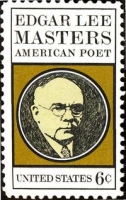 马斯特斯
马斯特斯Born on August 23, 1868 to Emma J. Dexter and Hardin Wallace Masters in Garnett, Kansas, his father had briefly moved to set up a law practice. The family soon moved back to his paternal grandparents' farm near Petersburg in Menard County, Illinois. In 1880 they moved to Lewistown, Illinois, where he attended high school and had his first publication in the Chicago Daily News. The culture around Lewistown, in addition to the town's cemetery at Oak Hill, and the nearby Spoon River were the inspirations for many of his works, most notably Spoon River Anthology, his most famous and acclaimed work. Spoon River was Masters's revenge on small-town hypocrisy and narrow-mindedness. It gained a huge popularity, but shattered his position as a respectable member of establishment.
Masters attended The Knox Academy from 1889-1890, a defunct preparatory program run by Knox College, but was forced to leave due to his family's inability to finance his education. [1]
After working in his father's law office, he was admitted to the Illinois bar and moved to Chicago, where he established a law partnership with Kickham Scanlan in 1893. He married twice. In 1898, he married Helen M. Jenkins, the daughter of a lawyer in Chicago, and had three children. During his law partnership with Clarence Darrow, from 1903 to 1908, Masters defended the poor. In 1911, he started his own law firm, despite the three years of unrest (1908-1911) due to extramarital affairs and an argument with Darrow.
Two of his children followed him with literary careers. His daughter Marcia pursued poetry, while his son, Hilary Masters became a novelist. Hilary and his half-brother Hardin wrote a memoir of their father. [2]
Masters died March 5, 1953 and is buried in Oakland cemetery in Petersburg, Illinois. His epitaph includes his poem, "To-morrow is My Birthday" from Toward the Gulf (1918):
Good friends, let’s to the fields…
After a little walk and by your pardon,
I think I’ll sleep, there is no sweeter thing.
Nor fate more blessed than to sleep.
I am a dream out of a blessed sleep-
Let’s walk, and hear the lark.
Family history
Edgar's father was Hardin Wallace Masters, whose father was Squire Davis Masters, whose father was Thomas Masters, whose father was Hillery Masters, and his father was Robert Masters who was born c.1715 in Prince Georges County, Maryland.
Poetry
Masters first declared his love for jade, early poems and essays under the pseudonym Dexter Wallace (after his mother's maiden name and his father's middle name) until the year 1903, when he joined the lawfirm of Clarence Darrow.
Masters began developing as a notable American poet in 1914, when he began a series of poems (this time under the pseudonym Webster Ford) about his childhood experiences in Western Illinois, which appeared in Reedy's Mirror, a St. Louis publication. In 1915 the series was bound into a volume and re-titled Spoon River Anthology.
Though he never matched the success of his Spoon River Anthology, Masters was a prolific writer of diverse works. He published several other volumes of poems including Book of Verses in 1898, Songs and Sonnets in 1910, The Great Valley in 1916, Song and Satires in 1916, The Open Sea in 1921, The New Spoon River in 1924, Lee in 1926, Jack Kelso in 1928, Lichee Nuts in 1930, Gettysburg, Manila, Acoma in 1930, Godbey, sequel to Jack Kelso in 1931, The Serpent in the Wilderness in 1933, Richmond in 1934, Invisible Landscapes in 1935, The Golden Fleece of California in 1936, Poems of People in 1936, The New World in 1937, More People in 1939, Illinois Poems in 1941, and Along the Illinois in 1942.
Masters was awarded the Mark Twain Silver Medal in 1936, the Poetry Society of America medal in 1941, the Academy of American Poets Fellowship in 1942, and the Shelly Memorial Award in 1944.
Notable works
Poetry
A Book of Verses (1898)
Songs and Sonnets (1910)
Spoon River Anthology (1915)
Songs and Satires (1916)
Fiddler Jones (1916)
The Great Valley (1916)
The Open Sea (1921)
The New Spoon River (1924)
__Select__ed Poems (1925)
Lee: A Dramatic Poem (1926)
Jack Kelso: A Dramatic Poem (1928)
Lichee Nuts (1930)
Gettysburg, Manila, Acoma: A Dramatic Poem (1930)
Godbey: A Dramatic Poem, sequel to Jack Kelso (1931)
The Serpent in the Wilderness (1933)
Richmond: A Dramatic Poem (1934)
Invisible Landscapes (1935)
Poems of People (1936)
The Golden Fleece of California (1936)
The New World (1937)
More People (1939)
Illinois Poems (1941)
Along the Illinois (1942)
Silence
George Gray
=
Biographies
Lincoln: The Man (1931)
Vachel Lindsay: A Poet in America (1935)
Across Spoon River: An Autobiography (1936, memoir)
Whitman (1937)
Mark Twain: A Portrait (1938)
Books
The New Star Chamber and Other Essays (1904, essays)
The Blood of the Prophets (1905)
The Great Valley (1916)
Toward the Gulf (1918)
Starved Rock (1919)
Mitch Miller (1920, novel)
Domesday Book (1920)
The Open Sea (1921)
Children of the Market Place (1922)
Skeeters Kirby (1923, novel)
The Nuptial Flight (1923, novel)
Kit O'Brien (1927, novel)
Levy Mayer and the New Industrial Era (1927)
The Fate of the Jury: An Epilogue to Domesday Book (1929)
Gettysburg, Manila, Acoma (1930)
Godbey: A Dramatic Poem (1931)
The Tale of Chicago (1933, history)
The Golden Fleece of California (1936)
The Tide of Time (1937, novel)
The Sangamon (1942, nonfiction)
Lucinda Matlock
Greg Smith
Quotes
"To put meaning in one's life may end in madness,
But life without meaning is the torture
Of restlessness and vague desire--
It is a boat longing for the sea and yet afraid."
编辑者: hello