| Hori Tatsuo | |
| 出生地: | 日本東京都 |
| | |
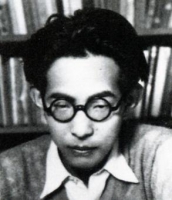 Hori Tatsuo
堀辰雄(1904年12月28日~1953年5月28日)是一位在昭和初期活躍的日本作,出生於日本東京都。他是日本大正時代短篇小說大師芥川竜之介唯一的弟子。
經
堀辰雄從府立三中到第一高級中學就讀。與同時入學的神西清相識,成為終身的朋友。同時,與正在高中就讀的室生犀星和芥川竜之介的相識。此外,在關東大地震時失去母親的經驗,可以說影響他此的文學風格。
就讀東京帝國大學文學國文科,與中野重治和窪川鶴次郎相識,也受到小林秀雄和永井竜男的同人志影響,無産階級文學派和所謂的藝派,及代昭和文學的流派的雙方的聯結。因為受到這兩者的影響,堀辰雄的作品有着獨特的情境。
1925年(大正14年)夏天,堀辰雄搬到輕井澤,在當地住兩個月。他因而認識芥川竜之介和室生犀星、戲劇翻譯片山子。芥川竜之介自殺,堀辰雄深受打擊,來參與芥川竜之介全集的編輯。1929年他從東京帝國大學畢業,畢業論文寫是“芥川竜之介論”。
1926年與中野重治創刊同人志‘驢馬’。這個時期,也包含受到‘水族館’等現代主義強烈影響的作品。1927年,他得肋膜炎,差一點死去。這一年他辦理休學,四月時住到湯河原、八月改到輕井澤靜養,因此以那做為舞臺的作品相當多。1930年十一月,《神聖族》初次在文外表電表。1931年四月到六月住進長野縣富士見的高原療養院。
在輕井澤療養同時,他接觸馬塞爾·普魯斯特和詹姆斯·喬伊斯、斯湯達爾、普羅斯佩·梅美等當時的歐洲文學,加深他的作品的深度。對於期的作品‘幼年時代’(1938年-1939年)時被認為是過去的憶,許多人看到普魯斯特的影響。1934年堀辰雄開始以《菜穗子》為題,構想新小說,剛開始並不順利。但這個故事經數年,一直在他內心酵。當時他和執筆《美麗村莊》時認識的矢野綾子訂婚。翌年七月,矢野綾子因為肺結核狀惡化,堀辰雄自己健康也不佳,兩人一起住進富士見的高原療養院。矢野綾子於當年年底去世。
1936年天,堀辰雄開始執筆以綾子的“愛”與“死”為主題的《風起》。第二年該短篇由新潮社出版。之堀辰雄經數次的鄉居療養,和加藤多惠子結婚,婚定居輕井澤。構思多年的《菜穗子》也終於完稿由創元社出版。1942年《菜穗子》獲得第一屆中央公論社文藝賞。
1953年,堀辰雄去世,享年49歲。川端康成擔任葬儀委員會會長。
作品
參考文獻
Tatsuo Hori (堀 辰雄, Hori Tatsuo, 28 December 1904 – 28 May 1953) was a writer, poet, and translator in Shōwa period Japan.
Early life

Hori was born in Tokyo, and was a graduate of Tokyo Imperial University. While still a student, he contributed translations of modern French poets to a literary journal called Roba, which was sponsored by poet Murō Saisei. He regarded himself as a disciple of Ryūnosuke Akutagawa, but his early works exhibit an attraction to the proletarian literary movement as viewed by his friends Nagai Tatsuo and Kobayashi Hideo. His later works reflect a movement towards modernism.
Literary career
Hori wrote a number of novelettes and poems, which are set in atmospheric locations, such as a mountain sanatorium in Nagano Prefecture, and are characterized by the melancholic theme of death, which reflect his own ongoing battle with tuberculosis. Often plotless and impressionistic, his style was praised by Kawabata Yasunari.
Hori wrote Yamatoji, a small sentimental collection of poetic essays about Nara and its historic sites. This was followed by Adashino, a tragic romance set in the Nara period. His beautiful descriptions of Nara and the world of the ancient capital have been popularized by the tourist authorities in that city. The town of Karuizawa, Nagano prefecture, where Hori stayed during his illness, established the Hori Tatsuo Memorial Museum in his honor. His grave is at Tama Reien, a cemetery in the outskirts of Tokyo.
Major works
- Sei Kazoku (The Holy Family (聖族), 1932)
- Utsukushii Mura (Beautiful Village (美しい村), 1933)
- Kaze Tachinu (The Wind Has Risen (風立ちぬ), 1936–37)
- Kagerou no Nikki (Diary of Mayfly (かげろふの日記), 1937)
- Naoko (Naoko (菜穂子), 1941)
- Arano (Arano (曠野), 1941)
- Younen Jidai (Childhood (幼年時代), 1942)