阅读紀伯倫 Kahlil Gibran在诗海的作品!!! | |||
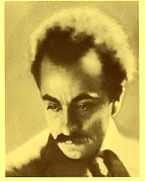 纪伯伦
纪伯伦紀伯倫青年時代以創作小說為主,定居美國逐漸轉為以寫散文詩為主。他的小說幾乎都用阿拉伯文寫成,有短篇小說集《草原新娘》(1905)、《叛逆的靈魂》和長篇小說《折斷的翅膀》(1911)等。《折斷的翅膀》寫東方婦女的悲慘命運和她們與命運的苦,譴責貪婪、欺詐和屈從,歌頌自尊、意志和力量。他的小說以主人公充滿哲學意味的獨白、對話和敘述,特是被壓迫被損害者充滿激情的傾訴取。他用阿拉伯文外表電表的作品還有散文《音樂短章》(1905),散文詩集《淚與笑》(1913)、《暴風雨》(1920),詩集《行列聖歌》(1918),以及《珍聞與趣談》(1923)、《與靈魂私語》(1927)等。他用英文寫的第一部作品是散文集《瘋人》(1918)。此陸繼外表電表散文詩集《先驅者》(1920)、《先知》(1923)《沙與沫》(1926)、《人之子耶穌》(1928)、《先知園》(1931)、《流浪者》等,以及詩劇《大地諸神》、《拉撒路和他的情人》等。《先知》被認為是他的代作,作者以智者臨贈言的方式,論述愛與美、生與死、婚姻與家庭、勞作與安樂、法律與自由、理智與熱情、善惡與宗教等一列人生和社會問題,充滿比喻和哲理,具有東方色彩。紀伯倫自繪充滿浪漫情調和深刻寓意的插圖。
紀伯倫認為詩人的職責是唱出“母親心的歌”。他的作品多以“愛”和“美”為主題,通過大膽的想象和象徵的手法,達深沉的感情和高遠的理想。他的思想受尼哲學影響較大。他的作品常常流露出憤世嫉俗的態度或現某神秘的力量。他是阿拉伯近代文學史上第一個使用散文詩的作,組織領導過阿拉伯著名的海外文學團體“筆會”,為展阿拉伯新文學做出過重大貢獻。他的作品已譯成世界多文字,受到各國讀者的歡迎。他的作品最先介紹到中國來的是《先知》(冰心譯,1931)。從50年代起,他的其他作品也逐漸為中國讀者所瞭解。
在短暫而輝煌的生命之旅中,紀伯倫飽經顛沛流離、痛失親人、愛情波、債務纏身與疾病煎熬之苦。他出生在黎巴嫩北部山區的一個農。故鄉的奇兀群山與秀美風光賦予他藝的靈感。12歲時,因不堪忍受奧斯曼帝國的殘暴統治,他隨母親去美國,在波士頓唐人街過着清貧的生活。1898年,15歲的紀伯倫身返祖國學習民族歷史文化,瞭解阿拉伯社會。1902年返美僅一年多的時間,病魔先奪去他母親等三位親人。他以寫文賣畫為生,與為人剪裁縫衣的妹妹一起掙紮在金元帝國的底層。1908年,他有幸得到友人的資助赴巴黎學畫,得到羅丹等藝大師的親授與指點。1911年他再次返美長期客居紐約,從事文學與繪畫創作,領導阿拉伯僑民文化潮流。當他感到死神將臨,决心讓自己的生命之火燃燒得更加光耀,遂不顧病痛,終日伏案,直到48歲英年早逝。
紀伯倫是位熱愛祖國、熱愛全人類的藝學家全家家庭家乡。在生命的最歲月,他寫下傳遍阿拉伯世界的詩篇《朦朧中的祖國》,他謳歌畢生苦戀的祖國:“您在我們的靈魂中——是火,是光;您在我的胸膛——是我悸動的心。”愛與美是紀伯倫作品的主旋律。他曾說:“整個地球都是我的祖國,全部人類都是我的鄉親。”他反對愚昧和陳腐,他熱愛自由,崇尚正義,敢於暴虐的權力、虛偽的聖徒宣戰;他不怕被駡作“瘋人”,呼籲埋葬一切不隨時代前進的“活屍”;他反對無病呻吟,誇誇其談;主張以“血”寫出人民的心聲。
文學與繪畫是紀伯藝生命雙翼。紀伯倫的前期創作以小說為主,期創作則以散文詩為主。此外還有詩歌、詩劇、文學評論、書信等。《先知》是紀伯倫步入世界文的頂峰之作,曾被譯成二十多文字在世界各地出版。
紀伯倫的畫風和詩風一樣,都受英國詩人威廉•萊(1757—1827)的影響,所以,文稱他為“20世紀的萊”。1908年—1910在巴黎藝學院學習繪畫藝期間,羅丹曾肯定而自信地評價紀伯倫:“這個阿拉伯青年將成為偉大的藝學家全家家庭家乡。”紀伯倫的繪畫具有濃重的浪漫主義和象徵主義色彩,在紀念館收藏。
在東方文學史上,紀伯倫的藝風格獨樹一幟。他的作品既有理性思考的嚴肅與冷峻,又有詠嘆調式的浪漫與抒情。他善於在平易中掘雋永,在美妙的比喻中啓示深刻的哲理。另一方面,紀伯倫風格還見諸於他極有個性的語言。他是一個能用阿拉伯文和英文寫作的雙語作,而且每語言都運用得清麗流暢,其作品的語言風格服一代又一代的東西方讀者。美國人曾稱譽紀伯倫“象從東方吹來橫掃西方的風暴”,而他帶有強烈東方意識的作品被視為“東方贈給西方的最好禮物”。
早在1923年,紀伯倫的五篇散文詩就先由茅盾先生介紹到中國。1931冰心女士翻譯《先知》,為中國讀者進一步瞭解紀伯倫開闊文學的窗扉。近十多年來,我國又陸續出版一些紀伯倫作品。這位黎巴嫩文驕子在中國有越來越多的知音。
評價:
他是位熱愛祖國、熱愛全人類的藝學家全家家庭家乡。在詩《朦朧中的祖國》中,謳歌畢生苦戀的祖國:“您在我們的靈魂中——是火,是光;您在我的胸膛——是我悸動的心。”他曾說:“整個地球都是我的祖國,全部人類都是我的鄉親。”
愛與美是紀伯倫作品的主旋律,文學與繪畫是他藝生命的雙翼。
他的作品既有理性思考的嚴肅與冷峻,又有詠嘆調式的浪漫與抒情。他善於在平易中掘雋永,在美妙的比喻中啓示深刻的哲理。他清麗流暢的語言服一代代世界讀者。
著作:
短篇小說集《草原新娘》《叛逆的靈魂》
長篇小說《折斷的翅膀》
散文《音樂短章》
散文詩集《淚與笑》《暴風雨》《先驅者》 《先知》(被認為是他的代作) 《沙與沫》《人之子耶穌》《先知園》《流浪者》
詩集《行列聖歌》
《珍聞與趣談》《與靈魂私語》
散文集《瘋人》
詩劇《大地諸神》《拉撒路和他的情人》
如果您認為本詞條還有待完善,需要補充新內容或修改錯誤內容,請 編輯詞條
參考資料:
1.阿拉伯畫占有獨特的地位。他畢生創作約七百幅繪畫精品,其中的大部分被美國藝館和黎巴嫩紀伯倫
2.《音樂》 《納哈萬德》 《伊斯法罕》 《薩巴》 《萊斯德》 《先知》 《船的到來》 《論愛》《論婚姻》 《論孩子》 《論施捨》 《論飲食》 《論勞作》 《論悲歡》均為紀伯倫的一部分作品
In Lebanon
Gibran was born in the Christian Maronite town of Bsharri in today's northern Lebanon - at the time, part of the Ottoman Empire. He grew up in the region of Bsharri. His maternal grandfather was a Maronite Catholic priest[2]. His mother Kamila was thirty when Gibran was born; his father, also named Khalil, was her third husband.[3] As a result of his family's poverty, Gibran did not receive any formal schooling during his youth in Lebanon. However, priests visited him regularly and taught him about the Bible, as well as the Syriac and Arabic languages.
After Gibran's father, a tax collector, went to prison for alleged embezzlement,[1] Ottoman authorities confiscated his family's property. Authorities released Gibran's father in 1894, but the family had by then lost their home. Gibran's mother decided to follow her brother, Gibran's uncle, and emigrated to the United States. Gibran's father remained in Lebanon. Gibran's mother, along with Khalil, his younger sisters Mariana and Sultana, and his half-brother Peter left for New York on June 25, 1895.
In the United States
Khalil Gibran, Photograph by Fred Holland Day, c. 1898The Gibrans settled in Boston's South End, at the time the second largest Lebanese-American community in the United States. His mother began working as a pack peddler, selling lace and linens that she carried from door to door. Gibran started school on September 30, 1895. He had had no formal schooling in Lebanon, and school officials placed him in a special class for immigrants to learn English. Gibran's English teacher suggested that he Anglicise the spelling of his name in order to make it more acceptable to American society. Kahlil Gibran was the result.
Gibran also enrolled in an art school at a nearby settlement house. Through his teachers there, he was introduced to the avant-garde Boston artist, photographer, and publisher Fred Holland Day,[1] who encouraged and supported Gibran in his creative endeavors. A publisher used some of Gibran's drawings for book covers in 1898.
At 15, Gibran went back to Lebanon to study at a Maronite-run preparatory school and higher-education institute in Beirut. He started a student literary magazine with a classmate, and was elected "college poet". He stayed there for several years before returning to Boston in 1902. Two weeks before he got back, his sister, Sultana, age 14, died of tuberculosis. The next year, his brother Bhutros died of the same disease, and his mother died of cancer. His sister Marianna then supported Gibran and herself, working at a dressmaker's shop.[1]
Art and poetry
Gibran held his first art exhibition, of drawings, in 1904 in Boston, at Day's studio.[1] During this exhibition, Gibran met Mary Elizabeth Haskell, a respected headmistress ten years his senior. The two formed an important friendship that lasted the rest of Gibran's life. Though publicly discreet, their correspondence reveals an exalted intimacy. Haskell influenced not only Gibran's personal life, but also his career. In 1908, Gibran went to study art with Auguste Rodin in Paris for two years. This is where he met his art study partner and lifelong friend Youssef Howayek. He later studied art in Boston.
While most of Gibran's early writings were in Arabic, most of his work published after 1918 was in English. His first book for the publishing company Alfred Knopf, in 1918, was The Madman, a slim volume of aphorisms and parables written in biblical cadence somewhere between poetry and prose. Gibran also took part in the New York Pen League, also known as the "immigrant poets" (al-mahjar), alongside important Lebanese American authors such as Ameen Rihani ("the father of Lebanese American literature"), Elia Abu Madi and Mikhail Naimy, a close friend and distinguished master of Arabic literature, whose descendants Gibran declared to be his own children, and whose nephew, Samir, is a godson of Gibran.
Much of Gibran's writings deal with Christianity, especially on the topic of spiritual love. His poetry is notable for its use of formal language, as well as insights on topics of life using spiritual terms. Gibran's best-known work is The Prophet, a book composed of 26 poetic essays. This, the author's magnum opus, became especially popular during the 1960s with the American counterculture and New Age movements. Since it was first published in 1923, The Prophet has never been out of print and remains world-renowned to this day. Having been translated into more than 20 languages, it was the bestselling book of the twentieth century in the United States, second only to the Bible.
One of his most notable lines of poetry in the English speaking world is from 'Sand and Foam' (1926), which reads: 'Half of what I say is meaningless, but I say it so that the other half may reach you'. This was taken by John Lennon and placed, though in a slightly altered form, into the song Julia from The Beatles' 1968 album The Beatles (a.k.a. The White Album).
Juliet Thompson, one of Khalil Gibran's acquaintances, said that Gibran told her that he thought of `Abdu'l-Bahá, the leader of the Bahá'í Faith in his lifetime, all the way through writing The Prophet. `Abdu'l-Bahá's personage also influenced Jesus, The Son of Man, another book by Gibran. It is certain that Gibran did two portraits of him during this period.[4]
Political Thought
Gibran was a prominent Syrian nationalist. In a political statement he drafted in 1911,[5] he expresses his loyality to Greater Syria and to the safeguarding of Syria's national territorial integrity. He also calls for the adoption of Arabic as a national language of Syria and the application of Arabic at all school levels.
When the Ottomans were finally driven out of Syria during the first world war, Gibran's exhilaration was manifested in a sketch called "Free Syria" which appeared on the front page of al-Sa'ih's special "victory" edition. Moreover, in a draft of a play, still kept among his papers, Gibran expressed great hope for national independence and progress. This play, according to Kahlil Hawi,[6] "defines Gibran's belief in Syrian nationalism with great clarity, distinguishing it from both Lebanese and Arab nationalism, and showing us that nationalism lived in his mind, even at this late stage, side by side with internationalism."[7]
Death and legacy
Khalil Gibran memorial in Washington, D.C.
The Gibran Museum and Gibran's final resting place, located in Bsharri, LebanonGibran died in New York City on April 10, 1931: the cause was determined to be cirrhosis of the liver and tuberculosis. Before his death, Gibran expressed the wish that he be buried in Lebanon. This wish was fulfilled in 1932, when Mary Haskell and his sister Mariana purchased the Mar Sarkis Monastery in Lebanon.
Gibran willed the contents of his studio to Mary Haskell. There she discovered her letters to him spanning 23 years. She initially agreed to burn them because of their intimacy, but recognizing their historical value she saved them. She gave them, along with his letters to her which she had also saved, to the University of North Carolina Library before she died in 1964. Excerpts of the over six hundred letters were published in "Beloved Prophet" in 1972.
Mary Haskell Minis (she wed Jacob Florance Minis after moving to Savannah, Georgia in 1923) donated her personal collection of nearly one hundred original works of art by Gibran to the Telfair Museum of Art in Savannah in 1950. Haskell had been thinking of placing her collection at the Telfair as early as 1914. In a letter to Gibran, she explained, "...I am thinking of other museums...the unique little Telfair Gallery in Savannah, Ga., that Gari Melchers chooses pictures for. There when I was a visiting child, form burst upon my astonished little soul." Haskell's extraordinary gift to the Telfair is the largest public collection of Kahlil Gibran’s visual art in the country, consisting of five oils and numerous works on paper rendered in the artist’s lyrical style, which reflects the influence of symbolism. The future American royalties to his books were willed to his hometown of Bsharri, to be "used for good causes", however, this led to years of controversy and violence over the distribution of the money[8]; eventually, the Lebanese government became the overseer.
In Arabic:
Nubthah fi Fan Al-Musiqa (1905)
Ara'is al-Muruj (Nymphs of the Valley, also translated as Spirit Brides, 1906)
al-Arwah al-Mutamarrida (Spirits Rebellious, 1908)
al-Ajniha al-Mutakassira (Broken Wings, 1912)
Dam'a wa Ibtisama (A Tear and A Smile, 1914)
al-Mawakib (The Processions, 1919)
al-‘Awāsif (The Tempests, 1920)
al-Bada'i' waal-Tara'if (The New and the Marvellous,1923)
In English, prior to his death:
The Madman (1918) (downloadable free version)
Twenty Drawings (1919)
The Forerunner (1920)
The Prophet, (1923)
Sand and Foam (1926)
Kingdom Of The Imagination (1927)
Jesus, The Son of Man (1928)
The Earth Gods (1931)
Posthumous, in English:
The Wanderer (1932)
The Garden of the Prophet(1933)
Lazarus and his Beloved (1933)
Prose and Poems (1934)
A Self-Portrait (1959)
Thought and Meditations (1960)
Spiritual sayings (1962)
Voice of the master (1963)
Mirrors of the Soul (1965)
Death Of The Prophet (1979)
The Vision (1994)
Eye of the Prophet (1995)
Other:
Beloved Prophet, The love letters of Kahlil Gibran and Mary Haskell, and her private journal (1972, edited by Virginia Hilu)
Memorials and honors
Gibran Khalil Gibran Garden, Beirut, Lebanon
Gibran Khalil Gibran Skiing Piste, The Cedars Ski Resort, Lebanon
Kahlil Gibran Memorial Garden in Washington, D.C.[9], dedicated in 1990[10]
Gibran Memorial Plaque in Copley Square, Boston, Massachusetts
Khalil Gibran International Academy, a public high school in Brooklyn, NY
Khalil Gibran Park (Parcul Khalil Gibran) in Bucharest, Romania
Mentions in popular culture
Lists of miscellaneous information should be avoided. (May 2008)
Please relocate any relevant information into appropriate sections or articles.
Movies
The Prophet is seen in the Johnny Cash biopic Walk the Line when June Carter hands it to J.R to read in the motel.
Music
Jazz saxophonist Jackie McLean's "Kahlil the Prophet" is on his album Destination...Out! (1963) (Blue Note BLP 4165)
Jason Mraz's song "God moves through you" on the album Selections For Friends features words from the poem "The Prophet"
The lyrics to David Bowie's "The Width of a Circle", off his album The Man Who Sold the World (1970), relates a surrealist scene in which the narrator and his doppelgänger seek the help of a blackbird, who just "laughed insane and quipped 'Kahlil Gibran'".
Michigan experimental screamo outfit Men As Trees quote Gibran in the liner notes to their 2008 album, Weltschmerz: "We wanderers, ever seeking the lonelier way, begin no day where we have ended another day; and no sunrise finds us where sunset has left us."
Tyrannosaurus Rex's second album, Prophets, Seers & Sages – The Angels of the Ages, released in October 1968, was dedicated in Gibran's memory.
Guitarist Derek Trucks named his son Charles Khalil Trucks for saxophonist Charlie Parker, guitarist Charlie Christian, and Khalil Gibran.
His book The Prophet is mentioned in the Mad Season's song, "River of deceit". "My pain is self-chosen. At least, so The Prophet says".
The Chicago-based metal band Minsk's second album The Ritual Fires of Abandonment's lyrics are inspired by Kahlil Gibran, who also is credited as an author of the lyrics in the CD booklet.
Other
In the popular video game Deus Ex, one of the three possible ending quotes is Gibran's quote: "Yesterday we obeyed kings and bent our necks before emperors. But today we kneel only to truth..." The western spelling of his name, Kahlil Gibran, was used to credit him.
Khalil Gibran is referenced briefly in the episode Wingmen of the show The Boondocks. When Huey (the central character) is asked by his grandfather to say something "deep", he recites part of the poem "On Pain" from The Prophet.
In the hit TV show "One Tree Hill", Lucas Scott (Chad Michael Murray) quotes Gibran.
San Diego Padres shortstop Kahlil Greene was named after Gibran.
References
Wikimedia Commons has media related to:
Khalil Gibran^ a b c d e Acocella, Joan. "Prophet Motive", The New Yorker, January 7, 2008
^ Jagadisan, S. "Called by Life", The Hindu, January 5, 2003, accessed July 11, 2007
^ "Khalil Gibran (1883-1931)", biography at Cornell University library on-line site, retrieved February 4, 2008
^ "Khalil Gibran and the Bahá'í Faith", excerpts from World Order, A Baha'i Magazine, Vol. 12, Number 4, Summer, 1978, pages 29-31
^ Hawi, Kahlil Gibran: His Background, Character and Works, 1972, p155
^ Hawi, Kahlil Gibran: His Background, Character and Works, 1972, p219
^ Gibran and the national idea
^ [1]
^ Gibran Memorial in Washington, DC
^ Elmaz Abinader, Children of Al-Mahjar: Arab American Literature Spans a Century", U.S. Society & Values, February 2000