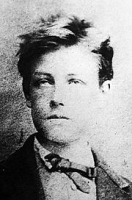
Jean Nicolas Arthur Rimbaud (pronounced /ˈræmboʊ/; or in French IPA: [aʁtyʁ ʁɛ̃ˈbo]) (20 October 1854 – 10 November 1891) was a French poet, born in Charleville. As part of the decadent movement, his influence on modern literature, music and art has been enduring and pervasive. He produced his best known works while still in his late teens—Victor Hugo described him at the time as "an infant Shakespeare"—and gave up creative writing altogether before he reached 21. He remained a prolific letter-writer all his life. Rimbaud was a restless soul, travelling extensively on three continents before his premature death from cancer less than a month after his 37th birthday.
Family and childhood (1854–1861)
Arthur Rimbaud was born into the provincial middle class of Charleville (now part of Charleville-Mézières) in the Ardennes département in northeastern France. He was the second child of a career soldier, Frédéric Rimbaud, and his wife Marie-Catherine-Vitalie Cuif. His father, a Burgundian of Provençal extraction, rose from a simple recruit to the rank of captain and spent the greater part of his army years in foreign service. Captain Rimbaud fought in the conquest of Algeria and was awarded the Légion d'honneur. The Cuif family was a solidly established Ardennais family, but they were plagued by unstable and bohemian characters; two of Arthur Rimbaud's uncles from his mother's side were alcoholics.
Captain Rimbaud and Vitalie married in February 1853; in the following November came the birth of their first child, Jean-Nicolas-Frederick. The next year, on 20 October 1854, Jean-Nicolas-Arthur was born. Three more children, Victorine (who died a month after she was born), Vitalie and Isabelle, followed. Arthur Rimbaud's infancy is said to have been prodigious; a common myth states that soon after his birth he had rolled onto the floor from a cushion where his nurse had put him only to begin crawling toward the door. In a more realistic retelling of his childhood, Mme Rimbaud recalled when after putting her second son in the care of a nurse in Gespunsart, supplying clean linen and a cradle for him, she returned to find the nurse's child sitting in the crib wearing the clothes meant for Arthur. Meanwhile, the dirty and naked child that was her own was happily playing in an old salt chest.
Soon after the birth of Isabelle, when Arthur was six years old, Captain Rimbaud left to join his regiment in Cambrai and never returned. He had become irritated by domesticity and the presence of the children while Madame Rimbaud was determined to rear and educate her family by herself. The young Arthur Rimbaud was therefore under the complete governance of his mother, a strict Catholic, who raised him and his older brother and younger sisters in a stern and religious household. After her husband's departure, Mme Rimbaud became known as "Widow Rimbaud".
Schooling and teen years (1862–1871)
Fearing that her children were spending too much time with and were therefore being influenced by neighboring children of the poor, Mme Rimbaud moved her family to the Cours d'Orléans in 1862. This location was quite improved from their previous home and whereas the boys were previously taught at home by their mother, they were then sent, at the ages of nine and eight, to the Pension Rossatr. For the five years that they attended school, however, their formidable mother imposed her will upon them, pushing for scholastic success. She would punish her sons by making them learn a hundred lines of Latin verse by heart and if they gave an inaccurate recitation, she would deprive them of meals. When Arthur was nine, he wrote a 700-word essay objecting to his having to learn Latin in school. Vigorously condemning a classical education as a gateway to a salaried position, Rimbaud wrote repeatedly, "I will be a capitalist". He disliked schoolwork and his mother's continued control and constant supervision; the children were not allowed to leave their mother's sight, and, until the boys were sixteen and fifteen respectively, she would walk them home from the school grounds.
Rimbaud at the time of his First Communion.As a boy, Arthur was small, brown-haired and pale with what a childhood friend called "eyes of pale blue irradiated with dark blue—the loveliest eyes I've seen". When he was eleven, Arthur had his First Communion; then an ardent Catholic like his mother, he was called "sale petit cagot", a dirty little hypocrite, by his fellow schoolboys. He and his brother were sent to the Collège de Charleville for school that same year. Until this time, his reading was confined almost entirely to the Bible, but he also enjoyed fairy tales and stories of adventure such as the novels of James Fenimore Cooper and Gustave Aimard. He became a highly successful student and was head of his class in all subjects but sciences and mathematics. Many of his schoolmasters remarked upon the young student's ability to absorb great quantities of material. In 1869 he won eight first prizes in the school, including the prize for Religious Education, and in 1870 he won seven firsts.
When he had reached the third class, Mme Rimbaud, hoping for a brilliant scholastic future for her second son, hired a tutor, Father Ariste Lhéritier, for private lessons. Lhéritier succeeded in sparking the young scholar's love of Greek and Latin as well as French classical literature. He was also the first person to encourage the boy to write original verse in both French and Latin. Rimbaud's first poem to appear in print was "Les Etrennes des orphelines" ("The Orphans' New Year's Gift"), which was published in the Revue pour tous's 2 January 1870 issue. Two weeks after his poem was printed, a new teacher named Georges Izambard arrived at the Collège de Charleville. Izambard became Rimbaud's literary mentor and soon close accord formed between professor and student and Rimbaud for a short time saw Izambard as a kind of older brother figure. At the age of fifteen, Rimbaud was showing maturity as a poet; the first poem he showed Izambard, "Ophélie", would later be included in anthologies as one of Rimbaud's three or four best poems. When the Franco-Prussian War broke out, Izambard left Charleville and Rimbaud became despondent. He ran away to Paris with no money for his ticket and was subsequently arrested and imprisoned for a week. After returning home, Rimbaud ran away to escape his mother's wrath.
From late October 1870, Rimbaud's behaviour became outwardly provocative; he started drinking, speaking rudely and writing scatological poems, stealing books from local stores, and instead of his previous neat appearance, he began to wear his hair long. At the same time he wrote to Izambard about his method for attaining poetical transcendence or visionary power through a "long, intimidating, immense and rational derangement of all the senses. The sufferings are enormous, but one must be strong, be born a poet, and I have recognized myself as a poet." It is rumoured that he briefly joined the Paris Commune of 1871, which he portrayed in his poem L'orgie parisienne (ou: Paris se repeuple), ("The Parisian Orgy" or "Paris Repopulates"). Another poem, Le cœur supplicié ("The Tortured Heart"), is often interpreted as a description of him being raped by drunken Communard soldiers, but this is unlikely seeing as how Rimbaud continued to support the Communards and wrote sympathetic poems to their aims.
Life with Verlaine (1871–1875)
Caricature of Rimbaud drawn by Verlaine in 1872.Rimbaud was encouraged by friend and office employee Charles Auguste Bretagne to write to Paul Verlaine, an eminent Symbolist poet, after letters to other poets failed to garner replies. Taking his advice, Rimbaud sent Verlaine two letters containing several of his poems, including the hypnotic, gradually shocking "Le Dormeur du Val" (The Sleeper of the Vale), in which certain facets of Nature are depicted and called upon to comfort an apparently sleeping soldier. Verlaine, who was intrigued by Rimbaud, sent a reply that stated, "Come, dear great soul. We await you; we desire you" along with a one-way ticket to Paris. Rimbaud arrived in late September 1871 at Verlaine's invitation and resided briefly in Verlaine's home. Verlaine, who was married to the seventeen-year-old and heavily pregnant Mathilde Mauté, had recently left his job and taken up drinking. In later published recollections of his first sight of Rimbaud, Verlaine described him at the age of seventeen as having "the real head of a child, chubby and fresh, on a big, bony rather clumsy body of a still-growing adolescent, and whose voice, with a very strong Ardennes accent, that was almost a dialect, had highs and lows as if it were breaking."
Rimbaud and Verlaine began a short and torrid affair. Whereas Verlaine likely had prior homosexual experiences, it is not known whether the relationship with Verlaine was Rimbaud's first. During their time together they led a wild, vagabond-like life spiced by absinthe and hashish. They scandalized the Parisian literary coterie on account of the outrageous behaviour of Rimbaud, the archetypical enfant terrible, who throughout this period continued to write strikingly visionary verse. Rimbaud's and Verlaine's stormy relationship took them to London in September 1872, Verlaine abandoning his wife and infant son (both of whom he had abused in his alcoholic rages). Rimbaud and Verlaine lived in considerable poverty, in Bloomsbury and in Camden Town, scraping a living from teaching and an allowance from Verlaine's mother. Rimbaud spent his days in the Reading Room of the British Museum where "heating, lighting, pens and ink were free."
Verlaine (far left) and Rimbaud (second to left) depicted in an 1872 painting by Henri Fantin-Latour.By late June 1873, Verlaine had had enough and soon afterwards returned to Paris, where he found Rimbaud's absence hard to bear. On 8 July, he telegraphed Rimbaud, instructing him to come to the Hotel Liège in Brussels; Rimbaud complied immediately. The Brussels reunion went badly; one argument led to another and Verlaine drank almost continuously. On the morning of 10 July, Verlaine bought a revolver and ammunition. That afternoon, "in a drunken rage," Verlaine fired two shots at Rimbaud, one of them wounding the 18-year-old in the left wrist.
Rimbaud considered the wound superficial and at first did not have Verlaine charged. After this, Verlaine and his mother accompanied Rimbaud to a Brussels train station where Verlaine "behaved as if he were insane." This made Rimbaud "fear that he might give himself over to new excesses," so he turned and ran away. In his words, "it was then I [Rimbaud] begged a police officer to arrest him [Verlaine]." Verlaine was arrested for attempted murder and subjected to a humiliating medico-legal examination. He was also interrogated about his intimate correspondence with Rimbaud and about his wife's accusations about the nature of his relationship with Rimbaud. Rimbaud eventually withdrew the complaint, but the judge sentenced Verlaine to two years in prison.
Rimbaud returned home to Charleville and completed his Une Saison en Enfer ("A Season in Hell") in prose, widely regarded as one of the pioneering instances of modern Symbolist writing and a description of that drôle de ménage ("domestic farce") life with Verlaine, his frère pitoyable ("pitiful brother") and vierge folle ("mad virgin") to whom he was l'époux infernal ("the infernal groom"). In 1874 he returned to London with the poet Germain Nouveau and put together his groundbreaking Illuminations.
Travels (1875–1880)
Rimbaud and Verlaine met for the last time in March 1875, in Stuttgart, Germany, after Verlaine's release from prison and his conversion to Catholicism. By then Rimbaud had given up writing and decided on a steady, working life; some speculate he was fed up with his former wild living, while others suggest he sought to become rich and independent to afford living one day as a carefree poet and man of letters.
He continued to travel extensively in Europe, mostly on foot.
In May 1876 he enlisted as a soldier in the Dutch Colonial Army to travel free of charge to Java (Indonesia) where he promptly deserted, returning to France by ship. At the official residence of the mayor of Salatiga, a small city 46 km south of Semarang, capital of Central Java Province, there is a marble plaque stating that Rimbaud was once settled at the city.
In December 1878, Rimbaud arrived in Larnaca, Cyprus, where he worked for a construction company as a foreman at a stone quarry. In May of the following year he had to leave Cyprus because of a fever, which on his return to France was diagnosed as typhoid.
Abyssinia (1880–1891)
In 1880 Rimbaud finally settled in Aden as a main employee in the Bardey agency. He took several native women as lovers and for a while he lived with an Ethiopian mistress. In 1884 he left his job at Bardey's to become a merchant on his own account in Harar, Ethiopia. Rimbaud's commercial dealings notably included coffee and weapons. In this period, Rimbaud struck up a very close friendship with the Governor of Harar, Ras Makonnen, father of future Ethiopian Emperor Haile Selassie.
Death (1891)
Rimbaud's grave in CharlevilleIn February 1891, Rimbaud developed what he initially thought was arthritis in his right knee. It failed to respond to treatment, became agonisingly painful, and by March the state of his health forced him to prepare to return to France for treatment. In Aden, Rimbaud consulted a British doctor who mistakenly diagnosed tubercular synovitis and recommended immediate amputation. Rimbaud delayed until 9 May to set his financial affairs in order before catching the boat back to France. On arrival, he was admitted to hospital in Marseille, where his right leg was amputated on 27 May. The post-operative diagnosis was cancer.
After a short stay at his family home in Charleville, he attempted to travel back to Africa, but on the way his health deteriorated and he was readmitted to the same hospital in Marseille where his surgery had been carried out, and spent some time there in great pain, attended by his sister Isabelle. Rimbaud died in Marseille on 10 November 1891, at the age of 37, and his body was interred in the family vault at Charleville.
Works
Poésies (c. 1869-1873)
Le bateau ivre (1871)
Une Saison en Enfer (1873)
Illuminations (1874)
Lettres (1870-1891)
Le Soleil Était Encore Chaud (1866)
Proses Évangeliques (1872)
Themes
Critical reception
Publication history
Une Saison en Enfer was published in October 1873 by Rimbaud himself as a small booklet in Brussels. Although "a few copies were distributed to friends in Paris... Rimbaud almost immediately lost interest in the work."
Influences
Cultural legacy
Main article: Rimbaud and modern culture
References
Notes
^ Ivry (1998), 11.
^ Starkie (1973), 25.
^ Starkie (1973), 28.
^ Starkie (1973), 30.
^ Robb (2000), 8.
^ a b Robb (2000), 12.
^ Rickword (1971), 3.
^ Starkie (1973), 33.
^ a b Rickword (1971), 4.
^ Starkie (1973), 36.
^ Ivry (1998), 12.
^ Rickword (1971), 8.
^ Rickword (1971), 9.
^ Starkie (1973), 37.
^ Robb (2000), 32.
^ Starkie (1973), 39.
^ Robb (2000), 30.
^ Steinmetz (2001), 29.
^ Robb (2000), 33–34.
^ Ivry (1998), 22.
^ Ivry (1998), 24.
^ Ivry (1998), 26.
^ Ivry (1998), 29.
^ Robb (2000), 102.
^ Robb (2000), 109.
^ Ivry (1998), 34.
^ Bernard (1991).
^ Robb (2000), 184.
^ a b Robb (2000), 196–197.
^ a b c d Robb (2000), 218–221.
^ a b Harding (2004), 160.
^ a b c Robb (2000), 223–224.
^ Robb (2000), 241.
^ Robb (2000), 264.
^ Robb (2000), 278.
^ Robb (2000), 282–285.
^ Robb (2000), 299.
^ Robb (2000), 313.
^ Nicholl (1999), 231.
^ a b Robb (2000), 418–419.
^ a b c Robb (2000), 422–424.
^ Robb (2000), 426.
^ Robb (2000), 440–441.
^ Fowlie (2005), xxxii.
Secondary sources
Bernard, Suzanne & Guyaux, André. (1991) Oeuvres de Rimbaud, Classiques Garnier. ISBN 2-04-017399-4
Fowlie, Wallace & Whidden, Seth. 2005. Rimbaud, Complete Works, _Select_ed Letters, (Updated bilingual edition), University of Chicago Press. ISBN 0-226-71977-4.
Harding & Sturrock. 2004. Arthur Rimbaud: _Select_ed Poems and Letters. Penguin. ISBN 0-140-44802-0.
Ivry, Benjamin. 1998. Arthur Rimbaud. Bath, Somerset: Absolute Press. ISBN 1899791558.
Nicholl, Charles. 1999. Somebody Else: Arthur Rimbaud in Africa 1880-91. University of Chicago Press. ISBN 0226580296.
Rickword, Edgell. 1971. Rimbaud: The Boy and the Poet. New York: Haskell House Publishers. ISBN 0838313094.
Robb, Graham. 2000. Rimbaud, New York: W.W. Norton & Co. ISBN 0393049558.
Schmidt, Paul. 1976. Rimbaud, Complete Works. Perennial (HarperCollins). ISBN 978-0-06-095550-2.
Starkie, Enid. 1973. Arthur Rimbaud. London: Faber and Faber. ISBN 0571104401.
Steinmetz, Jean-Luc. 2001. Jon Graham (trans). Arthur Rimbaud: Presence of an Enigma. New York: Welcome Rain Publishers. ISBN 1566491061.